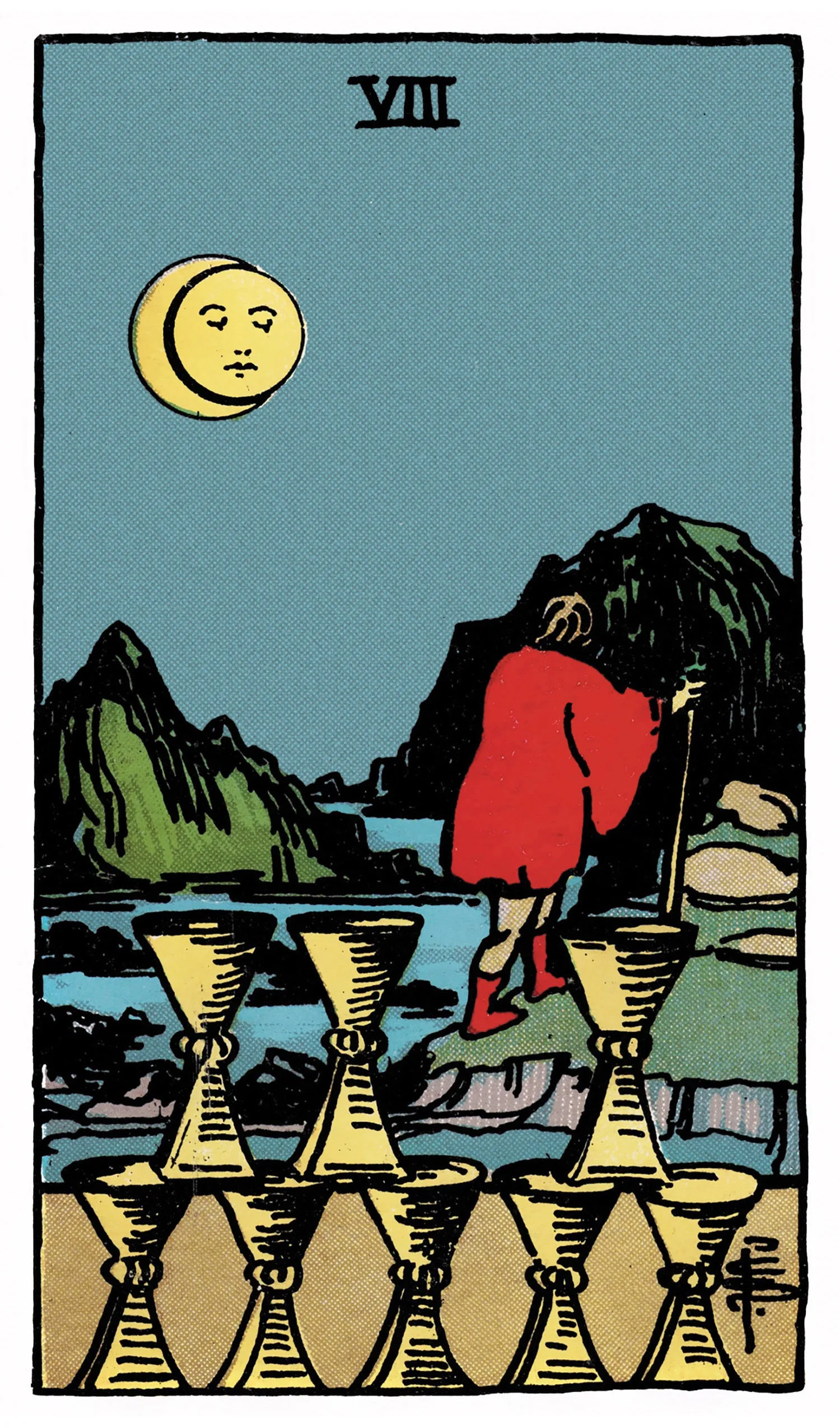
Minor Arcana · Cups · Eight
The Eight of Cups Tarot Card Meaning
The Eight of Cups represents profound emotional realism and the moment when a person finally understands what a situation truly is.
The confusion has largely ended. The person sees what the relationship, goal, project, lifestyle, or emotional pattern actually gives them — and what it does not.
The central realization is:
“I understand this now, and I do not want it this way.”
This does not automatically mean that the person leaves, resigns, separates, moves away, or closes the situation. Cups primarily describe emotional reality rather than guaranteed external action.
The reversed Eight of Cups shows the damaged version of the same principle: the truth is there to be recognized, but the person is not ready, willing, or able to face it.
Card Meanings
General Meaning
The Eight of Cups represents the point at which emotional experience becomes understanding.
Something that may have been confusing, idealized, tolerated, justified, or repeatedly reconsidered becomes clear.
The person finally sees:
- what the situation actually is;
- what it gives them;
- what it costs them;
- what they have been hoping would change;
- what has already stopped satisfying them;
- what they no longer want to experience in the same form.
The Eight of Cups is therefore one of the most realistic cards in the Tarot.
Its central statement is not:
“I am leaving.”
It is:
“I finally see this clearly.”
And then:
“I know that I do not want it this way.”
From Seven to Eight
The transition from the Seven of Cups is especially important.
The Seven contains:
- possibilities;
- fantasies;
- competing desires;
- uncertainty;
- projections;
- difficulty distinguishing what is real from what is imagined.
The Eight represents a dramatic increase in realism.
The person reaches the conclusion that the Seven could not yet provide.
The Seven asks:
“What is real?”
The Eight answers:
“Now I understand what is real.”
The emotional fog has cleared enough for a genuine conclusion to form.
The Eight Principle
Within TAROVERA, the later numerical cards — especially Eights, Nines, and Tens — carry relatively little direct external-action potential compared with earlier stages.
They often represent:
- accumulated experience;
- an internal threshold;
- a point of emotional or mental intensity;
- a conclusion reached after previous stages;
- a state the person has arrived at internally.
For the Eight of Cups, the important event is therefore primarily internal understanding.
The card does not automatically tell us what practical action follows.
Cups Describe Emotional Reality
This distinction is critical.
Cups primarily describe:
- feelings;
- emotional reactions;
- satisfaction and dissatisfaction;
- emotional atmosphere;
- attachment;
- disappointment;
- the way a situation is experienced internally.
They are comparatively weak as direct indicators of concrete external action.
Therefore:
“I understand that this relationship does not satisfy me.”
does not automatically mean:
“I break up.”
And:
“I understand that this job is wrong for me.”
does not automatically mean:
“I resign.”
The Eight of Cups can create the emotional conditions from which such decisions later emerge.
But the actual action must be confirmed by the question, spread position, and surrounding cards.
Awareness Is Not Action
The Eight of Cups must not be interpreted as if emotional realization and practical behavior were the same thing.
A person can clearly understand:
“I cannot live like this forever.”
and still:
- remain;
- hesitate;
- negotiate;
- attempt to change the situation;
- postpone action;
- return to the same pattern.
The card shows what the person has understood.
What they actually do with that understanding is another interpretive layer.
One of the Most Realistic Cards
Unlike the Seven of Cups, the upright Eight is not primarily about distorted perception.
The person is not merely imagining that something is wrong.
They have reached a realistic emotional conclusion based on what they have experienced.
This is not:
“Maybe this is not good enough.”
It is closer to:
“I now understand why this is not good enough for me.”
The conclusion may be painful, but it is clear.
Giving More Than You Receive
A common Eight of Cups realization is:
“I have been giving more than this situation gives back.”
The imbalance may involve:
- love;
- emotional labor;
- patience;
- loyalty;
- time;
- money;
- effort;
- hope;
- repeated attempts to repair something.
Eventually the person understands that the exchange is no longer emotionally acceptable.
Again, the card does not automatically say what they will do.
It says that the imbalance is no longer invisible to them.
A Change in Values
Sometimes the situation itself has not dramatically deteriorated.
The person has changed.
Something that once seemed sufficient may no longer feel meaningful.
A relationship may still exist.
A job may still pay.
A project may still function.
A lifestyle may still provide security.
But the person realizes:
“This mattered to me before. It is no longer enough now.”
The Eight of Cups can therefore represent a profound change in personal values.
Emotional Completion
The card often appears when a situation is very close to emotional completion.
The old version of the future is losing its emotional power.
Hope may be fading.
The person may stop trying to convince themselves that the same situation will eventually become something completely different.
However:
close to completion is not the same as final external completion.
The relationship may continue.
The job may continue.
The person may remain physically where they are.
Further cards show whether the emotional conclusion eventually becomes an external ending.
“Another Road Is Needed”
The Eight of Cups can bring the understanding:
“I need another road.”
But this is not an active search card.
The person may not yet know:
- what the other road is;
- where it leads;
- how to reach it;
- whether they are ready to change anything.
The Eight understands what is no longer wanted much more clearly than it understands what comes next.
The Shadow Side of The Eight of Cups
The difficult side of the upright card appears when the person's emotional conclusion becomes so strong that they begin to disengage before deciding what practical response is appropriate.
They may:
- withdraw emotionally;
- lose motivation to continue investing;
- become distant;
- stop trying to repair the same pattern;
- feel exhausted by repeatedly giving more than they receive.
There is also a risk of assuming:
“I know I do not want this”
therefore:
“I must immediately know exactly what to do next.”
Those are different conclusions.
The Eight gives emotional realism.
It does not automatically give a complete practical strategy.
The Eight of Cups Reversed
The reversed Eight of Cups blocks the central upright quality: the ability to look directly at emotional reality and understand it honestly.
The truth may already be visible.
The person may even sense that something is seriously wrong.
But they are not ready or willing to fully recognize what it means.
This is the classic:
head in the sand.
The person may:
- avoid thinking about the problem;
- minimize obvious dissatisfaction;
- make excuses;
- rationalize another person's behavior;
- insist that things are “not that bad”;
- cling to hope without real evidence;
- distract themselves;
- refuse difficult conversations;
- emotionally push away conclusions that would be painful to accept.
The central reversed statement is:
“I do not want to see what this really is.”
Knowing Somewhere Inside — but Refusing Full Awareness
Reversed Eight of Cups does not always mean that the person has absolutely no awareness at all.
They may have moments when reality becomes obvious.
They may feel:
“Something is wrong.”
But then immediately retreat from that understanding.
They may tell themselves:
- “I am overreacting.”
- “It will change.”
- “Maybe I misunderstood.”
- “It is easier not to think about it.”
- “Everything will somehow work itself out.”
The truth approaches consciousness — and the person pushes it away again.
Denial Protects the Existing Situation
The denial often has a psychological function.
If the person fully admits:
“This relationship does not work for me,”
they may then have to confront difficult questions.
If they admit:
“This project is not viable,”
they may have to face losses.
If they admit:
“This lifestyle is destroying my emotional wellbeing,”
they may have to consider change.
The reversed Eight can therefore preserve an unsatisfactory situation simply because the truth feels harder to face than the familiar problem.
The Rose-Colored Glasses Remain
The broader reversed-Cups mechanism also appears here.
In the upright Eight, the person has become realistic.
In the reversed Eight, emotional idealization, excuses, or denial interfere with that realism.
The person may continue believing that:
- the relationship will become what they once imagined;
- the project will eventually justify all the investment;
- the other person will change;
- the problem will disappear if ignored;
- the emotional dissatisfaction is temporary when evidence suggests otherwise.
The difficulty is not lack of available information.
It is resistance to accepting what the information means.
Core Message
The Eight of Cups upright says:
“Look at reality. Understand what this really is.”
The reversed Eight says:
“Reality is asking to be seen, but you are still avoiding the conclusion.”
The Eight of Cups as a Person
The Eight of Cups as a person describes someone capable of deep emotional realism.
They may be:
- introspective;
- observant;
- emotionally perceptive;
- serious;
- reflective;
- difficult to deceive once they have understood a pattern;
- capable of recognizing when something has lost meaning.
They often need to understand the emotional truth beneath appearances.
Once they genuinely reach a conclusion, it can become difficult for them to return to their previous attitude.
Emotional Fatigue and Old Wounds
This person may also appear distant because of accumulated experience.
Their reserve can come from:
- previous disappointment;
- repeated emotional investment;
- old wounds;
- having given too much before;
- learning that affection alone does not solve every problem.
They may therefore seem cautious or emotionally tired rather than naturally cold.
The Eight of Cups as Actions
The upright Eight of Cups does not automatically mean literal departure.
More reliable behaviors include:
- reducing emotional investment;
- becoming quieter;
- taking some distance;
- no longer trying to idealize the situation;
- observing more realistically;
- reconsidering participation;
- emotionally preparing for possible change.
If the question specifically asks what a person will do, the card can suggest withdrawal or movement away.
But a final breakup, resignation, relocation, or permanent departure requires additional confirmation.
The Eight of Cups in Love and Relationships
In Love, the upright Eight of Cups represents a realistic emotional conclusion:
“These relationships are not giving me what I need in their current form.”
This is a serious card.
But it is not automatically a breakup card.
The person may realize that:
- the relationship no longer satisfies them;
- they are giving more than they receive;
- the emotional connection has changed;
- a future they hoped for is not developing;
- something important is missing;
- they no longer want the relationship in its present form.
What follows can be very different depending on surrounding cards.
The couple may:
- have a serious conversation;
- change boundaries;
- renegotiate the relationship;
- temporarily distance themselves;
- remain together;
- eventually separate.
The Eight itself represents the realization.
“I Care, but I Do Not Want This”
The card does not automatically show an absence of love.
The person may still:
- care;
- feel attachment;
- remember good experiences;
- love the partner;
- feel sadness about what has happened.
But they may simultaneously understand:
“My feelings do not make the current relationship acceptable to me.”
That distinction is essential.
Distance and Different Life Directions
Contextually, the Eight can also appear when emotional reality is affected by:
- distance;
- relocation;
- incompatible life directions;
- a meaningful connection that cannot continue easily in its current form.
Again, the card shows recognition of the difficulty rather than guaranteeing separation.
The Eight of Cups as Thoughts
Upright thoughts are unusually realistic.
The person may think:
- “Now I understand.”
- “This is not enough for me.”
- “I do not want things to continue like this.”
- “I have given too much.”
- “Something here has fundamentally changed.”
- “I need to stop pretending this works for me.”
This is a conclusion, not Seven of Cups uncertainty.
The Eight of Cups as Feelings
Upright feelings may include:
- disappointment;
- emotional fatigue;
- sadness;
- detachment;
- resignation;
- reduced hope;
- emotional dissatisfaction;
- the feeling that something is reaching its limit.
The person can still care while feeling that the current emotional pattern is no longer acceptable.
The Eight of Cups as Intentions
Upright intentions can include:
- wanting the situation to change;
- wanting more distance;
- wanting a different relationship dynamic;
- considering reduced involvement;
- thinking about separation;
- no longer wanting to continue exactly as before.
But intention is not action.
The Eight of Cups as an Outcome
The Eight of Cups as an Outcome represents clear emotional understanding, not automatically a completed external ending.
The person reaches the point where they understand:
- what the situation really is;
- why it disappoints them;
- what they have been giving;
- what they are receiving;
- what they no longer want.
This can bring the situation very close to emotional completion.
Close to Completion Is Not Final Completion
The doors are closing emotionally.
The old expectation loses its power.
The person may no longer believe in the future they once imagined.
But this does not automatically mean:
- final separation;
- resignation;
- permanent departure;
- closure of the project.
Those developments require confirmation.
A relationship spread can therefore end with Eight of Cups and mean:
“The person finally understands that the relationship cannot continue in the same form.”
What they actually do next remains open.
The Eight of Cups in Career and Work
In Career, the upright Eight of Cups represents a realistic professional assessment.
The person may understand:
- this job no longer suits them;
- the work has lost meaning;
- effort exceeds emotional return;
- professional growth has stalled;
- the project is weaker than expected;
- the role no longer fits their current values.
They may realize:
“I understand why I do not want to keep working like this.”
That is not the same as resignation.
Giving More Than Work Returns
The person may recognize that they have invested:
- time;
- energy;
- creativity;
- loyalty;
- emotional resources;
without receiving enough in return.
The imbalance becomes obvious.
Recognizing a Nonviable Direction
The Eight can also indicate a realistic understanding that:
- a project is not sufficiently profitable;
- a professional direction has reached its limit;
- the original expectations were not justified;
- an enterprise consumes too much energy for too little return.
Again:
recognition is not closure.
The person may continue the project for practical reasons even after understanding its limitations.
The Eight of Cups in Money and Finances
The upright Eight of Cups represents realistic recognition of the true value and cost of a material situation.
The person may understand that:
- an investment consumes too many resources;
- a project is emotionally important but financially weak;
- an asset is burdensome;
- an arrangement no longer makes practical sense;
- preserving something costs more than it returns.
The card does not automatically say:
“Sell it.”
or:
“Close it.”
It says:
“You now understand what this actually costs and what it actually gives back.”
Sunk Cost
The Eight can expose a situation maintained mainly because too much has already been invested.
The person may realize:
“Continuing only because I already spent so much does not make this worthwhile.”
The Eight of Cups in Health
Within the TAROVERA health correspondence system, the upright Eight of Cups is treated as a serious card for overall condition and emotional wellbeing.
It is associated with:
- profound depressive states;
- severe loss of motivation to continue struggling;
- a wish to escape overwhelming problems;
- irreversible changes;
- the pituitary gland.
The internal TAROVERA reference contains particularly severe self-harm and mortality-related language. These meanings must not be presented as proof that Tarot predicts suicide, death, or a medical outcome.
If someone is experiencing thoughts of suicide, self-harm, or a severe loss of desire to continue living, real professional support is necessary regardless of any Tarot reading.
The Eight of Cups Timing — When Will It Happen?
The Eight of Cups does not primarily indicate rapid realization of the desired event.
Instead, it shows that the situation is moving very close to emotional completion.
The doors are closing.
But closing doors are not the same thing as the desired event happening quickly.
Key Timing Correspondence
The Eight of Cups can indicate:
approximately three months.
Its deeper timing meaning is:
when you finally look directly at reality and understand something important.
The decisive moment is awareness.
The card may therefore answer:
“When will it happen?”
with:
“When you finally understand what this situation actually is.”
It frequently indicates that the person is approaching a realization that the original path is emotionally ending rather than approaching quick fulfillment of the original expectation.
The Eight of Cups as an Event
The Eight of Cups does not necessarily describe a dramatic external event.
The event may be the realization itself.
Possible manifestations include:
- an honest conversation;
- information that makes the situation clear;
- finally recognizing an imbalance;
- understanding that something no longer works;
- realizing that expectations have changed;
- acknowledging disappointment;
- recognizing that the current path cannot remain emotionally acceptable forever.
This understanding may later contribute to:
- separation;
- resignation;
- relocation;
- closing a project;
- changing direction.
But those are possible consequences, not automatic Eight of Cups events.
The Eight of Cups as Card of the Day
The Eight of Cups can bring a day of unusually clear emotional recognition.
You may suddenly understand:
- what drains you;
- what no longer works;
- where you give more than you receive;
- what has lost meaning;
- what you no longer want in its current form.
This does not mean you must immediately make a dramatic decision.
The important development may simply be:
you stop lying to yourself about how you feel.
The Eight of Cups as Advice
Look at the situation exactly as it is.
Not as:
- it used to be;
- you hoped it would become;
- someone promised it would become;
- you believe it should be.
Ask:
“What do I finally understand?”
And:
“What am I no longer willing to experience in this form?”
The Eight of Cups advises radical emotional honesty.
Awareness Is Not Immediate Action
Understanding:
“I do not want this.”
does not automatically mean:
“I must destroy everything today.”
Separate:
- what you have understood;
- what must change;
- what practical response is appropriate.
The Eight provides clarity.
Use that clarity before deciding what comes next.
Recognize the Real Exchange
Ask:
- How much am I giving?
- What am I receiving?
- Has this exchange changed?
- Does this still matter to me?
- Am I preserving it because it has present value?
- Or only because I have already invested too much?
The Eight of Cups Reversed as Advice
Stop hiding from the conclusion you do not want to reach.
Notice where you:
- make excuses;
- minimize obvious facts;
- postpone difficult conversations;
- keep hoping without evidence;
- pretend not to understand what you already sense.
Do not force an answer before you are ready.
But do not confuse avoidance with uncertainty.
Sometimes you do not need more information.
You need the courage to honestly look at the information already in front of you.
The Eight of Cups as a Warning
Do not automatically convert:
“I know I do not want this”
into:
“I already know exactly what I must do next.”
The upright Eight is realistic about the emotional problem.
It is not automatically a complete practical solution.
Possible responses may include:
- conversation;
- boundaries;
- restructuring;
- reduced involvement;
- waiting;
- eventual departure.
The surrounding cards determine the development.
Do Not Romanticize Leaving
Wanting to:
- leave;
- start again;
- live differently;
- reject the old path;
can feel emotionally powerful.
But knowing what you do not want is not the same as knowing the correct next action.
Do Not Stay Only Because You Already Invested
Past investment does not automatically create present value.
Years, money, effort, history, and emotional attachment do not by themselves make an unsatisfactory situation worthwhile.
The Eight of Cups — Yes or No
Upright: No
No.
The Eight of Cups indicates disappointment, emotional dissatisfaction, and clear recognition that the original path no longer works in its current form.
The negative answer is:
“No — not like this.”
This does not automatically mean the person physically leaves or that the situation has already ended.
It means the original scenario has lost emotional viability.
Reversed: No
No.
The reversed Eight of Cups shows that the situation remains emotionally problematic while the person is still unable or unwilling to look at it honestly.
The answer remains negative because denial does not make the original path more viable.
Instead, the person may continue hoping for a version of the situation that reality is not currently supporting.
The Eight of Cups Symbolism
The Rider–Waite–Smith Eight of Cups shows a figure turned away from eight standing cups beneath a dark sky.
The image is often interpreted too literally as:
“The person leaves.”
Within TAROVERA, the more important symbolism is the emotional state that makes turning away imaginable:
the person has understood that what is represented by the cups is no longer enough.
The Eight Standing Cups
The cups remain standing.
Nothing has been completely destroyed.
This is critical.
The situation may still contain:
- value;
- affection;
- history;
- memories;
- achievements;
- practical benefits.
The problem is not necessarily that everything is ruined.
The person has understood that what remains no longer satisfies something essential.
The Empty Space
The arrangement suggests that something is missing despite everything already present.
This reflects the Eight of Cups realization:
“I have something here — but I now understand what is absent.”
External completeness and emotional fulfillment are not always the same thing.
The Figure
The figure is turned away from the cups.
This represents a change in emotional orientation.
Attention is no longer completely invested in maintaining the old emotional picture.
However, the figure must not be treated as literal proof that every Eight of Cups reading predicts:
- separation;
- resignation;
- physical departure.
Symbolism describes the internal state.
The spread determines the event.
The Difficult Landscape
The path ahead is difficult and unclear.
This matters because the Eight does not contain a ready-made new solution.
The person may understand:
“Another road is needed.”
without knowing which road that is.
The card therefore represents recognition rather than active searching.
The Moon
The future may remain uncertain.
But the central upright Eight of Cups meaning is not confusion about the present.
The emotional reality of the present has become clear.
This creates an important contrast:
the future is unknown; the current truth is understood.
Previous Emotional Investment
The cups can represent everything already invested:
- love;
- time;
- hope;
- patience;
- effort;
- emotional energy.
The changed orientation reflects recognition that continuing the same investment may no longer provide enough emotional return.
The Number Eight
Within TAROVERA, Eight belongs to the later numerical sequence where accumulated internal meaning becomes more important than direct external action.
For Cups, Eight represents a major emotional threshold:
the person reaches a realistic conclusion about what they are experiencing.
This conclusion may later create action.
The card itself does not guarantee which action follows.
The Core Symbolism of The Eight of Cups
The Eight of Cups is not simply:
“I am leaving.”
Upright, it is:
“I finally see this clearly.”
“I understand what this gives me.”
“I understand what it does not give me.”
“I understand what it costs.”
“I know that I do not want it this way.”
Reversed, the truth has not disappeared.
But the person turns away from the understanding itself:
“I do not want to look at what this means.”
The upright Eight faces emotional reality.
The reversed Eight hides from it.