Minor Arcana · Cups · Four
The Four of Cups Tarot Card Meaning
The Four of Cups represents emotional dissatisfaction inside a situation that has already taken shape. There may be an offer, relationship, job, financial result, or other concrete outcome — yet what has been achieved does not produce the emotional satisfaction the person expected.
Where the Three of Cups expands emotion into celebration, enjoyment, and shared pleasure, the Four can show what happens after emotional saturation: the excitement fades, the experience becomes familiar, and the person begins wondering whether any of it is still enough.
Card Meanings
General Meaning
The Four of Cups describes a situation that has reached a certain degree of stability, form, or result, but does not satisfy the person emotionally.
The number Four carries the principle of structure and fixation. Something has already taken shape.
In the suit of Cups, however, emotional energy trapped inside a fixed structure can become stagnant.
This card often follows the emotional expansion of the Three of Cups.
After excitement, social activity, celebration, pleasure, or repeated emotional stimulation, a person may eventually reach saturation.
What was enjoyable yesterday no longer produces the same response today.
The Four can therefore describe the emotional “morning after”:
there was pleasure, but now there is nothing left to feel excited about.
The person may have:
- received an offer;
- entered a relationship;
- reached an important stage;
- obtained a result;
- been given several options;
- received something they previously wanted;
and still feel:
“This is not what I wanted.”
This distinction is essential.
The Four of Cups does not always mean that nothing happens.
Quite often, something happens and a result is achieved — but the result does not emotionally satisfy the person.
The card can indicate:
- apathy;
- emotional boredom;
- dissatisfaction;
- loss of enthusiasm;
- rejection of an offer;
- difficulty choosing because nothing feels right;
- emotional saturation;
- disappointment after achievement;
- waiting for a better option;
- inability to appreciate what is available.
The person may clearly see the opportunity in front of them and still refuse it.
Not every rejected cup is a wonderful opportunity that the person was foolish to miss.
Sometimes they see it perfectly well and genuinely do not want it.
The Shadow Side of The Four of Cups
The shadow appears when dissatisfaction becomes habitual.
The person may stop asking whether a particular option is actually unsuitable and begin rejecting everything automatically.
Nothing is good enough.
Every relationship lacks something.
Every offer could be better.
Every achievement feels smaller than expected.
This can produce irritability, resentment, capriciousness, or the attitude:
“Everything is wrong, and nothing is enough.”
The person may become emotionally spoiled by expectation, continually imagining that a perfect option exists somewhere else.
This creates a cycle:
expectation → result → disappointment → rejection → new expectation.
Another shadow is emotional passivity.
Instead of changing what is unsatisfying, the person may remain inside the same stagnant situation while continuing to complain about it.
The Four of Cups Reversed
The reversed Four of Cups shows a deeper deterioration of the same principle.
The dissatisfaction becomes heavier, more chronic, and more destructive.
The person may move from:
“This particular option does not satisfy me”
to:
“Nothing satisfies me anymore.”
They may become:
- emotionally exhausted;
- deeply apathetic;
- cynical;
- increasingly withdrawn;
- convinced that nothing worthwhile is available.
The broader reversed-Cups mechanic is especially important here:
the rose-colored glasses come off the imagined better alternative.
The person may have rejected real opportunities while waiting for something more perfect.
Then comes the painful realization:
the real opportunity is gone — and the ideal one never appeared.
The train has left the station.
A person may finally understand the value of an offer only after it is no longer available.
This can intensify:
- regret;
- disappointment;
- emotional emptiness;
- loss of hope;
- resentment;
- apathy;
- self-defeating withdrawal.
The reversed Four is therefore not automatically a cheerful return to life or renewed enthusiasm.
Within TAROVERA logic, it is a worsened form of the upright card: dissatisfaction has progressed far enough to create real emotional consequences.
Core Message
A result can exist without bringing fulfillment.
The Four of Cups asks you to distinguish between a genuinely unsuitable option and a state in which dissatisfaction itself has become the reason nothing can satisfy you.
The Four of Cups as a Person
The Four of Cups as a person describes someone emotionally reserved, selective, difficult to impress, or currently disconnected from what is happening around them.
They may appear:
- withdrawn;
- skeptical;
- indifferent;
- difficult to motivate;
- emotionally tired;
- irritable;
- resentful;
- hard to please.
This person often evaluates whether something is truly worth their emotional investment.
At their best, they are capable of refusing situations that genuinely do not suit them.
At their worst, they become so focused on what is missing that they stop recognizing value altogether.
Their dissatisfaction may not always be quiet.
Some Four of Cups personalities externalize it through complaining, moodiness, irritation, or the persistent belief that someone else should be providing something better.
The Four of Cups as Actions
As Actions, the Four of Cups is passive.
The person may:
- ignore an offer;
- reject an invitation;
- delay a decision;
- fail to respond;
- withdraw;
- refuse to participate;
- remain undecided;
- turn down an available option.
The action may be very simple:
“I was offered something, and I did not take it.”
The refusal does not always come from strategy.
Sometimes the person simply does not feel enough emotional motivation.
The Four of Cups in Love and Relationships
The Four of Cups is difficult in romantic questions because emotional satisfaction is weak.
In an existing relationship, it can describe the first real crisis of stability.
The initial attraction has already happened.
The mutual connection has already formed.
The enjoyable social stage may also have passed.
Now the relationship has become familiar, predictable, and established.
The question becomes:
“What happens next?”
This can produce:
- boredom;
- routine;
- loss of excitement;
- emotional stagnation;
- taking the partner for granted;
- dissatisfaction;
- reduced motivation to invest;
- uncertainty about whether the relationship still fulfills important needs.
Nothing dramatic may have happened.
That is precisely the problem.
The relationship may be stable while emotionally feeling “flat.”
In a new connection, someone may receive attention, invitations, affection, or opportunities for closeness but simply not feel enough interest.
It is important not to turn every Four of Cups into:
“They secretly love you but are too depressed to show it.”
Sometimes the meaning is simpler:
they are not interested enough.
Another important manifestation is fixation on a past, unavailable, or unpromising relationship.
A person may remain emotionally attached to:
- an ex;
- an unavailable person;
- an old disappointment;
- a relationship that is no longer developing;
and because their attention remains fixed there, they fail to notice a real opportunity appearing in the present.
The fourth cup can be available — but the person is still staring at the three cups already associated with their past emotional experience.
The Four of Cups as Thoughts
As Thoughts, the Four of Cups shows dissatisfaction and comparison.
The person may think:
- “I am not sure I want this.”
- “This is not enough.”
- “I expected more.”
- “Maybe there is something better.”
- “None of these options really appeal to me.”
- “I thought this would feel different.”
They tend to focus on what the situation lacks.
They may also mentally compare the present with an idealized past, another person, or an imagined better future.
The Four of Cups as Feelings
The Four of Cups is a relatively weak card for strong romantic feelings.
There may be:
- familiarity;
- mild affection;
- emotional attachment;
- some warmth;
but enthusiasm is limited.
The person may feel:
“I do not dislike you, but I do not feel enough.”
In established relationships, the feeling may exist beneath layers of boredom and emotional routine.
The Four of Cups as Intentions
As Intentions, the Four of Cups usually does not want to move forward quickly.
The person may intend to:
- wait;
- do nothing;
- avoid deciding;
- decline;
- remain emotionally distant;
- keep options open;
- postpone commitment.
They may simply not feel sufficiently motivated to choose.
The Four of Cups as an Outcome
As an Outcome, the Four of Cups does not mean that there is no result.
This is one of the most important TAROVERA distinctions for the card.
Four represents established form.
Something can materialize.
A result can be obtained.
A decision can be made.
A relationship can reach a stable stage.
A project can produce something concrete.
An offer can arrive.
But the person's emotional response is:
“This is not what I wanted.”
The result exists but fails to satisfy.
The person may get close to what they requested and still discover that reality does not feel the way they imagined.
This can be particularly frustrating because there is no obvious disaster to blame.
The situation simply fails to bring fulfillment.
The Four of Cups in Career and Work
In Career, the Four of Cups often describes professional dissatisfaction inside a relatively stable situation.
The job may exist.
The position may be secure.
The salary may continue arriving.
There may even be new offers.
Yet the person feels uninspired.
Possible manifestations include:
- boredom;
- professional stagnation;
- routine;
- lack of motivation;
- rejecting a job offer;
- several options but no appealing choice;
- dissatisfaction with career development;
- feeling that current work has stopped being meaningful.
This is a classic card of:
“I have something, but I do not want this anymore.”
It can also appear after professional excitement has faded.
A project, position, or company that once felt interesting has become predictable.
The Four of Cups in Money and Finances
Financially, the Four of Cups often shows stability without growth or satisfaction.
The financial structure may be relatively fixed.
The person may have a stable income or predictable resources, but still feel dissatisfied with the amount.
Money is not necessarily collapsing.
It simply does not develop enough to create the emotional sense of security or freedom the person wanted.
The card may show:
- stable but stagnant income;
- an offer that seems financially insufficient;
- disappointment with a financial result;
- rejecting terms that do not feel worthwhile;
- dissatisfaction despite having enough for basic stability.
It can also describe consumption used to compensate for emotional emptiness.
A person buys something expecting pleasure.
The excitement fades quickly.
Then another purchase is needed.
The financial behavior becomes part of the same cycle of emotional dissatisfaction.
The Four of Cups in Health
In the TAROVERA health system, the upright Four of Cups is associated with depressive states, low physical activity, overeating, and the stomach.
Within the internal correspondence system, it is also associated with stomach ulcers.
The Four of Cups Timing — When Will It Happen?
The Four of Cups indicates slow, prolonged realization.
The situation tends to remain stagnant or develop gradually before reaching its result.
Key Timing Correspondence
Approximately one to four months.
The card generally suggests a drawn-out process rather than rapid development.
The Four of Cups as an Event
The Four of Cups can describe an event that produces a concrete result but fails to create the expected satisfaction.
Possible manifestations include:
- receiving an offer that does not appeal;
- rejecting an invitation;
- declining an opportunity;
- attending an event and feeling disappointed;
- reaching a result that feels underwhelming;
- receiving something and immediately realizing it is not enough;
- reaching a stable stage and asking, “Is this really all there is?”
It can also describe the emotional slump after a period of pleasure or celebration.
After the social abundance of the Three of Cups, the Four may represent the quieter moment when the excitement ends and the person realizes they are emotionally saturated.
Something has happened.
A result exists.
The problem is that the person does not like what the result feels like.
The Four of Cups as Card of the Day
The Four of Cups can make the day feel emotionally flat.
Something may be offered, but you may not want it.
A result may arrive without producing the excitement you expected.
Plans may feel repetitive.
You may find yourself thinking that everything available is somehow “not quite right.”
Pay attention to whether the problem is truly the situation — or whether emotional saturation is affecting your ability to enjoy anything today.
The Four of Cups as Advice
Do not accept something simply because it is available.
If an offer genuinely does not suit you, you are allowed to refuse it.
But investigate the reason for your refusal.
Ask:
“Do I truly not want this — or have I reached a state where nothing seems good enough?”
That distinction is crucial.
The Four of Cups advises emotional honesty.
Do not choose from fear of missing out.
But do not reject everything while waiting endlessly for an ideal option that may not exist.
If you are still emotionally attached to a past or unavailable possibility, examine whether that attachment is preventing you from seeing what is available now.
The Four of Cups Reversed as Advice
Stop waiting for reality to match an idealized emotional picture.
If disappointment has become chronic, the issue may no longer be only the options around you.
Look at the opportunities you have already refused.
Some may genuinely have been wrong for you.
Others may have been rejected simply because you expected something better.
Do not assume that every opportunity will remain available indefinitely.
If something has already passed, acknowledge the loss rather than remaining trapped in regret.
The Four of Cups as a Warning
Be careful not to turn dissatisfaction into an identity.
If every result disappoints and every offer seems insufficient, eventually the problem may no longer be entirely external.
The Four of Cups warns against:
- habitual rejection;
- chronic dissatisfaction;
- emotional saturation;
- waiting endlessly for perfection;
- passivity;
- devaluing what is available;
- fixation on the past;
- ignoring new possibilities because of an unavailable person or old disappointment.
Not everything valuable produces immediate emotional excitement.
And not every real opportunity will wait until you finally decide it is good enough.
The Four of Cups — Yes or No
Upright: Yes, but the Result Will Not Satisfy You
Yes — but you are unlikely to be happy with the result.
The Four of Cups indicates that something can reach a result or become established.
However, what you receive may not match what you hoped for emotionally.
The answer is therefore yes, but with an important qualification:
the result itself may leave you thinking that you wanted something different or something more.
Reversed: No
No — and the outcome is likely to be far from what you expected.
The reversed Four of Cups indicates that the desired result is unlikely to materialize properly.
What happens instead may create disappointment, emotional withdrawal, regret, or apathy.
There is also a risk that a real opportunity has already been missed while the person waited for something better.
The problem is not simply that the answer is no.
It is that the difference between expectation and reality may be especially difficult to accept.
A Yes/No interpretation should not be used mechanically without considering the exact question, spread position, and surrounding cards.
The Four of Cups Symbolism
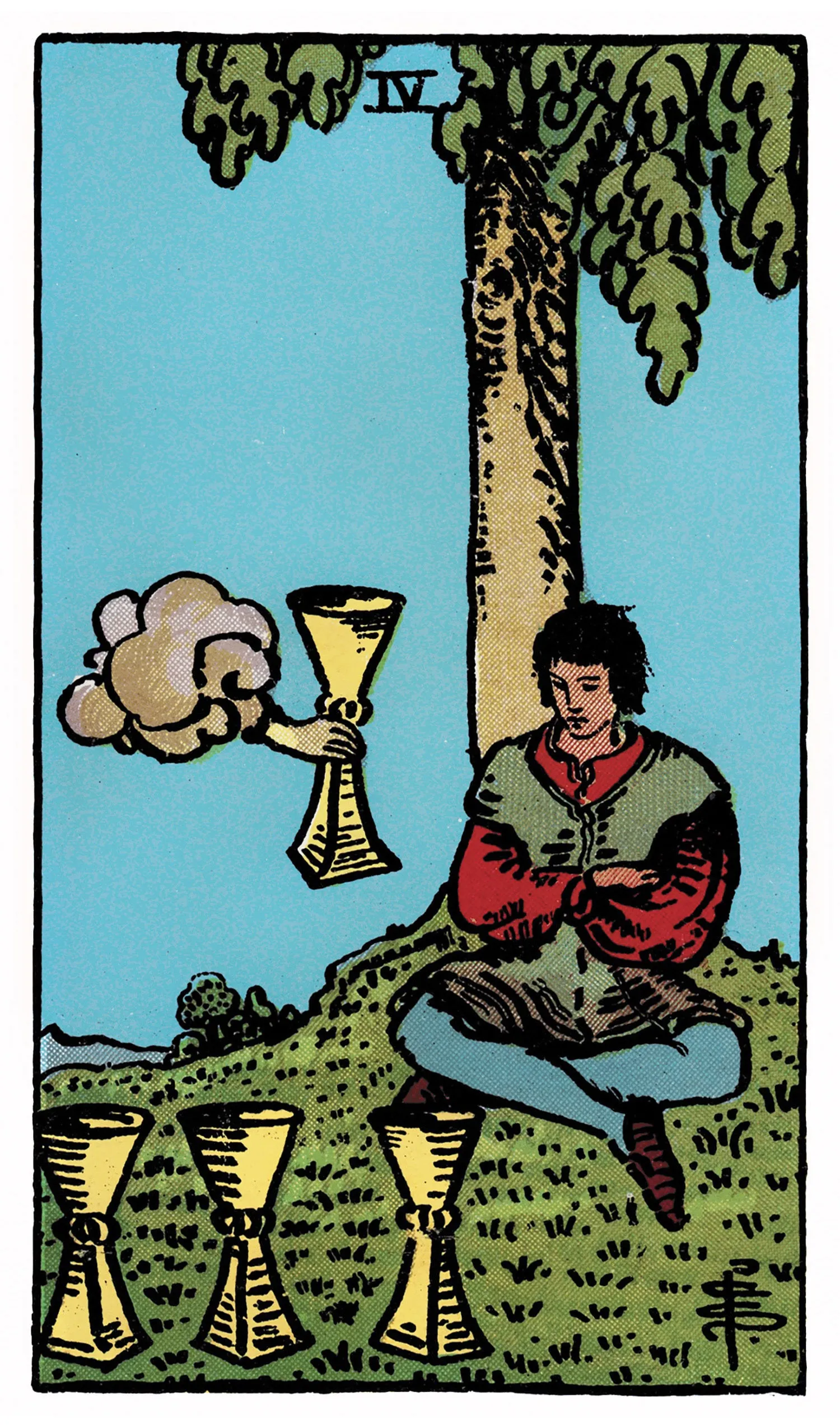
The Rider–Waite–Smith Four of Cups shows a seated figure beneath a tree, facing three cups while another cup is offered by a hand emerging from a cloud.
The image visually expresses the card's central contradiction:
something is available, but the person does not want it.
The Seated Figure
The figure remains seated and closed off rather than moving toward what is being offered.
This posture reflects:
- passivity;
- withdrawal;
- lack of motivation;
- emotional stagnation;
- refusal to participate.
The person is not necessarily unaware.
They may simply not feel emotionally engaged enough to act.
The Three Cups on the Ground
The three cups can represent what has already been experienced.
In the progression of the suit, this creates an important link with the Three of Cups.
The person has already experienced:
- emotional exchange;
- pleasure;
- social connection;
- enjoyment.
Now that emotional abundance has become familiar.
The cups remain present, but they no longer create excitement.
This is the symbolism of emotional saturation.
The Offered Fourth Cup
The fourth cup is presented as an additional possibility.
Yet the figure does not reach for it.
The offer may be valuable.
Or it may genuinely be wrong for the person.
The card does not force one interpretation.
Instead, it asks:
Is this an unsuitable offer — or has dissatisfaction made every offer look unsuitable?
The reversed card develops another possibility:
the person may refuse the cup for so long that eventually it is no longer being offered.
The Tree
The tree provides stability, permanence, and a fixed environment.
This reinforces the Four's connection with established form.
But Water needs movement.
When emotional Water becomes fixed for too long, stability can turn into stagnation.
The Number Four
Four represents structure, fixation, and established form.
This is why the Four of Cups can indicate a concrete result rather than absence of development.
Something has taken shape.
The important question is not whether a result exists.
It is:
Does the result emotionally satisfy the person?
Usually, it does not.
The Core Symbolism of The Four of Cups
The Four of Cups is the image of emotional dissatisfaction inside an established situation.
Something exists.
Something has been achieved.
Something else may still be offered.
Yet the emotional response remains weak.
Where the Ace receives emotion, the Two exchanges it, and the Three shares and celebrates it, the Four fixes the emotional field until pleasure turns into saturation and stagnation.
The card therefore asks two difficult questions:
Is what you have genuinely wrong for you?
And:
If something better appears, will you still be able to recognize it before it disappears?