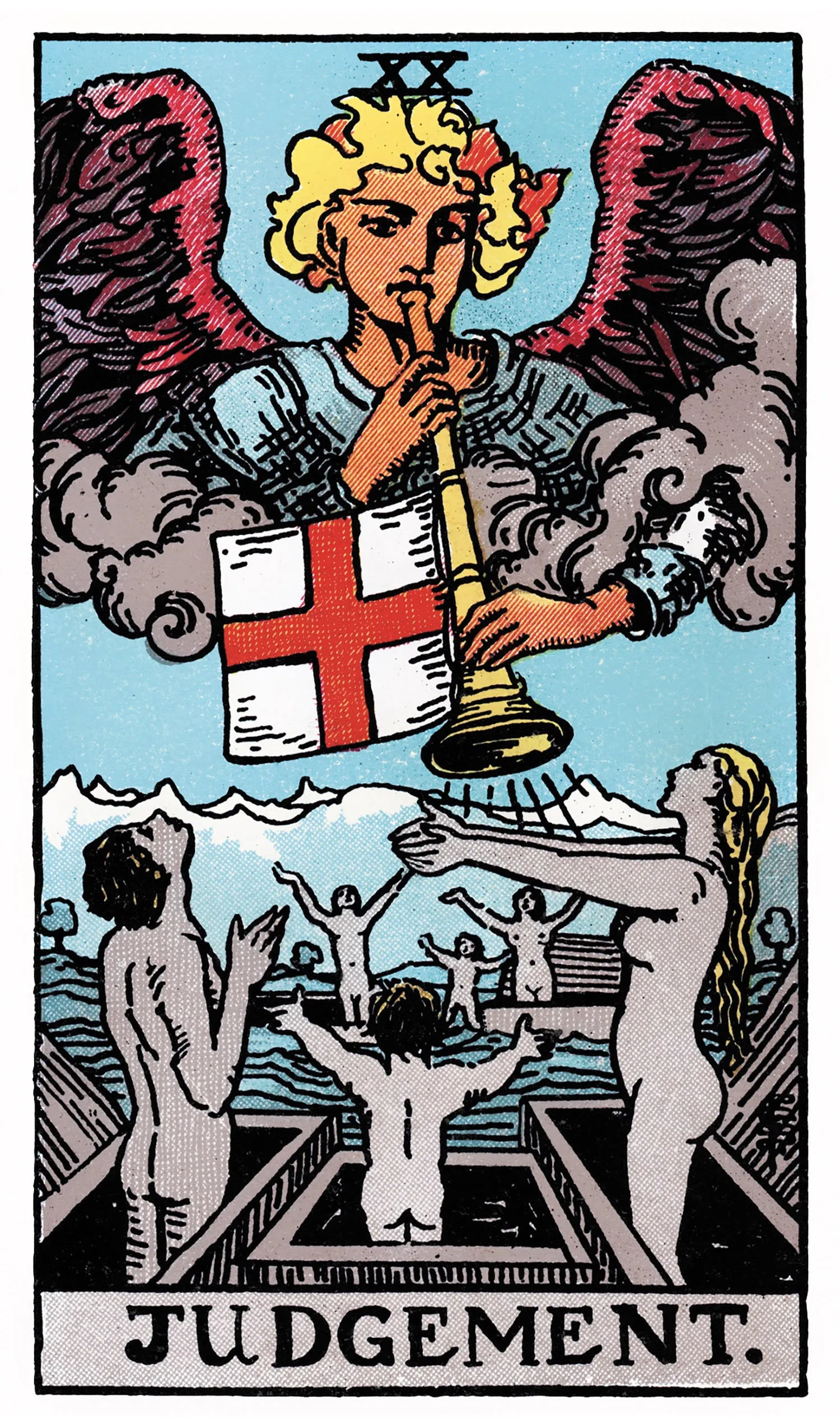
Major Arcana · Card XX
The Judgement Tarot Card Meaning
Judgement is a card of awakening, realization, positive change, and transition into a better stage. Its process often begins internally: a person understands that the old state can no longer continue, and this realization creates the decision that leads to external improvement. Unlike sudden transformative cards, Judgement usually describes changes that have already been developing and are connected with previous actions, choices, or efforts.
Card Meanings
General Meaning
Judgement represents a stage when previous actions begin to produce their results and the situation is ready to move forward.
The card is fundamentally positive. It usually indicates improvement, resolution, renewal, or movement into a better state. However, this is rarely an accidental stroke of luck. What happens now is often connected with what the person has already done, learned, built, endured, or decided in the past.
One of the most important mechanisms of Judgement is inner transformation preceding external change. A realization develops first. The person begins to understand themselves, their circumstances, or the consequences of previous choices differently. Once this internal shift has matured, external changes naturally follow.
For this reason, Judgement can indicate a final answer, an important decision, the result of previous efforts, a return to something unfinished, a second chance, recovery of something thought to be lost, or a transition into another stage.
These changes are usually not as abrupt or radical as those represented by Death or The Tower. They tend to feel more expected, prepared, or logically connected with the development of the situation.
Judgement can also operate on a collective level. It may describe decisions, developments, or changes that involve a group of people rather than only one individual.
The Shadow Side of Judgement
The difficult side of Judgement appears when evaluation turns into excessive judgment.
A person may become too critical of themselves or others, repeatedly reviewing past mistakes instead of using them as a basis for change.
Another shadow expression is the inability to leave a completed stage behind. The past keeps returning because its lesson has been recognized intellectually but not truly integrated.
The collective quality of Judgement can also become difficult when the person becomes caught in group pressure, collective tension, or processes that are larger than their individual control.
Judgement Reversed
Reversed Judgement shows a blocked or deteriorated version of the upright process.
Change has already become necessary, but the transition does not happen properly. The person may understand what needs to change but continue postponing the decision, remain attached to the old situation, or repeat a cycle they should already have outgrown.
It can indicate stagnation, delayed resolution, missed opportunities, failure to learn from previous experience, or a second chance that is not used effectively.
Where upright Judgement tends to improve the situation, reversed Judgement can show that improvement is being prevented or delayed.
It can also point to unfavorable collective processes, group-level complications, or situations where a larger shared process develops in an undesirable direction.
Core Message
What you have done before is now producing consequences. Recognize what has changed internally, respond to it consciously, and allow the situation to move into a better stage.
Judgement as a Person
A Judgement person is often capable of substantial personal growth.
They learn through experience and may periodically go through strong internal reassessments that change their priorities, beliefs, or direction in life.
They are usually aware that actions have consequences and may take important decisions very seriously. They can be reflective, principled, responsible, and able to recognize when a previous stage of life has run its course.
Such people are often capable of rebuilding or improving their lives because they do not simply experience the past — they eventually extract meaning from it.
Judgement as Actions
As actions, Judgement shows someone making a mature decision based on what has already happened.
The person may return to an unresolved matter, correct a previous choice, give something another chance, respond to an important realization, resume a project, reopen communication, or take the step necessary to move the situation forward.
The action is usually not completely spontaneous. It has been developing internally or has become a logical consequence of previous events.
Judgement in Love and Relationships
In relationships, Judgement usually indicates positive change, renewal, or an important improvement in the relationship dynamic.
It can show a serious conversation, reconciliation, renewed contact, forgiveness, a second chance, or the movement of an existing relationship into another stage.
Past experience is extremely important here. Judgement rarely describes a completely random development. Something that happened before now produces a result, and the relationship changes because one or both partners have reached a new understanding.
The card is particularly strong in questions such as “Is this the right man for me?” or “Is this person meant to be in my life?” In this context, Judgement can indicate a fated or destiny-linked partner and a connection that has meaningful importance in the person's life path.
This does not mean that every appearance of Judgement automatically guarantees lifelong partnership. The exact form of the relationship still depends on the question and surrounding cards.
Judgement as Thoughts
The person is seriously reassessing the relationship and thinking about what previous events mean now.
They may be considering whether the connection deserves another chance, whether previous mistakes can be corrected, or what decision should be made based on everything that has already happened.
They may also perceive the relationship as particularly important or meaningful.
Judgement as Feelings
Judgement can indicate feelings that awaken again or become much clearer after a period of uncertainty, distance, or emotional confusion.
The person may suddenly understand the true significance of the connection or recognize that their feelings are more important than they previously admitted.
It can also show renewed emotional interest in someone from the past.
Judgement is more about emotional realization and awakening than soft romantic sentimentality.
Judgement as Intentions
The person intends to change the existing situation for the better.
They may want to return, reconcile, restart communication, correct something that previously went wrong, make a serious decision, or move the relationship into a new stage.
These intentions are usually based on previous experience rather than temporary impulse.
Judgement as an Outcome
As an outcome, Judgement is generally positive.
It indicates improvement, resolution, a favorable change of state, or movement into a better stage as a result of what has already happened.
Previous actions begin to produce a meaningful result. A decision may finally be made, an answer received, an old problem resolved, or a situation renewed after a difficult period.
The changes shown by Judgement are usually not radical or destructive. They tend to be the logical culmination of a process that has already been developing.
It can therefore represent a situation becoming better because the necessary experience, effort, realization, or decision has already accumulated.
Judgement in Career and Work
In career readings, Judgement often shows positive professional change produced by previous effort, experience, or decisions.
The development is usually not completely unexpected. It may have been building for some time or may be the natural result of earlier work.
Judgement can indicate:
- receiving the result of an interview, examination, application, or selection process;
- professional recognition or evaluation;
- promotion or movement into another professional stage;
- returning to a previous profession, project, or field;
- successfully revisiting something that was unfinished;
- realizing what professional direction feels genuinely meaningful;
- changing career after a period of serious reflection;
- seeing previous work finally produce visible results.
The card can be particularly significant when a person realizes their professional calling or understands that their previous experience has been leading them toward a particular direction.
Judgement in Money and Finances
In finances, Judgement indicates improvement, resolution, or a meaningful change in financial circumstances connected with previous actions.
It may show repayment, settlement, recovery of money, closure of an old financial obligation, the result of a previous investment or financial decision, or an official answer concerning money.
In larger financial questions, Judgement can also indicate a significant change in the person's material situation. However, this change usually develops from previous circumstances rather than appearing from nowhere.
The card does not automatically promise wealth, but it does tend to show movement toward a better or more resolved financial state.
Judgement in Health
In the Tarovera Tarot-health system, upright Judgement can indicate a crisis point in a health situation and is associated with operations or situations in which surgery becomes an important part of the question.
In severe spreads, it can also accompany other cards associated with serious health outcomes.
These meanings are Tarot associations and should never be treated as medical diagnosis.
Tarot should not be used as a substitute for medical diagnosis or treatment.
Judgement Timing — When Will It Happen?
Judgement tends to describe a process that has already been developing and is approaching the stage where its result becomes visible.
For the question “When?”, Judgement corresponds to spring.
For the question “How soon?” or “Within what period?”, Judgement indicates within three months.
Key Timing Correspondence
When: Spring
How soon: Within 3 months
Judgement as an Event
As an event, Judgement often indicates a positive development that grows out of previous circumstances.
Possible manifestations include:
- receiving an important answer or result;
- an official decision or announcement;
- a situation finally becoming resolved;
- someone from the past returning;
- a relationship or project being renewed;
- an unfinished matter being reopened and successfully reconsidered;
- receiving news that changes the direction of the situation;
- a personal realization leading to visible external improvement;
- a collective decision or group-level development;
- movement into a new and more favorable stage.
The event is often significant, but it does not have to be sudden. Judgement commonly shows something that has already been preparing beneath the surface.
Judgement as Card of the Day
Judgement as Card of the Day suggests that something may become clearer and begin moving in a better direction.
You may receive an answer, see the result of something you did earlier, reconsider an old decision, hear from someone connected with the past, or understand what needs to change next.
Pay attention to situations that feel familiar. Today may show you how previous actions are beginning to produce consequences.
Judgement as Advice
Recognize what your previous experience has already taught you and act on that understanding.
If an opportunity to improve, restore, correct, or renew something appears, use it consciously.
Allow the situation to move forward instead of remaining attached to a stage you have already outgrown.
Do not force radical change where it is unnecessary. Judgement favors mature improvement based on what has already been learned.
Judgement Reversed as Advice
Do not remain in stagnation after you already understand what needs to change.
Stop repeating the same cycle while expecting a different result. If you have been given another opportunity, use what previous experience has taught you instead of recreating the same situation.
Judgement as a Warning
Judgement warns against ignoring the consequences of previous decisions.
You may already have enough information to understand what a situation requires, but excessive hesitation can prevent the improvement that is now possible.
The card can also warn against judging yourself or other people so harshly that evaluation replaces action.
Because Judgement can operate collectively, it may also indicate that a person should pay attention to larger group dynamics and not assume that every important development is under individual control.
Judgement — Yes or No
Upright: Yes
Judgement gives a yes.
The card is generally positive and indicates improvement, successful transition, or a favorable result developing from previous actions and accumulated experience.
Reversed: Most likely no
Reversed Judgement is more likely no.
The main reason is stagnation: the process fails to move into its next stage, improvement is blocked, or the necessary decision is postponed.
Judgement Symbolism
The Rider–Waite–Smith image of Judgement reinforces the themes of awakening, response, renewal, consequences, and transition.
The Angel and the Trumpet
The trumpet represents a call that can no longer be ignored.
Something becomes clear enough that a response is necessary. This connects Judgement with realization, announcements, decisions, results, and moments when something previously developing finally becomes known.
The Flag
The banner attached to the trumpet emphasizes the significance of the message.
The realization represented by Judgement is not a passing thought. It has enough importance to influence what happens next.
The Rising Figures
The figures rising from their coffins symbolize emergence from a previous state.
They do not simply return to exactly what existed before. Their awakening represents renewal, improvement, and the possibility of entering another stage after previous experience has been understood.
The Coffins
The coffins represent previous conditions, old identities, and stages that have already served their purpose.
They reinforce one of Judgement's central principles: external change happens because the old state has already become internally exhausted.
The Open Arms
The raised arms show recognition and response.
The call has been heard. What matters now is whether the person is willing to accept what they have understood and allow the next stage to begin.
The Group of Figures
The card does not depict only one isolated individual.
The presence of many figures reflects the collective dimension of Judgement and its ability to describe decisions, changes, or processes involving a group rather than only one person.
The Water
The water reinforces the idea of transition between states.
It suggests that the change represented by Judgement affects more than external circumstances. It develops through emotional and internal realization before becoming visible in the outer world.
The Mountains
The distant mountains give the scene a sense of scale and inevitability.
They emphasize that Judgement often concerns a meaningful transition whose foundations have already been developing for some time.
The Core Symbolism of Judgement
The visual logic of Judgement follows a clear sequence:
previous experience → awakening → realization → conscious response → positive transition into a new stage.
The card therefore describes change that has matured rather than change that simply erupts. What happens externally is the result of something that has already developed internally and through previous actions.