Minor Arcana · Cups · King
The King of Cups Tarot Card Meaning
The King of Cups represents emotional maturity, depth, self-control, diplomacy, compassion, and the ability to understand powerful feelings without being completely ruled by them. His emotional world may be extremely strong, but experience has taught him how to contain, direct, and use that emotional force.
Unlike the Knight of Cups, who actively follows what emotionally attracts him, the King is less easily carried away by the immediate wave. Unlike the Queen of Cups, whose strength lies in receptivity, care, and emotional support, the King is more likely to use emotional understanding deliberately: to guide, influence, calm, protect, negotiate, or manage a difficult human situation.
Card Meanings
General Meaning
The King of Cups represents mastery of the emotional sphere.
This does not mean that he feels less than other Cups cards.
Quite the opposite.
His emotional world can be powerful, complicated, and extremely deep. The difference is that experience has taught him how to remain functional while those emotions exist.
He does not need the emotional sea to become calm in order to remain steady.
This is one of the central distinctions of the card.
The King of Cups can:
- understand complicated emotional motives;
- remain composed in conflict;
- calm other people;
- give mature advice;
- mediate;
- protect;
- influence without using open force;
- maintain emotional control in difficult circumstances.
His strength often appears through:
- emotional intelligence;
- diplomacy;
- maturity;
- patience;
- tact;
- compassion;
- self-restraint;
- psychological understanding;
- the ability to manage emotional atmosphere.
The King can also represent an emotionally mature or influential man who is favorably disposed toward the querent.
Unlike the Queen of Cups, whose help may primarily come through understanding, sympathy, advice, and emotional support, the King may sometimes have position, influence, connections, authority, or practical ability to help.
He may not only understand the problem.
He may be able to call someone, influence a decision, protect the querent, introduce them to the right person, or use his status to make the situation easier.
This still does not make the King of Cups a guaranteed card of external success.
He can significantly improve the human side of a situation without being able to control every external condition.
The Shadow Side of The King of Cups
The King's greatest strength can also become his greatest danger.
Because he understands emotions well, he often knows exactly how other people will react.
He may understand:
- what they want to hear;
- what will reassure them;
- what will make them trust him;
- what will make them feel guilty;
- what will calm them;
- what will make them emotionally dependent.
In a healthy King, this understanding is used responsibly.
In the shadow, emotional intelligence becomes emotional strategy.
He may influence someone so subtly that very little is said directly.
The King of Cups does not always need an explicit statement.
He can communicate through:
- tone;
- attention;
- silence;
- implication;
- atmosphere;
- emotional timing;
- carefully chosen words.
This can be sophisticated diplomacy.
It can also become manipulation.
Another shadow is excessive control.
He may become so skilled at containing his feelings that he begins to hide them even from himself.
Calmness turns into suppression.
Diplomacy turns into avoidance.
Maintaining peace becomes more important than addressing what is actually wrong.
The King of Cups Reversed
Reversed, the King loses mastery over the emotional world he is supposed to govern.
This is a particularly important deterioration of the upright principle.
The problem is not lack of feeling.
The problem is that strong feeling is no longer being managed constructively.
He may begin to drown in the same emotional element he normally controls.
This can manifest as:
- emotional manipulation;
- passive aggression;
- concealed resentment;
- mood instability;
- emotional dependency;
- self-pity;
- avoidance;
- escapism;
- dishonesty;
- psychological pressure;
- addiction;
- self-destructive behavior.
The reversed King may appear calm externally while becoming increasingly chaotic internally.
He can also be someone who was deeply hurt in the past and now manages vulnerability through:
- control;
- alcohol;
- substances;
- withdrawal;
- emotional games;
- avoidance of genuine intimacy.
In situations involving another person with influence, the reversed King can also show that support, protection, or goodwill exists — but it is directed toward someone else rather than toward the querent.
Core Message
The King of Cups does not conquer emotion by becoming emotionless.
He becomes powerful because he learns how to live inside deep emotion without surrendering control of his behavior.
His challenge is to use emotional influence with maturity rather than turning it into concealment, avoidance, or manipulation.
The King of Cups as a Person
The King of Cups is usually emotionally experienced, psychologically perceptive, composed, tactful, understanding, and difficult to provoke openly.
He may feel far more than he visibly demonstrates.
A calm exterior should therefore not be confused with emotional shallowness.
This person often understands:
- why people behave the way they do;
- what another person needs emotionally;
- what kind of response will calm a conflict;
- what should be said — and what should not;
- when direct pressure would make things worse.
He can be the person others come to when the situation becomes emotionally complicated.
He may be a:
- adviser;
- mentor;
- counselor;
- mediator;
- manager;
- therapist-type figure;
- supportive father;
- mature partner;
- respected senior person.
One of his distinctive qualities is the ability to influence without making that influence obvious.
He may not issue commands.
He may change the entire emotional direction of a conversation through a few carefully chosen words, a look, tone of voice, or the way he responds.
The King may also be a benefactor.
If he is sympathetic toward someone, he may use:
- status;
- authority;
- connections;
- knowledge;
- access;
- influence
to help them.
The King of Cups as Actions
As Actions, the King of Cups responds deliberately.
He may:
- calm conflict;
- negotiate;
- mediate;
- advise;
- protect someone;
- use influence quietly;
- support a person in difficulty;
- make a sympathetic decision;
- speak diplomatically;
- soften another person's position;
- help through contacts or authority;
- manage a complicated emotional situation;
- prevent escalation.
He does not always state his intentions directly.
Sometimes his action is extremely subtle.
A hint, tone, introduction, private conversation, or quietly favorable decision may accomplish more than open confrontation.
This is still action.
It simply operates through emotional and social influence rather than obvious force.
The King of Cups in Love and Relationships
The King of Cups is a strong card of mature and substantial emotional involvement.
He can indicate:
- deep love;
- loyalty;
- emotional attachment;
- care;
- protectiveness;
- mature affection;
- emotional responsibility;
- understanding;
- sensuality;
- patience.
Unlike the Knight of Cups, the King is generally less likely to confuse the excitement of romance with the full reality of a relationship.
His feelings can be deeper and more stable precisely because he has greater emotional experience.
However, he may express much less than he feels.
This is crucial.
The absence of dramatic declarations does not mean the absence of strong emotion.
The King may feel intensely while choosing carefully what he reveals.
He can also be extremely skilled at shaping emotional atmosphere.
He may create intimacy through:
- attention;
- tone;
- eye contact;
- timing;
- emotional sensitivity;
- knowing exactly what makes the other person feel understood.
He does not only experience emotion.
He can influence the emotional state of the other person.
In a healthy relationship, this creates:
- trust;
- security;
- closeness;
- emotional depth;
- mature intimacy.
In an unhealthy expression, the same ability can become extremely effective emotional manipulation.
The King of Cups still does not automatically guarantee:
- marriage;
- formal commitment;
- moving in together;
- permanent external progression.
He shows mature emotional involvement more reliably than a specific practical milestone.
The King of Cups as Thoughts
As Thoughts, the King of Cups evaluates the emotional dynamics of the situation.
He may think:
- What is this person really feeling?
- What should I say?
- How can I avoid unnecessary escalation?
- What response will produce the best emotional result?
- How can I preserve the relationship?
- How much should I reveal?
His thinking is psychologically strategic rather than purely intellectual.
He may understand the emotional consequences of words before he speaks them.
The King of Cups as Feelings
As Feelings, the King of Cups can indicate exceptionally deep emotion.
There may be:
- love;
- attachment;
- protectiveness;
- loyalty;
- emotional respect;
- compassion;
- tenderness;
- profound concern.
These feelings are generally more experienced and less naive than those of the Knight of Cups.
The King may recognize the other person's flaws and still care deeply.
He may also keep much of this private.
Strong feelings do not necessarily produce strong visible expression.
This card can therefore appear when someone feels far more than their behavior openly reveals.
The King of Cups as Intentions
The King of Cups usually intends to preserve emotional control and manage the situation constructively.
He may want to:
- protect;
- support;
- maintain connection;
- negotiate;
- calm conflict;
- help;
- keep peace;
- use influence favorably;
- preserve emotional stability.
He may act indirectly if he believes a direct approach would create unnecessary resistance.
The King of Cups as an Outcome
As an Outcome, the King of Cups can indicate that the situation comes under more mature emotional management.
A person with:
- authority;
- experience;
- influence;
- connections;
- emotional intelligence
may become important.
This person may not merely sympathize.
They may be able to do something useful.
For example:
- make a favorable decision;
- intervene;
- mediate;
- introduce the querent to someone;
- use influence;
- protect;
- offer meaningful support.
This gives the King more external weight than the Queen of Cups.
However, his presence still does not automatically guarantee complete factual success.
The King can significantly improve the conditions around a situation while some external obstacles remain outside his control.
The King of Cups in Career and Work
In Career, the King of Cups is especially strong in fields where emotional intelligence, leadership, trust, diplomacy, and understanding people matter.
He can be effective in:
- management;
- counseling;
- psychology-related professions;
- healthcare and care work;
- education;
- HR;
- mediation;
- diplomacy;
- client relations;
- creative industries;
- hospitality;
- confidential or trust-based roles.
He can indicate a senior person who is sympathetic toward the querent and may have enough influence to help.
This can be particularly favorable when the outcome depends on:
- management;
- approval;
- negotiation;
- recommendation;
- mediation;
- access;
- goodwill from authority.
However, there is an internal tension in this card.
The rank of King wants:
- control;
- responsibility;
- structure;
- management.
The suit of Cups remains:
- emotional;
- intuitive;
- creative;
- changeable;
- less naturally suited to rigid systems.
The King may therefore manage people far better than he manages rigid processes.
He can be an excellent leader of a creative or human-centered environment without being the perfect administrator.
Work may also be chosen because it feels meaningful or emotionally fulfilling rather than purely because it maximizes income.
The King of Cups in Money and Finances
The King of Cups is not naturally a strong material card.
Even upright, his attention may be more naturally focused on:
- people;
- relationships;
- emotional wellbeing;
- creativity;
- meaningful work
than on strict resource management.
He may therefore be emotionally mature while still being less disciplined about:
- investments;
- property;
- accounting;
- financial control;
- material optimization.
This does not mean financial incompetence.
It means that material accumulation is not his strongest natural focus.
He may also use money to:
- help family;
- support someone;
- create comfort;
- maintain relationships;
- fund something meaningful.
A mature or influential person may give financial advice or assistance.
But the card itself does not guarantee:
- wealth;
- major profit;
- strong financial expansion;
- successful investment.
The King of Cups in Health
Within the TAROVERA Tarot health system, the upright King of Cups is associated with generally good health, psychosomatic disturbances, and mild poisoning or intoxication.
These are Tarot-system associations rather than medical diagnoses.
Tarot should not be used as a substitute for medical diagnosis or treatment.
The King of Cups Timing — When Will It Happen?
The King of Cups corresponds to the period from June 22 to September 23.
When the question is specifically “How soon?”, the card indicates a long process.
The situation may take approximately five to six months to develop.
Key Timing Correspondence
When? — June 22 to September 23.
How soon? — Approximately five to six months. The process develops gradually rather than quickly.
The King of Cups as an Event
As an Event, the King of Cups often indicates the involvement of a mature, emotionally intelligent, or influential person.
Possible manifestations include:
- receiving valuable advice;
- meeting a mature or influential man;
- receiving meaningful help;
- a sympathetic authority figure becoming involved;
- conflict being mediated;
- someone using contacts or influence in the querent's favor;
- a serious supportive conversation;
- reconciliation;
- a favorable interpersonal decision;
- emotional tension being brought under control.
Unlike the Queen of Cups, the King may sometimes possess enough external authority to turn sympathy into practical assistance.
But whether that assistance is sufficient to produce the final external result still depends on the rest of the spread.
The King of Cups as Card of the Day
The King of Cups makes emotional self-control, diplomacy, and psychological awareness especially important today.
You may need to:
- stay calm;
- read the atmosphere;
- listen carefully;
- advise;
- mediate;
- support someone;
- use influence tactfully;
- handle a sensitive conversation.
A mature or influential man may also become important.
The most effective action may be subtle rather than obvious.
A private conversation, well-timed remark, or quiet act of support may accomplish more than direct pressure.
The King of Cups as Advice
Stay emotionally steady without becoming emotionally numb.
Acknowledge what you feel.
Then decide what to do with it.
Use emotional intelligence deliberately.
If the situation involves conflict:
- understand the motives;
- lower unnecessary tension;
- choose the right tone;
- use influence responsibly;
- avoid impulsive reactions.
If you have status, connections, authority, or the ability to help someone, use them constructively.
The King of Cups advises emotional leadership.
The King of Cups Reversed as Advice
Regain control of your emotional world before trying to control the situation outside you.
Do not use:
- silence;
- guilt;
- sympathy;
- alcohol;
- substances;
- emotional withdrawal;
- psychological pressure
as substitutes for honest engagement.
And do not call suppression “maturity.”
The King becomes strong again when he acknowledges the emotional reality and manages it consciously.
The King of Cups as a Warning
The King of Cups warns that emotional intelligence can be used for both care and control.
Knowing how another person feels gives you influence.
Use it responsibly.
Be careful not to:
- manipulate emotional weakness;
- suppress your own feelings indefinitely;
- maintain peace at any cost;
- confuse calm appearance with genuine resolution;
- escape from pain instead of processing it;
- assume that emotional maturity automatically produces material competence.
The card also warns that a sympathetic influential person is not automatically on your side.
Their help, protection, or resources may ultimately be directed elsewhere.
The King of Cups — Yes or No
Upright: Yes
The King of Cups gives a yes.
It is particularly favorable when the question concerns:
- emotional support;
- mature feelings;
- reconciliation;
- understanding;
- mediation;
- advice;
- protection;
- whether an influential person will help;
- whether someone is favorably disposed;
- whether mature emotional involvement exists.
However, as a Cups card, it should not automatically be treated as proof that every material or external obstacle will disappear.
Reversed: No
The reversed King of Cups gives a no.
The situation may be weakened by:
- emotional instability;
- manipulation;
- avoidance;
- addiction;
- self-destructive behavior;
- concealed resentment;
- unreliable support;
- an influential person helping someone else instead.
The King of Cups Symbolism
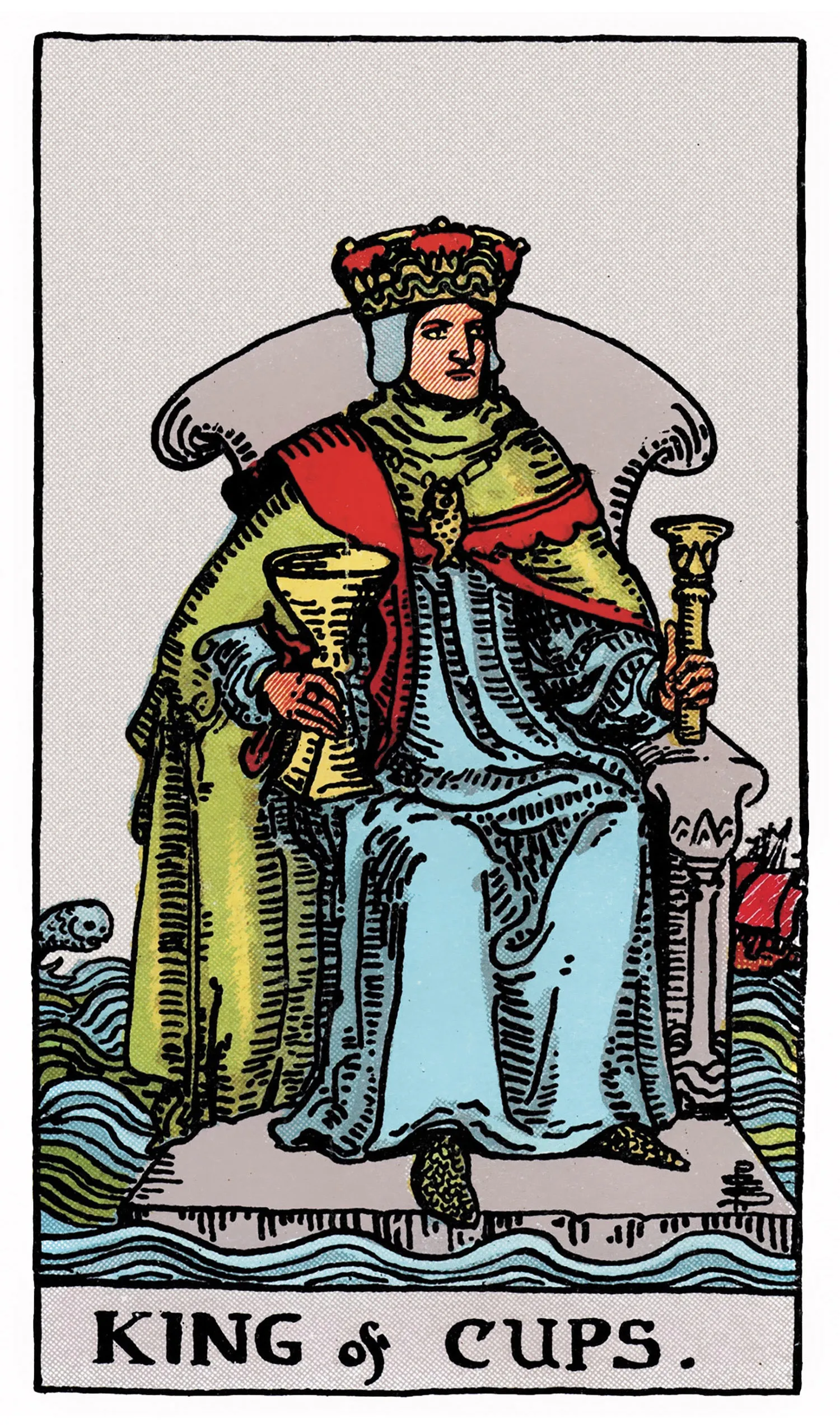
The Rider–Waite–Smith King of Cups sits on a stone throne surrounded by turbulent water.
The sea moves around him, yet the King remains composed.
This contrast expresses the central principle of the card: powerful emotion exists, but it does not automatically control behavior.
The Throne on the Water
The King's throne stands surrounded by the sea.
He does not require the water to become calm in order to remain stable.
This is emotional mastery.
His achievement is not lack of feeling.
It is the ability to remain himself while deep emotional forces move around and within him.
The Cup
The cup represents the emotional world he understands.
Unlike the Page, who is still discovering the suit, or the Knight, who actively follows what emotionally attracts him, the King has accumulated experience with Cups.
He knows what emotion can create.
He also knows what it can destroy.
The Scepter
The scepter represents authority and conscious direction.
Its presence beside the cup is essential.
The King holds both:
- feeling;
- control.
His power comes from combining them.
The Turbulent Sea
The water is not peaceful.
This matters.
The King is not emotionally mature because life has become easy.
He is emotionally mature because he has learned how to remain functional when emotional conditions are difficult.
The Fish and the Ship
The fish reinforces intuition, unconscious material, emotional instinct, and the living nature of Water.
The ship suggests movement in the external world.
The King remains present inside both.
He does not withdraw from life in order to maintain control.
The Core Symbolism of The King of Cups
The King of Cups represents authority over the emotional realm.
His feelings can be powerful, complex, and profound.
His maturity lies not in weakening those feelings but in learning how to contain, direct, and use them consciously.
At his best, he turns emotional understanding into guidance, protection, diplomacy, influence, and meaningful help.
At his worst, the same knowledge becomes manipulation, concealment, self-destruction, or control over other people's emotions.