Minor Arcana · Cups · Page
The Page of Cups Tarot Card Meaning
The Page of Cups represents emotional openness, curiosity, imagination, and the beginning of experience. It often brings a feeling, message, invitation, idea, offer of help, or opportunity that genuinely interests the person — but it also carries the unmistakable quality of a beginner.
This Page is receptive, creative, sensitive, and willing to explore, yet still lacks the experience needed to judge every situation accurately. In relationships this may appear as innocent attraction or a first emotional step; outside relationships, it can point much more literally to insufficient knowledge, qualifications, skills, or practical experience.
Card Meanings
General Meaning
The Page of Cups represents the beginning of emotional understanding and the first attempts to interact with the world through the qualities of Cups.
There is interest here.
There is openness.
There may be genuine talent.
But mastery has not yet been achieved.
The Page is still learning.
This is one of the most important distinctions when interpreting the card.
In romantic questions, the Page of Cups naturally describes feelings, attraction, emotional curiosity, affection, flirtation, a pleasant message, an invitation, an apology, or the first stages of emotional involvement.
Outside relationships, however, its beginner quality becomes much more important.
The card can represent someone who simply does not yet know enough.
They may lack experience, professional qualifications, technical knowledge, practical skills, or an adequate understanding of the situation.
This does not automatically mean that the person is incapable.
Quite the opposite: Pages frequently show potential.
The problem is that potential and competence are not the same thing.
The Page may be enthusiastic about an opportunity while underestimating how much knowledge is required.
They may have a good idea without knowing how to execute it.
They may understand the basic principle but not the complexity behind it.
They may sincerely believe that they are ready while still seeing the situation through the eyes of a newcomer.
The card therefore frequently appears around:
- students;
- trainees;
- interns;
- junior specialists;
- first attempts;
- new hobbies;
- unfamiliar professions;
- experimental projects;
- early creative work;
- situations where someone is learning by doing.
The Page of Cups is often a particularly good learner when emotionally interested in the subject.
If something genuinely fascinates them, they can become attentive, enthusiastic, diligent, and eager to improve. They may absorb knowledge quickly because curiosity keeps them engaged.
This makes the Page potentially valuable in a junior position.
They may not know enough yet, but they can be teachable.
A promising beginner and an experienced specialist are not the same thing, however. The card remains weak when immediate expertise is required.
The Page of Cups also carries strong imagination.
The person can be creative, intuitive, emotionally perceptive, artistic, and capable of seeing possibilities that more experienced but rigid people overlook.
That openness is one of the Page's greatest strengths.
But imagination must eventually meet reality.
Without enough experience, emotional impressions can easily be mistaken for facts, enthusiasm can be mistaken for ability, and hope can be mistaken for evidence.
The Page is also traditionally a messenger and helper.
It may indicate someone who reaches out, offers assistance, does a favor, supports another person, or tries to make a situation easier simply because they care.
This help is often sincere rather than calculated.
However, there is an important Page-like limitation:
someone can genuinely want to help and still not know enough to help effectively.
The card therefore says:
Explore it. Help if you can. Learn from the experience. But remember that you are still developing your skills.
The Shadow Side of The Page of Cups
The shadow begins with innocence that has not yet developed discernment.
A person may be so open to possibility that they believe what they want to believe.
They may trust too quickly, overestimate someone's intentions, underestimate practical difficulties, or assume that genuine enthusiasm is enough to compensate for lack of knowledge.
In professional situations, this can become particularly important.
The person may volunteer for something they are not yet qualified to handle.
They may underestimate the complexity of a task.
They may think that watching, reading, or trying something a few times means they already understand it.
The Page can also become trapped inside imagination.
Instead of using fantasy to create something, the person simply lives in the imagined version of what might happen.
Plans become more developed than actions.
Potential becomes more impressive than actual results.
Another shadow is weak personal boundaries.
Because the Page is sensitive, kind, inexperienced, and receptive to other people, they may find it difficult to stand up for themselves.
They may assume that other people know better.
They may treat someone else's opinion as more important than their own.
They may agree too quickly, tolerate behavior they dislike, or become vulnerable to stronger personalities.
Kindness then becomes excessive accommodation.
Openness becomes suggestibility.
In emotional situations, sensitivity may become oversensitivity.
Innocence may become gullibility.
Romantic imagination may become idealization.
The desire to be liked may become dependence on attention or reassurance.
The shadow of the Page of Cups is therefore not that the person has no potential.
It is that they may mistake potential for readiness and openness for good judgment.
The Page of Cups Reversed
The reversed Page of Cups is a deteriorated form of the same beginner energy.
The lack of experience becomes more serious.
Naivety becomes poor judgment.
Imagination becomes escapism.
Sensitivity becomes emotional instability or painful oversensitivity.
A person may have difficulty distinguishing what they feel, what they hope, and what is actually happening.
They may misunderstand another person's intentions because they are interpreting the situation through desire rather than evidence.
Outside relationships, the reversed Page may indicate a clear lack of competence.
The person may not have the knowledge, skills, qualifications, or practical experience required for the task.
They may produce immature work, make avoidable mistakes, misjudge the scale of the problem, or promise more than they are capable of delivering.
Another reversed manifestation is emotional attention seeking.
Instead of expressing feelings directly, the person may become sulky, dramatic, manipulative through vulnerability, or repeatedly seek reassurance.
Weak boundaries may also become more pronounced. The person can become excessively dependent on other people's opinions, approval, affection, or guidance.
The reversed card does not necessarily mean that emotions, talent, or interest are absent.
They are simply not being handled maturely enough to produce a healthy or reliable expression.
Core Message
The Page of Cups is the beginning of experience.
Be curious.
Feel.
Explore.
Create.
Learn.
Offer kindness.
Try.
But do not confuse emotional certainty with factual certainty, goodwill with competence, or enthusiasm with professional readiness.
You may have genuine potential — and still have a great deal to learn.
The Page of Cups as a Person
The Page of Cups person is sensitive, receptive, imaginative, and emotionally responsive.
They can be gentle, kind, creative, intuitive, romantic, caring, and genuinely interested in people and experiences around them.
There is often something youthful about them regardless of their actual age.
This may be pleasant youthful openness, but it can also reflect limited life experience.
The Page often approaches unfamiliar situations without the defensive cynicism of someone who has already been disappointed many times.
They still believe.
They still become excited.
They still imagine possibilities.
That makes them capable of creativity and emotional discovery, but also more vulnerable to idealization and poor judgment.
They can be good listeners.
They may naturally try to comfort people, encourage them, or offer emotional support.
Often they genuinely want to be useful.
They may offer help before anyone asks because seeing someone struggle affects them emotionally.
At the same time, their softness can make boundaries difficult.
The Page may struggle to say no.
They may underestimate their own value, assume someone else knows better, or defer too easily to stronger personalities.
They can occasionally confuse being kind with allowing other people to decide everything for them.
In non-romantic contexts, this person may quite literally be a beginner.
They may be learning a profession, entering a new field, developing a skill, or working at a junior level.
They can be talented and promising while still lacking professional depth.
One of their strongest qualities is teachability when emotionally engaged.
If they genuinely enjoy the subject, they may be diligent, attentive, enthusiastic, and eager to learn.
If the question is whether this person is qualified to handle a complicated task independently, however, the Page of Cups is a reason to examine their actual experience carefully.
Good intentions do not automatically equal competence.
The Page of Cups as Actions
The Page of Cups makes a first move.
They may send a message, make contact, express interest, invite someone somewhere, apologize, offer something, share an idea, experiment creatively, ask a question, or try something they have never done before.
They may also make a peace offering.
The card can show someone attempting to soften a conflict, reopen communication, apologize sincerely, make a friendly gesture, or take the first step toward reconciliation.
Another characteristic action is helping.
The person may volunteer, do someone a favor, provide emotional support, assist a colleague, or try to make life easier for another person simply because they want to.
Their actions are exploratory rather than authoritative.
They do not necessarily know exactly what they are doing yet.
They are finding out.
In work or practical matters, this may mean studying, practicing, attempting a first version, applying for an opportunity, starting training, assisting someone more experienced, or experimenting before committing fully.
The Page of Cups in Love and Relationships
In love, the Page of Cups is naturally at home.
It can represent attraction, tenderness, romantic curiosity, flirtation, emotional openness, a pleasant message, an invitation, an apology, or the beginning of a new emotional connection.
This is often the stage when feelings are being discovered rather than fully understood.
The person may be genuinely excited by someone.
They may want to know them better.
They may fantasize about what could develop.
There can be sweetness and sincerity here.
The Page is also an important card of reconciliation.
Someone may want to break an uncomfortable silence, apologize, restore emotional contact, make peace after a disagreement, or show that they are willing to talk again.
This does not guarantee that every conflict is solved. It shows the first emotional opening through which reconciliation may become possible.
However, the Page does not automatically describe mature commitment.
The feeling may be real while still being inexperienced.
A person can fall in love sincerely and still have little understanding of what maintaining an adult relationship actually requires.
For an existing relationship, the card may bring softness, renewed affection, playful communication, an apology, a romantic gesture, a willingness to become emotionally open again, or the desire to stop fighting and reconnect.
The Page of Cups as Thoughts
The person is thinking about emotional possibilities.
They may wonder whether the other person likes them, imagine future interactions, think about sending a message, replay pleasant conversations, consider apologizing, or think about how to become closer.
There is curiosity and openness.
Their thinking may also contain significant idealization.
They are often looking at what could be, not only at what already exists.
The Page of Cups as Feelings
As Feelings, the Page of Cups indicates genuine emotional interest.
There may be tenderness, affection, fascination, romantic excitement, vulnerability, curiosity, or a new feeling that the person is only beginning to understand.
These feelings can be sincere.
Their limitation is not necessarily falseness but immaturity.
The person may simply not yet know what their feelings mean or what they are capable of building from them.
This can be particularly characteristic of a first love, a new crush, or an emotionally inexperienced person.
There may also be a genuine desire to forgive, reconnect, or restore warmth after conflict.
The Page of Cups as Intentions
The Page of Cups usually wants to explore the connection.
The person may intend to write, meet, flirt, become closer, express affection, apologize, make a pleasant gesture, restore communication, or find out whether their feelings are reciprocated.
They are interested enough to move toward the other person, but their intentions may still be exploratory rather than fully formed.
They may genuinely want something romantic without yet knowing where they want the relationship to end.
The Page of Cups as an Outcome
As an Outcome, the Page of Cups usually indicates a beginning rather than a final achievement.
Something opens.
A message arrives.
Interest appears.
A new possibility emerges.
The person gets a first opportunity, enters a new field, begins learning, starts communicating, develops a creative idea, receives help, or gains initial experience.
This can certainly be a positive development.
But the Page does not usually show mastery or a fully realized large-scale result.
If the question concerns professional quality, completion, or whether someone can already perform at an expert level, the card may indicate that the person reaches only the beginning of that development.
The outcome can therefore be:
you get the chance to try.
What comes afterward depends on how much the person is willing to learn.
In relationships, it may be the beginning of emotional contact, renewed affection, an apology, or the reopening of communication after disagreement.
In practical matters, it may be an early-stage opportunity, test version, internship, introductory experience, assistance from another person, or first result rather than the finished product.
The Page of Cups in Career and Work
In Career, the Page of Cups is one of the cards where inexperience must be taken seriously.
This can be a student, intern, trainee, junior employee, beginner, career changer, or someone entering a field they do not yet fully understand.
They may have genuine potential.
They may be creative.
They may bring fresh ideas.
They may be enthusiastic and pleasant to work with.
And if they genuinely enjoy the subject, they can be an excellent learner.
A motivated Page may be diligent, attentive, eager to help, responsive to feedback, and willing to improve.
This can make them a very promising junior employee.
But they are not yet a seasoned professional.
The distinction matters:
excellent junior when properly taught; poor choice when immediate expertise is required.
If a question concerns hiring or assigning responsibility, the Page of Cups suggests checking:
- actual qualifications;
- practical experience;
- training;
- technical knowledge;
- ability to work independently;
- whether supervision will be required.
The Page may also describe an assistant or supportive team member.
They may willingly help a more experienced colleague, volunteer for tasks, or contribute where they can — sometimes even before they are fully competent to handle the responsibility alone.
The card can indicate a new job opportunity, invitation, pleasant professional message, training course, creative project, internship, or opportunity to explore work that genuinely interests the person.
It is particularly comfortable around creative industries, art, design, beauty, children, communication, care-oriented work, and occupations where sensitivity or imagination are useful.
But enthusiasm alone does not guarantee execution.
The Page of Cups in Money and Finances
The Page of Cups is not a strong card of material stability.
It can bring a pleasant financial message, small gift, offer, opportunity, idea, or something that creates emotional optimism around money.
However, it does not automatically indicate significant profit.
More importantly, the card can show financial inexperience.
A person may not fully understand money, pricing, investment, budgeting, contracts, financial conditions, or the practical consequences of a decision.
They may choose based on what feels attractive rather than what makes practical sense.
They may trust an appealing offer too quickly.
They may underestimate costs.
They may not yet know which questions need to be asked.
This is particularly important in transactions and agreements.
The Page can overlook contractual details, misunderstand payment terms, fail to understand legal conditions, miss restrictions hidden in documentation, or assume that an agreement is straightforward simply because the other party seems friendly.
The problem is not necessarily dishonesty on the other side.
Sometimes the Page simply does not know enough to recognize what requires checking.
For this reason, the card strongly favors asking for advice from someone more experienced before signing, investing, purchasing, or committing financially.
The Page of Cups in Health
In the TAROVERA health system, the Page of Cups can be associated with mental or developmental conditions, slowed development, childhood illnesses, and the intervertebral discs.
These are Tarot-system associations and should not be treated as medical diagnoses.
Tarot should not be used as a substitute for medical diagnosis or treatment.
The Page of Cups Timing — When Will It Happen?
As a timing indicator, the Page of Cups points to the period from February 20 to March 20.
When the question is about elapsed time rather than a calendar period, the expected timeframe is approximately three to four months.
Key Timing Correspondence
February 20 – March 20.
Alternative elapsed timeframe: approximately 3–4 months.
The Page of Cups as an Event
As an Event, the Page of Cups often brings something new enough that the person must learn how to respond to it.
This may be:
- a pleasant message;
- invitation;
- new acquaintance;
- romantic approach;
- apology;
- reconciliation attempt;
- friendly gesture;
- unexpected offer of help;
- someone doing you a favor;
- creative opportunity;
- new hobby;
- training;
- internship;
- first professional opportunity;
- introduction to an unfamiliar subject;
- contact with a child or young person;
- emotional conversation;
- unexpected idea or inspiration.
The event itself may be small, but it can open a new direction.
A Page often indicates that someone is willing to meet halfway.
A conflict may not be fully resolved yet, but a message, apology, or gesture can create the first real opportunity for peace.
The card frequently represents the first experience of something rather than its culmination.
The Page of Cups as Card of the Day
The Page of Cups makes the day feel exploratory.
You may receive a message, invitation, compliment, apology, interesting idea, offer of help, emotional signal, or opportunity to try something unfamiliar.
Someone may make a friendly gesture or try to restore contact after tension.
Something may catch your attention simply because it feels interesting.
This is a good day to experiment, learn, ask questions, create, meet someone new, help where you reasonably can, or approach a situation without pretending that you already know everything about it.
The Page rewards curiosity.
But stay realistic.
A pleasant first impression is information — not proof.
The Page of Cups as Advice
Try.
Explore the opportunity.
Allow yourself to be curious.
You do not need to know everything before taking the first step.
But approach the situation as a student, not as an expert.
Ask questions.
Learn.
Practice.
Get advice from people who know more than you do.
If someone needs help and you genuinely want to support them, do what you reasonably can — but do not take responsibility for something beyond your competence merely because you want to be useful.
If there has been conflict, consider whether a sincere message, apology, or small peace offering could reopen communication.
Check facts before allowing enthusiasm to make the decision for you.
Maintain your kindness without abandoning your boundaries.
The Page of Cups supports openness without blindness.
Keep the imagination.
Remove the rose-colored glasses.
The Page of Cups Reversed as Advice
Do not proceed as though enthusiasm can replace knowledge.
If you are underqualified, learn first.
If you do not understand something, admit it.
If you are emotionally involved, separate what you hope is true from what you actually know.
Do not agree simply because you are afraid to disappoint someone.
Do not let fantasy make promises on behalf of reality.
The Page of Cups as a Warning
The Page of Cups warns:
You may know less than you think you know.
Do not mistake curiosity for expertise.
Do not confuse a first success with professional mastery.
Do not assume that enthusiasm will solve technical problems.
Do not trust an appealing story solely because you want it to be true.
Do not allow kindness to erase your boundaries.
Wanting to help does not automatically mean you are qualified to take responsibility for the problem.
In relationships, be careful not to build an entire future out of one pleasant message or one emotional moment.
In work, check qualifications.
In money, check numbers.
In contracts, check the terms.
In unfamiliar situations, ask questions.
The Page's openness is valuable only when it remains willing to learn.
The Page of Cups — Yes or No
Upright: Yes — Try, But Take Off the Rose-Colored Glasses
Yes. Try it, but remove the rose-colored glasses.
The Page of Cups supports exploration, a first attempt, emotional openness, and the possibility of discovering something worthwhile.
However, the card does not guarantee that your current understanding of the situation is accurate.
Proceed — but check facts, recognize what you do not yet know, ask for experienced advice where necessary, and do not let enthusiasm replace preparation.
Reversed: No
No.
The reversed Page of Cups shows that naivety, emotional distortion, poor preparation, unrealistic expectations, weak judgment, or insufficient knowledge are currently too strong to support a reliable positive result.
The Page of Cups Symbolism
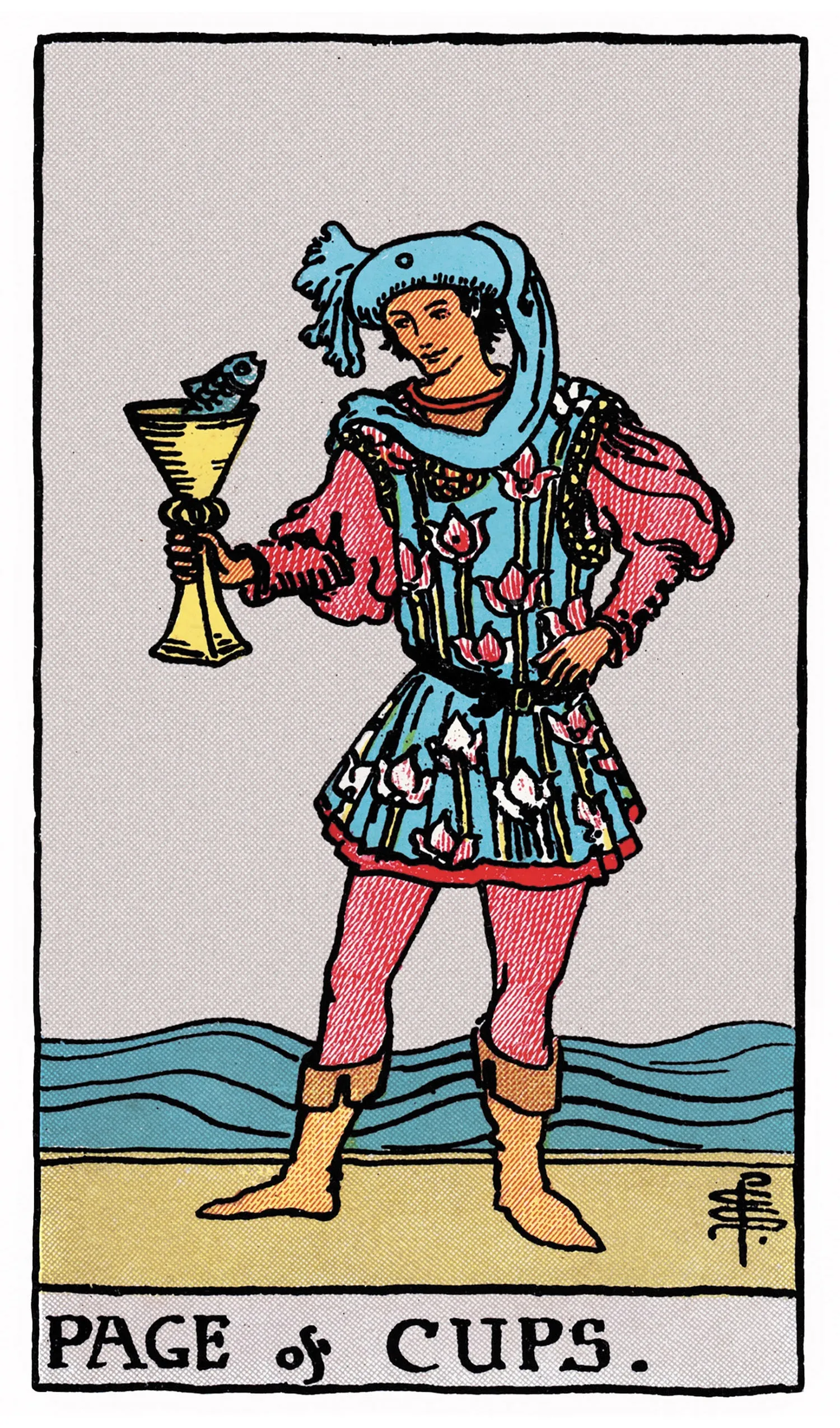
The traditional Rider–Waite–Smith Page of Cups presents a young figure holding a cup while a fish unexpectedly appears from inside it.
The scene captures the Page's central experience perfectly:
something unfamiliar appears, catches the person's attention, and asks them to respond before they fully understand what it means.
The Young Page
The youthful figure represents the beginner.
The Page has entered the world of the suit but has not mastered it.
Youth here does not have to refer to chronological age.
It represents openness, limited experience, learning, curiosity, and a developing relationship with the qualities of Cups.
The Page is not yet an authority.
Their strength lies in willingness to discover.
The Cup
The cup represents emotional experience, imagination, receptivity, relationships, intuition, and the inner world.
The Page holds the cup carefully and gives it attention.
This suggests willingness to engage with feelings and possibilities rather than reject them.
But holding the cup does not yet mean mastering everything it contains.
The Fish Emerging from the Cup
The fish is the most distinctive symbol of the card.
It represents something unexpected emerging from the emotional or imaginative world: a feeling, idea, message, intuition, creative image, or possibility that the Page did not fully anticipate.
The Page does not appear to control the fish.
They observe it.
This is important.
The card describes discovery before mastery.
Something has appeared, and now the Page has to learn what to do with it.
The fish also captures the strange logic of imagination: ideas sometimes arrive before we know how to make practical use of them.
The Sea
The water behind the Page reinforces the emotional nature of the card.
The sea is larger than the individual and remains in motion.
The Page has begun engaging with this emotional world but has not yet accumulated the experience represented by the more mature Cups court cards.
The Page's Clothing
The elaborate, youthful clothing strengthens the impression of creativity, imagination, individuality, and sensitivity.
The Page is not presented as a hardened authority figure.
There is openness and expressive potential here.
It suits someone who is still experimenting with who they are and what they can become.
The Core Symbolism of The Page of Cups
The Page of Cups shows a beginner encountering possibility.
The young figure represents inexperience and openness.
The cup represents emotional and creative potential.
The fish represents the unexpected idea, feeling, message, or opportunity that emerges from that potential.
The sea represents the much larger emotional world that still remains to be explored.
Together, the image expresses the essential lesson of the Page:
You do not need to be an expert before you begin — but beginning does not make you an expert.