Minor Arcana · Wands · Seven
The Seven of Wands Tarot Card Meaning
The Seven of Wands is a card of defending your position under pressure. Something has already been gained, chosen, established, or claimed, and now it has to be protected. The card brings resistance and confrontation, but it also shows the courage and inner resources needed to stand your ground.
Card Meanings
General Meaning
The Seven of Wands appears when a person has something worth defending. This may be a position, decision, relationship, achievement, reputation, personal boundary, belief, or right to act independently.
Unlike the Five of Wands, where people are still competing and trying to establish their positions, the Seven of Wands usually shows that a position has already been gained. The challenge now is to keep it when other people, circumstances, or competing interests begin to push back.
The card may indicate criticism, objections, competitors, interference, demands, or attempts to displace the person from what they have achieved.
At the same time, the Seven of Wands is not simply a card of being attacked. It also represents the ability to mobilize under pressure. A person may discover that they are stronger, braver, and more capable of resistance than they expected.
The card often favors the person who already holds the position, but the advantage does not remove the struggle. What has been gained may still require considerable effort to protect.
The Seven of Wands also has a strong connection with conviction. A person may be defending not only practical interests, but also a principle, belief, opinion, or decision they consider fundamentally right.
The Shadow Side of The Seven of Wands
The defensive instinct of the Seven of Wands can become excessive.
A person may become convinced that they are always right and increasingly unwilling to compromise. Every disagreement can begin to feel like an attempt to defeat or control them.
They may argue simply because they dislike yielding ground, continue battles that no longer serve a purpose, or defend pride rather than something genuinely valuable.
The card can also show exhaustion caused by having to remain strong for too long. Constant resistance consumes energy even when the person ultimately succeeds.
The Seven of Wands Reversed
Reversed, the defensive mechanism of the Seven of Wands becomes impaired, poorly directed, or excessive.
Pressure may become harder to withstand. The person can feel outnumbered, exhausted, insecure, or increasingly doubtful of their ability to maintain their position.
Confidence may weaken at exactly the moment it is needed most.
The reversed card can also show poor distribution of energy: fighting too many battles at once, defending the wrong priorities, reacting without strategy, or wasting enormous effort without strengthening the actual position.
In another manifestation, defensiveness becomes excessive. The person expects opposition everywhere and responds strongly even to minor criticism or harmless disagreement.
In both cases, the struggle to protect one's position has become inefficient, exhausting, or poorly controlled.
Core Message
Stand up for what genuinely matters. The Seven of Wands gives the courage and resources to resist pressure, but it also asks whether the position you are defending is truly worth the energy required to keep it.
The Seven of Wands as a Person
As a person, the Seven of Wands describes someone independent, strong-willed, resistant to pressure, and protective of their personal space.
They tend to defend their opinions, decisions, boundaries, and interests rather than adapting easily to what other people expect.
This person can perform surprisingly well under pressure. Opposition may activate their courage, concentration, and fighting spirit rather than immediately weakening them.
They often believe strongly in their own position and may have difficulty backing down once they have decided that they are right.
This can make them courageous and principled, but also stubborn, argumentative, or difficult to persuade.
They may be especially sensitive to attempts to control them and can instinctively resist anything that feels like intrusion.
The Seven of Wands as Actions
The Seven of Wands acts by resisting, defending, objecting, confronting, and refusing to surrender ground.
A person represented by this card may:
- defend a decision;
- refuse pressure;
- argue their position;
- protect personal boundaries;
- challenge criticism;
- compete for something;
- defend a project or reputation;
- reject interference;
- prove their competence;
- insist on their right to act independently;
- continue despite opposition.
These are active rather than passive actions.
The card can also show someone deliberately mobilizing themselves because circumstances demand courage.
The Seven of Wands in Love and Relationships
In relationships, the Seven of Wands often introduces defensiveness, resistance, or the need to protect personal territory.
In an existing relationship, one or both partners may feel they have to defend the connection from outside interference, competing interests, family pressure, rivals, or difficult circumstances.
It can also show recurring tension around independence and boundaries. One person may resist being controlled, pushed, or expected to surrender too much personal freedom.
However, the Seven of Wands does not always mean fighting for a relationship.
It can just as easily show someone fighting against closeness itself.
A person may keep potential partners at a distance, reject attempts at emotional intimacy, defend their single status, or interpret another person's desire for closeness as intrusion.
In this form, the card describes someone actively protecting themselves from becoming too involved.
The Seven of Wands is therefore not naturally a soft or relaxed relationship card. A bond may be worth defending, but the emotional atmosphere usually contains tension, resistance, or guardedness.
The Seven of Wands as Thoughts
In thoughts, the Seven of Wands shows a defensive mental position.
The person may be thinking:
“I need to protect my position.”
“I cannot let them push me.”
“I have to stand my ground.”
They may be evaluating threats, rivals, criticism, objections, or possible attempts to influence them.
If the question concerns a developing relationship, they may also be thinking about how to preserve independence and prevent the other person from getting too close too quickly.
Their attention is focused more on maintaining their position than on emotional surrender.
The Seven of Wands as Feelings
As feelings, the Seven of Wands is more protective and reactive than tender.
There can be attraction, attachment, or genuine interest, but the card itself does not strongly describe emotional softness or effortless intimacy.
The person may feel that the connection is important enough to defend.
At the same time, they can feel guarded, tense, irritated, territorial, or protective of their independence.
In some cases, the strongest emotional reaction is not a desire to move closer but a desire to preserve distance and avoid feeling vulnerable.
The Seven of Wands as Intentions
As intentions, the Seven of Wands wants to maintain the current position.
The person intends to protect their interests, preserve independence, resist pressure, defend the relationship if they value it, or prevent someone else from changing the terms of the connection.
If the card describes someone who does not want greater intimacy, their intention may be quite clear: to maintain distance and prevent the relationship from becoming closer than they are comfortable with.
This is a determined intention, but not necessarily a peaceful or romantic one.
The Seven of Wands as an Outcome
As an outcome, the Seven of Wands shows that the situation remains contested.
A position can be maintained, but maintaining it requires effort. There may still be opposition, competition, criticism, or pressure even after an important stage has been reached.
This is not a card of relaxed victory.
The person may technically get what they wanted and then discover that they still have to defend it.
The card therefore can indicate a favorable result in practical terms while still bringing little satisfaction, peace, or enjoyment.
The Seven of Wands in Career and Work
In career questions, the Seven of Wands strongly relates to competition, professional defense, and situations in which competence has to be demonstrated publicly.
It can show:
- defending your role or authority;
- competing for a position;
- responding to professional criticism;
- protecting a project or idea;
- proving your competence;
- defending a reputation;
- maintaining market position;
- dealing with competitors;
- negotiating under pressure;
- presenting or defending your work;
- examinations or professional assessments;
- competitive interviews;
- defending a thesis, project, proposal, or professional decision;
- public debate or situations where your expertise is challenged.
The card is especially relevant when success depends not only on ability but on the willingness to stand behind your work and defend it under questioning.
It can be a strong card for someone who needs to mobilize quickly in a demanding professional environment.
However, the situation may still be tiring. The Seven of Wands can bring achievement without comfort: a position is defended, but only through considerable effort.
The Seven of Wands in Money and Finances
Financially, the Seven of Wands is more about protecting resources than easily increasing them.
There may be pressure on money, competing financial demands, negotiations, disputes, unexpected expenses, or a need to defend what has already been earned.
The card can also describe competition for income, customers, contracts, or commercial opportunities.
In business, it may show having to defend market position or compete aggressively to maintain existing revenue.
However, the Seven of Wands does not independently guarantee profit or material prosperity.
Its financial strength lies primarily in resistance: preventing losses, protecting interests, negotiating, and refusing to give up a position too easily.
The Seven of Wands in Health
Within the Taronika Tarot health system, the upright Seven of Wands represents strong resistance and the ability to keep fighting even when the body's underlying defenses may be vulnerable.
It may also point symbolically to a health issue that is not immediately obvious or that creates concern before its nature is fully understood. The card is traditionally associated in this system with sensitivity around blood pressure.
Tarot should not be used as a substitute for medical diagnosis or treatment.
The Seven of Wands Timing — When Will It Happen?
The Seven of Wands is a relatively fast card.
Events usually develop quickly once the pressure, confrontation, or need to act has already appeared.
Key Timing Correspondence
Within approximately six weeks.
The card generally indicates fast development rather than a long delay.
The Seven of Wands as an Event
As an event, the Seven of Wands can represent a challenge to something that already exists.
Possible manifestations include:
- having to defend a decision;
- facing criticism or objections;
- direct competition;
- someone challenging your authority or position;
- defending personal boundaries;
- protecting a project, relationship, possession, or reputation;
- being required to demonstrate competence;
- public questioning or evaluation;
- confronting outside interference;
- being forced to prove that you deserve to remain where you are.
The defining feature is not simply conflict.
It is conflict over a position that has already been established.
The Seven of Wands as Card of the Day
Today may require you to protect your time, boundaries, decision, opinion, or position.
Someone may question you, pressure you, compete with you, or expect you to give way.
You may discover that you are more capable of handling the challenge than you initially expected.
Do not surrender simply because resistance is uncomfortable, but do not waste energy trying to win every argument.
The Seven of Wands as Advice
Stand your ground.
Protect what you have already achieved and do not abandon an important position merely because other people disagree with you.
Trust your ability to handle pressure.
You may have more courage, skill, or leverage than the situation initially makes you feel.
Defend your boundaries, decision, work, beliefs, interests, or right to act independently when they genuinely matter.
At the same time, choose your battles intelligently. Strength is not demonstrated by fighting everyone.
The Seven of Wands Reversed as Advice
Recognize where constant resistance is draining your resources.
Do not try to fight every person, criticism, objection, or problem at once.
Regain confidence, identify the position that genuinely needs protection, and stop wasting energy on battles that have little importance.
If you are already exhausted, continuing to defend everything in exactly the same way may only weaken you further.
The Seven of Wands as a Warning
The Seven of Wands warns against turning resistance into a permanent way of life.
Strong conviction can gradually become stubborn certainty that only your position is correct.
If you expect hostility everywhere, you may begin creating conflict even where cooperation or compromise was possible.
The card also warns that defending a position indefinitely is expensive. Energy, time, relationships, and opportunities can all be consumed by a battle that never really ends.
Make sure you are protecting something genuinely valuable rather than fighting simply because you cannot tolerate yielding ground.
The Seven of Wands — Yes or No
Upright: Yes, but it will bring little joy
The answer is yes, but achieving or maintaining the desired result requires resistance, effort, and dealing with pressure.
You may get what you want, yet the process and the result are unlikely to feel easy, pleasant, or particularly satisfying.
Reversed: No, and it will be exhausting
The answer is no.
The situation is likely to demand too much resistance and consume considerable energy without producing the desired result.
Continuing to push can become extremely exhausting.
The Seven of Wands Symbolism
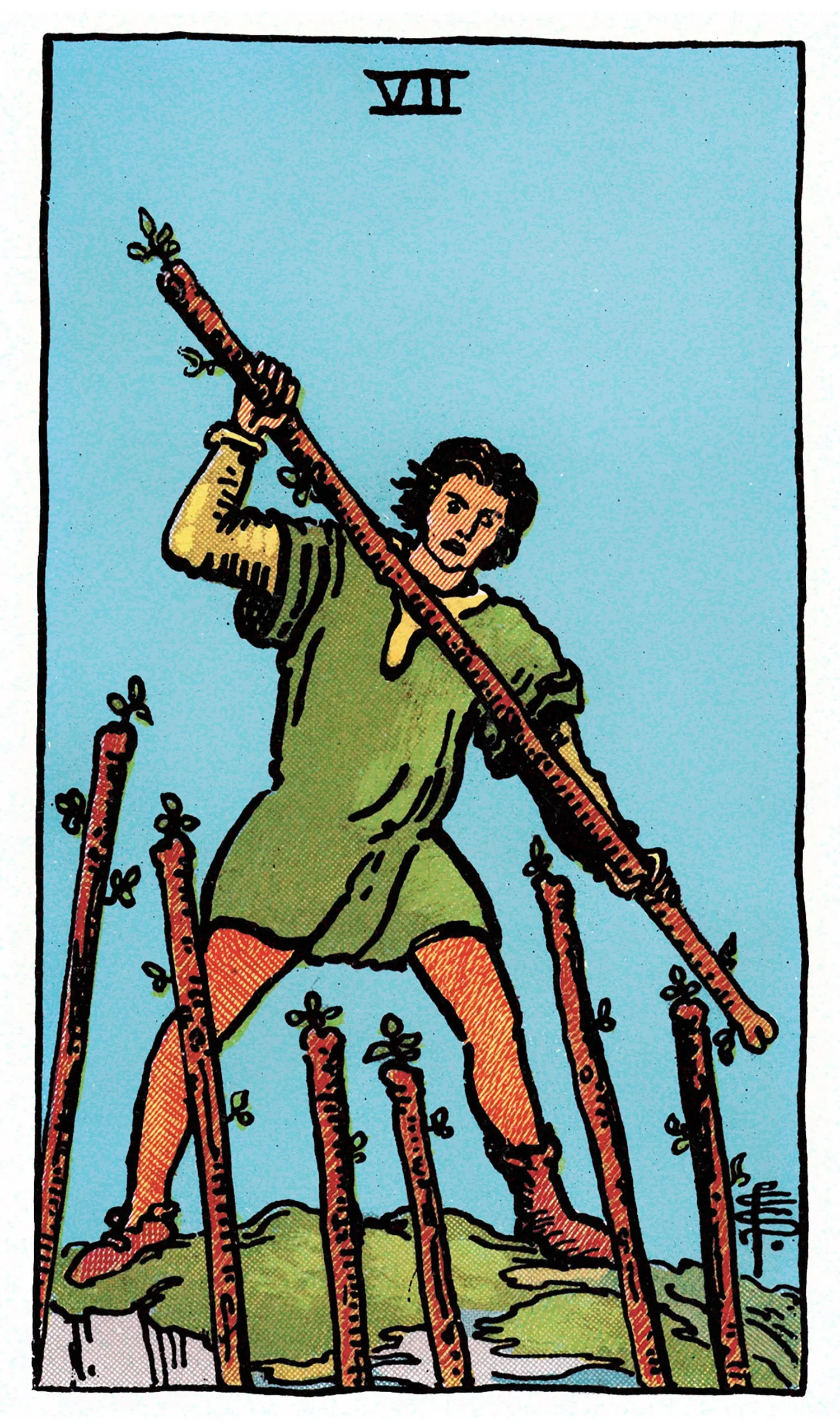
The Rider–Waite–Smith image shows a solitary figure standing on higher ground while six wands rise toward him from below.
The visual structure immediately establishes the main dynamic of the card: one position is being challenged by several opposing forces.
The Higher Ground
The figure stands above the opposing wands.
This suggests that he already possesses a position or advantage.
He is not fighting to enter the territory — he is fighting to remain there.
The higher ground therefore symbolizes both advantage and responsibility. Having a stronger position does not remove the need to defend it.
The Six Opposing Wands
The six wands rising from below represent pressure coming from outside.
They can symbolize competitors, criticism, demands, objections, conflicting interests, or several problems appearing at once.
Their number reinforces the feeling that the individual is facing more than one source of resistance.
The Raised Wand
The central figure holds his own wand across his body in an active defensive posture.
He is not passive and he is not retreating.
The wand becomes a symbol of willpower, courage, and conviction actively used to preserve territory, independence, or personal authority.
The Uneven Footing
The figure's stance appears unstable, and the traditional image is often noted for its mismatched footwear.
This adds an important nuance to the card: a person may have an advantage without feeling completely prepared or comfortable.
The Seven of Wands does not require perfect conditions.
It often describes having to respond immediately with whatever resources are available and discovering strength through the act of resistance itself.
The Core Symbolism of The Seven of Wands
The image combines advantage, pressure, and active resistance.
The figure occupies the higher position, but six opposing forces are still confronting him.
This is the essence of the Seven of Wands: having something worth defending does not mean being allowed to keep it without resistance.
The card symbolizes the moment when achievement turns into responsibility — and when a person must use courage, conviction, and personal strength to hold their ground without allowing the struggle itself to consume them.