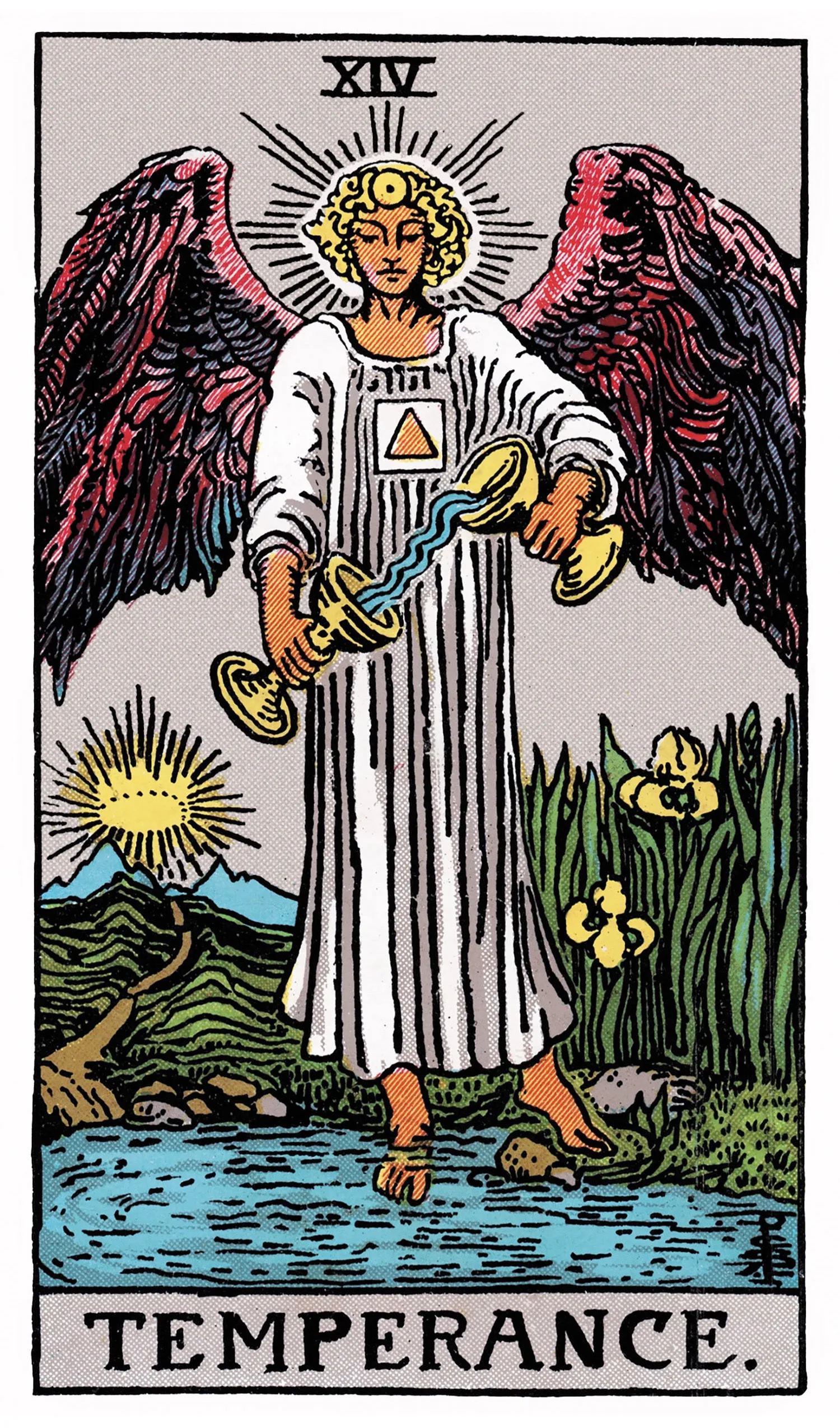
Major Arcana · Card XIV
The Temperance Tarot Card Meaning
Temperance is the card of measure, boundaries, proportion, patience, and the ability to bring different elements into a workable balance. It regulates rather than forces, combines rather than divides, and allows a situation to improve gradually until it reaches a more stable state. Its strength is harmony and sustainable progress, although its slow, measured nature can sometimes feel uneventful or even boring.
Card Meanings
General Meaning
Temperance represents the ability to find the right proportion and maintain it over time.
This is not merely passive peace. Something is being continually adjusted, combined, moderated, restrained, or brought back within healthy limits. The card asks how much is enough, where the boundary lies, what can be successfully combined, and what must be kept within a particular measure.
Temperance is naturally slow. It rarely describes a sudden breakthrough, radical transformation, or dramatic leap forward. Instead, it shows a process improving gradually until the different parts begin to function together.
This makes Temperance especially favorable when a situation has previously been unstable, difficult, conflicted, or poorly organized. It suggests that the problem can be brought under control and that circumstances can gradually settle into a more harmonious and workable state.
The result may not be spectacular, but it is real. Things become calmer, more manageable, and more sustainable.
Temperance can also represent integration: two different approaches, people, needs, or circumstances can gradually be combined into something that works better than either extreme on its own.
At the same time, the card can describe a period in which very little changes externally. Everything may be reasonably fine, but progress is so gradual that life begins to feel repetitive, predictable, or dull.
The Shadow Side of Temperance
The difficult side of Temperance appears when patience becomes excessive and moderation becomes an excuse for avoiding necessary change.
A person may tolerate too much, continually adapt to an uncomfortable situation, or remain within familiar limits long after those limits have become restrictive.
The desire to preserve harmony can also create excessive caution. Someone may become afraid of conflict, strong emotion, decisive action, or anything that could disturb the existing balance.
Temperance can therefore describe stagnation hidden inside stability: nothing is collapsing, but nothing meaningful is developing either.
Its shadow is not simply imbalance. It can also be maintaining balance at too high a personal cost.
Temperance Reversed
Temperance reversed shows the same need for measure, boundaries, regulation, and integration, but these principles are functioning poorly.
A person may struggle to recognize the correct proportion, tolerate too much, cross boundaries, overdo something, or continually attempt to correct a situation without ever finding a stable balance.
Different elements may still be capable of working together, but they are being combined badly or in the wrong proportions.
In other cases, the person is trying so hard to preserve harmony that the process itself becomes exhausting. They repeatedly adjust, compensate, compromise, and restore balance without addressing the underlying cause of the instability.
Temperance reversed is therefore not the simple opposite of harmony. It is harmony that has become difficult to maintain, poorly calibrated, or increasingly unsustainable.
Core Message
Find the right measure.
Temperance shows that progress is possible when you respect limits, avoid extremes, combine different elements intelligently, and give the process enough time to settle.
Its result is rarely dramatic, but what is achieved can be stable and sustainable.
Temperance as a Person
A Temperance person is usually calm, patient, reasonable, and self-controlled.
They tend to understand limits well and often have a natural ability to adjust their behavior according to the situation. They do not usually react impulsively and prefer to reduce tension rather than intensify it.
This person often knows how to compromise without immediately losing their own position. They can combine different opinions, temperaments, or responsibilities and create a workable middle ground.
They are usually comfortable with gradual progress. They do not need everything to happen immediately and may have considerably more patience than the people around them.
At their best, they are mature, diplomatic, emotionally balanced, and easy to cooperate with.
However, the same qualities can make them excessively tolerant or slow to change. They may remain in situations for a very long time simply because they can adapt to them.
They can also seem predictable or even somewhat boring to people who need constant excitement or emotional intensity.
Temperance as Actions
Temperance acts gradually and deliberately.
The person does not usually rush, force, confront, or make abrupt decisions. They observe what is happening, reduce extremes, make small corrections, negotiate, compromise, and allow the situation to develop at a manageable pace.
Their actions can involve reconciling people, restoring communication, combining different approaches, adjusting plans, or gradually bringing a difficult situation back under control.
Temperance can also show someone deliberately avoiding unnecessary movement because they believe the current situation should be preserved rather than radically changed.
Temperance in Love and Relationships
Temperance is a very good card for partnership.
It describes mature, harmonious, calm relationships in which two people are capable of living together, respecting each other's boundaries, adapting to differences, and maintaining a healthy balance between their individual needs and the relationship itself.
The card often indicates genuine compatibility. The partners do not have to be identical; in fact, Temperance can show two quite different people who gradually learn how to combine their temperaments and create a relationship that works for both of them.
It is also an important card of reconciliation and restoration. If there has been tension, conflict, emotional distance, or instability, Temperance can show that the relationship gradually becomes calmer and more harmonious again.
This is not usually a card of dramatic passion or emotional extremes. Its strength lies elsewhere: steadiness, mutual adjustment, maturity, patience, and the ability to preserve the relationship over time.
In some contexts the relationship may feel too predictable or lack excitement, but this should be treated as a possible secondary manifestation rather than the card's main meaning.
Temperance as Thoughts
The person is thinking calmly and cautiously about how the situation should be handled.
They are unlikely to be thinking in extremes. Instead, they are considering what is reasonable, how much involvement is appropriate, where the boundaries are, and whether different needs or circumstances can be reconciled.
Their internal logic is often: do not rush, do not make things worse, find the right approach, allow time, and keep the situation manageable.
They may also be thinking about how to restore peace after tension or how to combine two different positions without forcing either one completely.
Temperance as Feelings
Temperance shows calm, stable, mature feelings.
There may be affection, warmth, trust, tenderness, emotional comfort, and a sense that the other person fits naturally into one's life.
These feelings are usually easier to sustain than dramatic emotional highs because they are not dependent on constant excitement or intensity.
Temperance can indicate a genuine emotional bond that has become balanced and peaceful over time.
However, it is not inherently a card of overwhelming passion. The feelings may be sincere and strong enough for a good relationship while still remaining emotionally measured.
Temperance as Intentions
The intention is usually to preserve, improve, reconcile, or gradually develop the relationship.
The person wants to find a workable format rather than force a dramatic change. They may want to restore harmony, build trust slowly, maintain contact, or allow the relationship to mature naturally.
Temperance can indicate serious long-term intentions because the person is interested in something sustainable rather than temporary emotional intensity.
At the same time, it does not suggest urgency. The person may be willing to move forward, but only at a pace they consider safe and reasonable.
Temperance as an Outcome
Temperance as an outcome gives a result, but the result develops gradually.
If the situation has been difficult, unstable, conflicted, chaotic, or emotionally intense, the card is a strong indication that circumstances can stabilize.
Things begin to settle. Extremes diminish, different factors become easier to manage, and the situation gradually reaches a more harmonious and workable state.
The essential logic is:
slowly, but things are moving in the right direction.
Temperance does not usually promise a spectacular triumph, sudden success, or dramatic breakthrough. Its result is quieter: normalization, stabilization, reconciliation, recovery of balance, or the creation of conditions that can actually be sustained.
In a favorable context, this is a clearly positive result.
If the question specifically asks whether something will change radically or very quickly, however, Temperance may indicate that the change will be far more gradual than expected.
Temperance in Career and Work
Temperance in career matters favors steady progress, cooperation, good organization, and the ability to combine different skills or responsibilities effectively.
It can show a stable professional environment in which development takes place gradually rather than through sudden promotion or aggressive advancement.
This card is especially strong for work that requires coordination, mediation, patience, process management, collaboration, or the integration of different people and systems.
If there has been professional instability or conflict, Temperance can indicate that the situation gradually improves and returns to a workable rhythm.
It can also describe a job that is stable and reasonably comfortable but lacks excitement. The work may function perfectly well while feeling repetitive or slow-moving.
Temperance is not a card of rapid career breakthrough, but it can absolutely show sustainable progress and eventual improvement.
Temperance in Money and Finances
Temperance in finances emphasizes measure, sensible distribution, and financial stability.
It favors controlled spending, realistic budgeting, keeping income and expenses in proportion, and avoiding unnecessary financial extremes.
The card does not normally indicate sudden wealth or a large financial breakthrough. Instead, it suggests that resources can be managed successfully and that the financial situation can gradually become more stable.
There may not be an abundance of money, but there can be enough when resources are used carefully.
If finances have previously been unstable, Temperance can show gradual normalization.
Temperance in Health
Within the Tarovera Tarot health system, upright Temperance is associated with a body functioning smoothly and in balance — an organism working “like clockwork.”
It is considered a very favorable health card and can also indicate the healthy development of a pregnancy.
These are Tarot-system associations rather than medical assessments.
Tarot should not be used as a substitute for medical diagnosis or treatment.
Temperance Timing — When Will It Happen?
Temperance is a slow card.
When the question is “When?”, its calendar correspondence is:
End of November / beginning of December.
When the question is “How long from now?”, Temperance usually means that the event is still quite far away.
The process tends to take a long time, and Temperance is not especially precise when used to determine an exact elapsed period.
A practical approximate timeframe is:
Up to a year.
The important message is that the result is not immediate. Temperance develops gradually and usually requires patience.
Key Timing Correspondence
When: End of November / beginning of December
How long: Very slowly; approximately up to a year, with the exact timeframe difficult to determine
Temperance as an Event
Temperance as an Event often describes stabilization, reconciliation, normalization, or the gradual restoration of order.
A conflict may calm down. Two sides may reach an agreement. A disrupted routine may become manageable again. Different elements may finally begin to work together successfully.
It can also show a period of gradual improvement in which nothing dramatic happens on one particular day, but the overall situation steadily becomes better.
In quieter contexts, Temperance may simply describe an uneventful period when circumstances remain stable and within familiar limits.
Temperance as Card of the Day
Temperance suggests a calm, measured day.
Things may move more slowly than expected, and trying to force them is unlikely to help.
The day is well suited to restoring order, adjusting plans, resolving minor disagreements, combining different tasks, moderating excesses, and bringing something back into balance.
If there has recently been tension, today may feel noticeably calmer.
It may also simply be a stable and relatively uneventful day — peaceful, predictable, and perhaps slightly boring.
Temperance as Advice
Temperance advises you to know the measure.
Do not rush the situation or push it beyond what it can realistically sustain.
Reduce extremes, respect boundaries, regulate your pace, and make gradual adjustments rather than trying to change everything at once.
If different people, needs, or approaches are involved, look for a way to combine them instead of insisting that only one side can be right.
Patience is important, especially when the situation is already improving slowly.
However, patience should remain conscious and purposeful rather than becoming passive endurance.
Temperance Reversed as Advice
Look carefully at where your sense of measure has already become distorted.
You may be tolerating too much, compromising too much, crossing your own boundaries, or constantly adjusting yourself to keep an unstable situation functioning.
Do not continue restoring the same balance indefinitely if the structure itself is no longer workable.
Temperance as a Warning
Temperance warns against losing the correct measure.
The risk may come from doing too much, giving too much, waiting too long, ignoring boundaries, or repeatedly compensating for an imbalance rather than correcting its cause.
But there is another important danger: excessive patience.
A person can become so committed to stability and harmony that they continue tolerating a stagnant situation simply because nothing catastrophic is happening.
Not every stable situation is necessarily a good one.
Sometimes the ability to adapt allows a person to remain somewhere long after change has become necessary.
Temperance — Yes or No
Upright: Yes, but without rushing
Temperance gives a yes, but the result develops gradually.
The situation can move in the desired direction, especially if it is allowed enough time and is not forced beyond its natural pace.
Patience, moderation, and gradual adjustment are part of the positive answer.
Reversed: No
Temperance reversed gives a no.
The necessary balance, measure, boundaries, or conditions are not functioning well enough for the situation to develop as intended.
Temperance Symbolism
The Rider–Waite–Smith image of Temperance strongly reinforces the card's central themes of measure, integration, boundaries, regulation, and gradual progress.
The Two Cups
The angel pours liquid between two cups.
This is one of the clearest images of Temperance's central mechanism: balance is not static. It is created and maintained through continual adjustment.
The two cups also symbolize the ability to combine different elements in the correct proportion.
Temperance does not require everything to become identical. It creates a relationship between different components that allows them to function together.
One Foot on Land and One Foot in Water
One foot stands on solid ground while the other touches water.
The figure remains connected to two different states without becoming completely absorbed by either one.
This reflects Temperance's ability to move between different needs, realities, emotions, or approaches while maintaining a stable center.
It also reinforces the importance of boundaries: integration does not require the loss of distinction.
The Angel
The angel's posture is calm, controlled, and deliberate.
Nothing in the image suggests urgency.
The work is precise and continuous, which reflects the naturally slow rhythm of Temperance. Progress happens because the correct process is maintained long enough.
The Triangle Within the Square
The symbol on the angel's chest combines different geometric forms within a defined structure.
It supports the card's broader principle of integration: different forces can coexist successfully when placed within the correct limits and proportions.
The Path and Distant Light
A path stretches into the distance toward a bright point on the horizon.
There is a direction and there is a destination, but neither suggests immediate arrival.
The symbolism reflects the practical meaning of Temperance very well: progress exists, but it develops gradually.
This also supports the card's slow Timing meaning.
The Irises
The flowers beside the water suggest growth that develops naturally when the surrounding conditions are appropriate.
Temperance does not force growth.
It creates and maintains the conditions in which development can happen at its own sustainable pace.
The Core Symbolism of Temperance
Temperance is an image of active harmony.
Its balance is not accidental and not effortless. The figure continually combines, regulates, and adjusts different elements while remaining within clear boundaries.
This is why Temperance can produce a positive result after instability: disorder is gradually brought into proportion until the situation becomes workable again.
Its power lies in measure, patience, integration, and sustainability.
Its limitation comes from exactly the same source: when preserving balance becomes more important than movement, stability can slowly turn into monotony or stagnation.