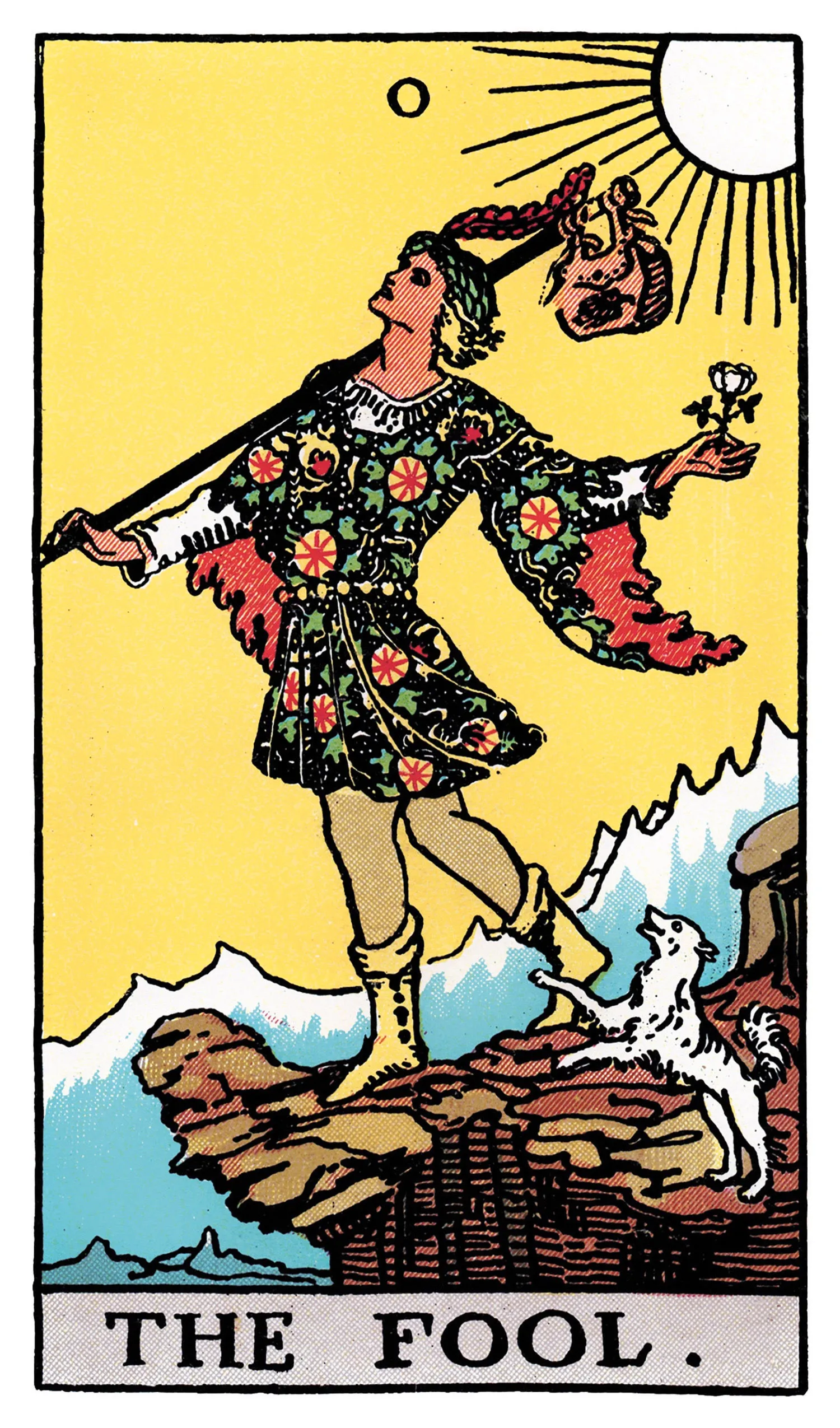
Major Arcana · Card 0
The Fool Tarot Card Meaning
The Fool represents new beginnings, freedom, spontaneity, risk, and the courage to step into the unknown. It brings opportunity and movement, but it also carries uncertainty: the path ahead has not yet taken shape, and the consequences cannot be fully predicted.
Card Meanings
General Meaning
The Fool represents freedom, new experience, and the moment of stepping beyond what is already known.
It appears when the old rules, familiar circumstances, or previous way of living no longer fully determine the path ahead, while the new direction has not yet taken a clear form.
This is what makes The Fool both promising and uncertain.
The card can bring an opportunity to start again, try something completely different, choose an independent path, or allow yourself to live with greater authenticity. At the same time, leaving the familiar behind also means losing some of the certainty and stability that came with it.
The Fool moves forward without having complete information about what lies ahead.
This is one of the central ideas of the card.
The Fool is strongly connected with individuality and inner freedom. It describes the ability to make choices without building your entire life around other people's expectations, social roles, or the fear of appearing different.
At its best, this energy brings openness, creativity, flexibility, curiosity, and the courage to change direction when life requires it.
But freedom does not automatically mean maturity.
The Fool may be brave partly because he does not yet understand every risk involved. The line between freedom and irresponsibility, originality and foolishness, trust and carelessness can therefore be very thin.
The Shadow Side of The Fool
Even upright, The Fool is not an entirely positive card.
Its difficult side appears when freedom turns into a refusal to accept responsibility, or when spontaneity becomes an inability to consider consequences.
The Fool may indicate:
- naivety;
- carelessness;
- lack of experience;
- underestimating risks;
- acting before understanding the situation;
- poor planning;
- inconsistency;
- avoiding commitments;
- chaotic behavior;
- living only for the present moment without considering what may follow.
A person may have enormous freedom of choice while having very little understanding of what to do with that freedom.
This is why The Fool should not automatically be interpreted as a fortunate new beginning. The card shows an opening and a possibility, but the quality of the outcome depends on the question, the position of the card, and the surrounding cards.
The Fool Reversed
The Fool reversed does not become the opposite of the upright card.
Its fundamental energy remains the same, but it becomes more difficult, uncontrolled, exaggerated, or damaging.
Uncertainty becomes more dangerous. Spontaneity turns into thoughtlessness. Freedom becomes irresponsibility. Risk becomes recklessness. A lack of experience begins to produce tangible consequences.
The Fool reversed may indicate:
- a poorly considered decision;
- serious misunderstanding of the situation;
- irresponsible behavior;
- recklessness;
- extreme carelessness;
- acting without considering consequences;
- chaos and inconsistency;
- repeatedly starting things without finishing them;
- unpleasant unexpected circumstances;
- excessive or unjustified risk.
If the upright Fool says:
“I don't know exactly what lies ahead, but I am willing to try,”
the reversed Fool is closer to:
“I don't know what lies ahead, and I am not even taking that uncertainty into account.”
Core Message
The Fool is the freedom to step into the unknown.
At its best:
new beginnings + openness + individuality + willingness to take a risk
At its most difficult:
inexperience + poor judgment + irresponsibility + chaos
The central question of The Fool is:
Am I free enough to choose my own path — and aware enough not to mistake freedom for recklessness?
The Fool as a Person
The Fool describes a person who is freedom-loving, independent, and not particularly inclined to conform to other people's expectations. They may be vibrant, unconventional, spontaneous, open to new experiences, and willing to follow their own path even when their choices seem strange to others.
This person often acts spontaneously and prefers to try something first and deal with the consequences later. They may find it difficult to live within rigid boundaries, follow a predetermined plan, or remain for long in situations that restrict their freedom.
At the same time, The Fool can point to inexperience, lack of seriousness, and irresponsibility. The person may underestimate risks, fail to think through the consequences of their actions, or treat important matters more lightly than the situation requires.
This does not necessarily mean that they are foolish or unintelligent. On the contrary, they may be original, talented, and capable of thinking outside the box. Their weakness lies not in a lack of ability, but in a lack of caution, experience, and willingness to take responsibility.
The Fool as Actions
As actions, The Fool represents spontaneous behavior without a carefully developed plan.
A person may suddenly reach out, send a message, suggest meeting, restart communication, or make a move that was not expected.
Their actions are often driven by a current impulse, curiosity, interest, or the desire to experience something new.
However, The Fool does not show a consistent long-term strategy.
Even if the person takes the first step, this does not necessarily mean they have already decided what they want to do afterward.
Their attitude is closer to:
“I’ll do it now and see what happens next.”
For this reason, The Fool is strong when describing a first move, an experiment, a spontaneous initiative, or an unexpected action — but much weaker when it comes to consistent follow-through and long-term planning.
In relationship questions, a person may actively re-enter communication or make a clear move toward you while still wanting to preserve their freedom and without seeing that action as a promise of future commitment.
The Fool in Love and Relationships
In love and relationships, The Fool primarily represents freedom from commitment and the absence of a predetermined relationship structure.
It can point to a new connection, light-hearted communication, flirting, spontaneous attraction, or a relationship that has not yet been clearly defined. Two people may enjoy each other’s company and feel curious about where things could go, but the relationship itself has not yet developed a stable or serious framework.
The Fool does not necessarily mean there is no attraction or interest. However, it often shows that one person — or the relationship itself — is not yet ready for major responsibility, stability, or long-term promises.
In an established relationship, The Fool can indicate a need for more freedom, freshness, spontaneity, or a break from routine. Sometimes the relationship genuinely needs new experiences and a lighter atmosphere.
In a more difficult context, however, the same energy can appear as lack of seriousness, avoidance of commitment, inconsistency, or unwillingness to consider the partner’s needs.
The Fool on its own therefore does not promise either a breakup or a serious long-term union.
Its main message is:
the relationship exists in a space of freedom and uncertainty, and its future form has not yet been established.
The Fool as Thoughts
As thoughts, The Fool usually shows that a person is not taking the situation too seriously and is not inclined to analyze it deeply.
They may be interested or curious, but they are unlikely to be making elaborate plans or trying to decide in advance exactly where the situation should lead. Their thoughts are focused more on the present moment: seeing what happens, trying something out, staying in contact, gaining a new experience, and responding to circumstances as they unfold.
The Fool can also indicate that the person has not yet formed a definite opinion or decision. They may not know exactly what they want, may not have all the necessary information, or may simply see no reason to make a final decision yet.
This is therefore not a card of careful strategy or long-term planning.
Its mindset is closer to:
“Let's see what happens.”
The Fool as Feelings
The Fool is not a card of deep or fully developed feelings.
In a feelings position, it points more to openness toward another person, ease of interaction, curiosity, and a willingness to stay in contact without immediately defining what the connection means.
The person may feel attraction, interest, curiosity, or simply enjoy being around you, but The Fool on its own does not indicate deep love, strong emotional attachment, or serious emotional involvement.
They are unlikely to spend much time analyzing their own emotions and may not even feel a need to define them. It is easier for them to simply enjoy the connection and see where it leads.
For this reason, The Fool as feelings is more often about emotional openness without depth or commitment than about a serious, established feeling.
The Fool as Intentions
As intentions, The Fool usually points to a lack of a clear long-term plan.
The person may want to continue communicating, explore the connection, get to know someone better, or simply see how the situation develops. They are open to the experience, but they are not yet trying to define what its final form should be.
In relationship questions, The Fool rarely suggests an immediate intention to move toward serious commitment. There is much more emphasis on communication, flirting, novelty, freedom, and allowing events to develop naturally.
This does not necessarily mean that the person intends to deceive or use someone. Often, they genuinely do not have a long-term plan and may not yet know what they will want later.
The core message of The Fool in this position is:
“I want to see where this goes, but I'm not promising anything yet.”
The Fool as an Outcome
As an outcome, The Fool represents a transition into a new stage whose final form has not yet been determined.
The old situation may end, lose its previous structure, or cease to function in the same way. In its place, a new direction, a fresh opportunity, or unexpected circumstances may appear and change the course of events.
However, The Fool is not a card of stable completion.
When it appears as the final outcome, the situation often does not arrive at a fixed conclusion. Instead, the ending of one phase becomes the beginning of another.
The Fool as an outcome may therefore indicate:
- a new chapter;
- a fresh opportunity;
- freedom from the previous situation;
- an unexpected turn of events;
- the chance to take a different path;
- uncertainty about what happens next.
The surrounding cards are especially important here. They can show whether this new direction is a promising opportunity or an unexpected development that creates additional difficulties.
The Fool as an outcome often says:
“The old situation will no longer remain as it was, but what comes next has not yet fully taken shape.”
The Fool in Career and Work
In career and work questions, The Fool primarily points to a new stage, a new experience, or a move beyond the familiar professional path.
This may be the beginning of a new job, a change of direction, the launch of a project, entering an unfamiliar profession, or deciding to try something you have never done before. The card captures the energy of a fresh start, when possibilities are opening up but the long-term direction is not yet fully clear.
The Fool is favorable in situations that require openness, creativity, flexibility, and a willingness to experiment. It is much less comfortable in matters that demand strict planning, discipline, calculation, and predictability.
For this reason, in a career forecast The Fool may show an interesting new opportunity, but it does not by itself confirm stability or long-term success. The person still needs to discover whether the new direction is genuinely viable.
If The Fool describes an employee, colleague, or business partner, the meaning becomes more cautious. This person may be talented, proactive, creative, and capable of unconventional thinking, but also inexperienced, disorganized, or insufficiently responsible. They may struggle with rigid rules, repetitive tasks, or consistently following a project through to completion.
The Fool in Money and Finances
In financial matters, The Fool often points to an immature, careless, or overly casual attitude toward money.
A person may act impulsively, spend according to the mood of the moment, underestimate future expenses, or invest in an idea without researching it carefully enough.
The card can also accompany the beginning of a new financial stage: earning money in a new field for the first time, developing a new source of income, launching an experimental project, or putting money into an unfamiliar opportunity.
However, the existence of a new opportunity does not mean that it will automatically be profitable.
The main weakness of The Fool in finances is a lack of calculation and foresight. It can be easy to mistake optimism for certainty, risk for opportunity, or a spontaneous decision for a sound financial strategy.
The card may indicate:
- impulsive spending;
- unexpected or unplanned expenses;
- poorly considered investments;
- lack of financial experience;
- an overly casual attitude toward budgeting;
- a new source of income with no guarantee of success;
- risky financial decisions.
When asking about major investments, purchases, or financial commitments, The Fool calls for additional evaluation. It can show a possibility, but it does not provide enough reason to assume that the opportunity is safe.
The Fool in Health
In health-related readings, The Fool usually points to good vitality combined with an insufficiently serious attitude toward one's health.
A person may feel generally well and, precisely because of that, ignore preventive care, symptoms, professional recommendations, or the need to seek medical attention in time.
The Fool can also be associated with conception, pregnancy, and the beginning of a new life, especially when the question and surrounding cards support this interpretation.
For an older person, The Fool may point less to physical strength and more to a tendency to underestimate existing limitations or to treat health concerns too casually.
In some tarot traditions, the card is also associated with psychological instability or unusual states of consciousness. However, The Fool by itself is not enough to make any medical conclusion or diagnosis. In a reading, it is better understood as a reason to pay closer attention to the person's psychological state and to the surrounding cards.
In questions about pregnancy, recovery, or a specific health outcome, The Fool should always be interpreted together with the question and additional cards. On its own, it does not confirm pregnancy, recovery, or any particular medical event.
The Fool Timing — When Will It Happen?
In timing questions, The Fool is associated with the spring equinox, approximately the end of March.
However, the unpredictable nature of The Fool makes exact timing difficult. This card rarely describes events that unfold according to a strict schedule. Something may happen unexpectedly, spontaneously, or when circumstances arise that could not have been predicted in advance.
So when asking “How soon?”, The Fool often gives less of a fixed date and more of a principle:
the event is likely to happen when a new opportunity suddenly appears or when circumstances unexpectedly change.
The card can indicate a sudden start, a sharp shift in the situation, or the moment when a person decides to take the first step without having complete certainty about what will follow.
Key Timing Correspondence
Period: spring equinox / late March
How the event occurs: unexpectedly, spontaneously, outside the original plan
Timing precision: low — The Fool is difficult to place within strict time limits
The Fool as an Event
On an event level, The Fool primarily represents unforeseen circumstances, an unexpected turn, or the beginning of a new stage that could not have been fully predicted in advance.
The situation may suddenly change direction. A new factor may appear, an unexpected offer may arise, or circumstances may force a person outside the familiar scenario.
The Fool by itself does not determine whether this change will be positive or difficult.
It shows the fact of the unexpected development and the break from the previous structure. The nature of that development should be judged from the surrounding cards.
With supportive cards around it, The Fool may indicate:
- a new opportunity;
- the beginning of a new life stage;
- an unexpected opening;
- freedom from previous restrictions;
- a spontaneous decision that starts a new development.
In a more difficult surrounding, the same energy may appear as:
- disrupted plans;
- unforeseen obstacles;
- chaotic developments;
- having to act without sufficient preparation;
- an unexpected situation the person was not ready for.
If elemental interactions are used in the reading, it is also useful to consider how the energy of The Fool interacts with the cards before and after it. A conflicting elemental transition may make the unexpected development much harder to handle, while a harmonious or neutral transition can make the change easier to accept and may even reveal a new opportunity.
When The Fool represents an unforeseen event, the card itself often does not tell you exactly what kind of surprise is coming. To understand whether it is positive, difficult, or neutral — and what area of life it may affect — consider the surrounding cards or draw an additional clarifying card.
The Fool as Card of the Day
As a Card of the Day, The Fool brings an element of surprise, spontaneity, or novelty.
Something may happen that was not part of the original plan: an unexpected meeting, offer, idea, change of direction, or circumstance that forces you to respond differently.
The day may offer a chance to try something new, step outside your usual routine, or approach a situation with greater openness and flexibility.
At the same time, The Fool encourages openness without abandoning common sense. Spontaneity may be useful today, but not every unexpected opportunity requires an immediate yes.
The Fool as Advice
As advice, The Fool encourages you not to be afraid of the new and to allow yourself to take the first step, even if the path ahead is not yet completely clear.
The card suggests letting go of the need to control every detail, avoiding unnecessary attachment to what has already run its course, and remaining open to unexpected opportunities. Sometimes it is impossible to receive every guarantee in advance — part of the experience only becomes available after you actually step into the situation.
The Fool also speaks about inner freedom. It asks you not to make decisions solely from fear of judgment, other people’s expectations, or familiar limitations, but to allow yourself to choose your own direction.
On a spiritual level, The Fool may advise you to trust life, fate, or a higher guidance, especially when you have already done everything within your control and the rest cannot be fully predicted.
The core advice of The Fool is:
Move toward the new. Do not be afraid to begin again. Stay open, light, and willing to change — but do not mistake trust in life for abandoning common sense.
You do not need to carry the entire weight of the past into your next chapter. Your experience remains with you even when a new stage requires you to begin almost from zero.
The Fool Reversed as Advice
The Fool reversed advises you not to take unnecessary risks or make a decision based on impulse alone.
This is not the moment to simply trust that circumstances will somehow work themselves out. Before taking the next step, stop and understand the situation, consider the possible consequences, and make sure you are not ignoring obvious risks.
The card may quite literally warn:
Do not be foolish. Do not confuse courage with recklessness, freedom with irresponsibility, or spontaneity with a complete lack of judgment.
If you do not understand the situation well, lack important information, or feel that you are acting purely on impulse, it is wiser to slow down and avoid making a poorly considered move.
The Fool as a Warning
As a warning, The Fool asks you to examine whether you are mistaking impulsiveness for freedom or lack of preparation for courage.
The card warns against:
- making a decision too quickly;
- underestimating the consequences;
- entering a situation you know too little about;
- overestimating your abilities;
- avoiding responsibility in the name of freedom;
- starting many things without finishing any of them;
- ignoring obvious risks, rules, or warning signs.
Sometimes The Fool is not warning you against the new path itself, but against the way you are entering it.
The direction may be right, but that does not mean you should move into it completely unprepared.
The central question of The Fool as a warning is:
Am I consciously choosing this risk — or do I simply not want to think about the consequences?
The Fool — Yes or No
Upright: Yes, but with uncertainty
The Fool gives a positive answer if you are willing to take a risk, step beyond what is familiar, and accept that the outcome is not yet fully determined.
This is not an absolute:
“Yes, everything will happen exactly the way you want.”
The card is closer to saying:
“Yes, the opportunity is there. Try it — but the road ahead has not yet taken shape.”
The Fool is especially supportive in questions about:
- beginning something new;
- trying a new approach;
- changing direction;
- taking the first step;
- accepting a spontaneous opportunity;
- leaving an old situation behind.
However, if the question requires a guarantee of stability, certainty, or a predictable outcome, The Fool does not provide that guarantee.
Reversed: No
When reversed, the risk becomes excessive, the circumstances more chaotic, and the decision may be made without enough understanding of the situation.
This “no” often means:
not now, not in this way, or not without further preparation.
The Fool Symbolism
The imagery of The Fool in the Rider–Waite–Smith deck reflects the central nature of the card: moving toward the unknown, freedom from previous limitations, and at the same time a limited understanding of what lies ahead.
A young traveler moves confidently forward, paying little attention to the ground beneath his feet. He stands at a great height, close to the edge of a cliff, yet his attention is directed not toward the danger but toward the open space ahead.
His image combines the two sides of The Fool:
trust in life and openness to the new on one side, and inexperience and underestimation of risk on the other.
The Cliff
The cliff is one of the most important symbols in the card.
It represents the boundary between the known and the unknown, between the previous stage of life and whatever comes next.
The Fool has already reached a point where he cannot continue in exactly the same way as before. There is no clearly marked road ahead, so the next step requires trust and a willingness to accept uncertainty.
At the same time, the cliff reminds us of risk: the freedom to move forward does not remove the possible consequences of the step.
The Staff and Bundle
The Fool travels lightly, carrying his belongings in a small bundle over his shoulder.
The bundle can symbolize experience, memories, and knowledge from the past that remain with a person even when they begin a completely new chapter.
However, this experience is not directly in front of The Fool. It exists, but it does not control every decision he makes.
This reflects an important quality of the card: the past remains part of the person, but entering a new stage requires more than repeating old patterns. It requires the willingness to gain new experience.
The staff also emphasizes movement, independence, and readiness to continue the journey.
The White Rose
The white rose symbolizes purity of intention, openness, and the state of a person before new experience has changed them.
The Fool does not yet know all the difficulties of the road ahead, which allows him to approach the world with fewer fears and expectations.
At the same time, this purity is connected with inexperience. A person may be sincere and open precisely because they have not yet encountered the consequences of their choices.
The Small Dog
The dog follows The Fool near the edge of the cliff.
It can be read as instinct, companionship, and warning at the same time. It seems to call the traveler’s attention back to the reality that he may be overlooking while absorbed in his own inspiration.
The dog therefore reflects one of the card’s central contradictions: you may move forward freely, but it is still wise to listen to the signals that warn you of danger.
The Snow-Capped Mountains
The high mountains emphasize the scale of the journey and suggest that The Fool’s path is not only practical but also inner and spiritual.
He is positioned high above the ordinary landscape and is moving toward new experience.
The mountains may represent both the heights already reached and the challenges, difficulties, and growth that still lie ahead.
The Sun
The bright sun illuminates The Fool’s path and creates a sense of vitality, clarity, and protection.
On a spiritual level, it may symbolize consciousness, life force, and a larger order that exists even when the individual does not yet know where the journey will lead.
This is where the theme of trust in life becomes especially clear: The Fool does not have a map of his future, but he is not walking in complete darkness.
The Red Feather
The red feather emphasizes vitality, inspiration, movement, and the willingness to follow an inner impulse.
It adds to the sense of lightness and motion present throughout the card.
At the same time, impulse does not always come with careful calculation. The Fool may feel the desire to move first and think about the consequences later.
The Colorful Clothing
The Fool is dressed unusually and brightly for someone beginning a difficult journey.
His appearance reflects individuality, creativity, and a lack of interest in conforming to conventional expectations.
Practicality is clearly not his highest priority. The Fool experiences life more as a space for discovery and experience than as a route that must be carefully organized in advance.
The Yellow Boots
Even The Fool’s footwear contributes to his bright and unconventional appearance.
The boots continue the themes of movement, optimism, and readiness to travel, while also reminding us that enthusiasm alone does not equal preparation.
The Core Symbolism of The Fool
Almost every element of the card returns to the same contradiction:
The Fool is free precisely because he does not yet know everything that awaits him.
That is both his strength and his weakness.
He is able to begin where another person might stop because of fear. But the same openness to the unknown also leaves him vulnerable to risks he may not yet be able to recognize.
The symbolism of The Fool therefore speaks not only about new beginnings and trust in life, but also about learning to distinguish inner freedom from recklessness.