Major Arcana · Card XVI
The Tower Tarot Card Meaning
The Tower is the card of sudden collapse, shock, disruption, and the destruction of a structure that can no longer remain as it is. Unlike gradual transformation, The Tower usually describes a sharp event: something breaks, is exposed, ends abruptly, or changes so quickly that there is little time to prepare. It can remove what was unstable or false, but the card itself does not promise that the process will be comfortable, beneficial, or easy to recover from.
Card Meanings
General Meaning
The Tower represents a structure being broken by a force strong enough to make continuation in its previous form impossible. This may be a relationship, plan, belief, job, financial arrangement, social position, living situation, or any other system that had seemed stable until the moment it failed.
The important point is not simply that something changes. The Tower describes a break in continuity. Events can accelerate suddenly, information may come to light, accumulated problems can reach a critical point, or an external event can destroy the assumptions on which the situation was built.
The card is therefore strongly associated with crisis and events. It frequently shows the moment when there is no longer enough room to postpone, negotiate around, or quietly manage a problem. Something has reached the point at which the existing structure gives way.
The Tower can eventually clear space for something different, but that is a later stage. The card itself primarily describes the collapse, shock, or forced restructuring — not the successful rebuilding that may or may not follow.
The Shadow Side of The Tower
The difficult side of The Tower appears when disruption becomes destructive for its own sake. A person may react explosively, burn bridges impulsively, provoke conflict, destroy something that might have been repaired, or create unnecessary damage because they cannot tolerate pressure.
It can also show chronic crisis: a life in which problems are repeatedly allowed to build until only an explosion forces change. Instead of making smaller corrections earlier, the person acts only when the situation becomes unbearable.
Another shadow is the belief that force is the only way to solve a problem. The Tower can become excessively confrontational, reckless, dramatic, or indifferent to collateral damage.
The Tower Reversed
Reversed, The Tower remains a card of collapse and disruption, but the destructive process becomes more difficult to manage. The damage may spread further, the crisis may have more consequences than expected, or attempts to resist an already collapsing situation may make the eventual breakdown worse.
It can indicate repeated shocks, prolonged instability, unsuccessful attempts to hold together something that has already lost its foundation, or a situation in which the initial collapse has occurred but the consequences are still unfolding.
The reversed Tower should not automatically be read as “disaster avoided.” In this system, the same Tower principle is impaired or intensified rather than reversed into its opposite.
Core Message
When The Tower appears, the existing structure cannot be assumed to continue unchanged. Something has reached a breaking point, and the safest interpretation is to take instability seriously rather than relying on the belief that everything will somehow remain as it was.
The Tower as a Person
As a person, The Tower can describe someone intense, abrupt, unpredictable, uncompromising, and capable of radically changing the atmosphere around them. They may speak or act with very little softening, especially when they believe something is false, ineffective, or no longer worth preserving.
This person can be extraordinarily decisive in a crisis. They are often capable of doing what others hesitate to do: exposing a problem, ending a failed arrangement, confronting someone directly, or demolishing an outdated structure.
At the same time, they may be difficult to live or work with because they can create instability around themselves. Their reactions may be sudden, and once they decide that something is finished, they may destroy the connection rather than gradually withdraw from it.
The Tower as Actions
As actions, The Tower is direct and sudden. A person may confront, expose, break off contact, quit, cancel, destroy an arrangement, reveal information, force an issue into the open, or take an action that immediately changes the entire situation.
The card often shows behavior with a clear before and after. Whatever the person does, it is unlikely to leave the existing structure untouched.
The Tower in Love and Relationships
In relationships, The Tower is one of the clearest cards of crisis. It can indicate an explosive argument, sudden separation, discovery of information that changes the relationship, collapse of trust, or a moment when problems that had been contained can no longer be ignored.
For an existing relationship, The Tower often means that the previous form of the relationship is breaking down. This does not automatically mean that two people can never interact again, but the structure they had before is unlikely to remain intact without major change.
If the relationship was already unstable, The Tower can show the point at which that instability finally becomes visible.
For a new connection, the card may indicate an intense but highly unstable development. Strong impact is possible, but stability should not be assumed from intensity alone.
The Tower as Thoughts
As thoughts, The Tower shows a mind focused on crisis, collapse, or the realization that the situation cannot continue normally. The person may be thinking, “This is falling apart,” “Something has to change immediately,” or “After what happened, things cannot go back to the way they were.”
It can also represent mental shock after unexpected information or an event that completely changes the person's understanding of the situation.
The Tower as Feelings
The Tower is not naturally a soft emotional card. As feelings, it more often indicates shock, anger, fear, emotional overwhelm, agitation, or an explosive emotional reaction than tenderness or stable attachment.
A person may feel emotionally shaken by the relationship or by something that has happened between the two people. The feelings can be extremely strong, but strength of emotion should not be confused with emotional security or love.
The Tower as Intentions
As intentions, The Tower suggests a desire to break the existing structure. The person may intend to confront the issue directly, reveal something, end the relationship, force a decisive conversation, remove an illusion, or make a change that cannot easily be reversed.
This is rarely an intention to preserve everything exactly as it is.
The Tower as an Outcome
As an outcome, The Tower usually means that the existing plan or structure does not survive in its current form. The situation reaches a breaking point, something falls apart, or an unexpected event changes the conditions so radically that the original outcome can no longer develop as expected.
If the question concerns whether a plan will proceed smoothly, whether a relationship will remain stable, or whether an existing arrangement will continue, The Tower is a strongly negative outcome.
The card should not automatically be softened into “everything collapses so something better can come.” Something better may eventually be built, but The Tower itself describes the collapse rather than the successful reconstruction.
The Tower in Career and Work
In career questions, The Tower can indicate sudden restructuring, dismissal, resignation, collapse of a project, failure of a business arrangement, conflict with management, scandal, or an unexpected professional event that changes the situation quickly.
It can also describe an organization going through severe internal disruption: management changes, departments closing, plans being cancelled, or systems failing under pressure.
The card is not always literal job loss, but it is rarely a sign of ordinary stable professional development. Something in the current structure is under serious pressure.
The constructive potential of The Tower is strongest in situations where an obsolete or dysfunctional system genuinely needs to be dismantled. Even then, the process itself tends to be disruptive.
The Tower in Money and Finances
In finances, The Tower warns of sudden instability: an unexpected expense, loss, financial emergency, failed investment, breakdown of a source of income, or the collapse of an arrangement that had previously provided material security.
It does not automatically mean total bankruptcy, but it does mean that existing financial assumptions should not be treated as secure.
The Tower is particularly important when a person has no reserve and depends heavily on one source of income, one asset, or one financial arrangement. The card exposes vulnerability when the structure has no room to absorb a shock.
The Tower in Health
Within the Tarovera Tarot health system, The Tower is associated with acute and rapidly developing health crises rather than slow, stable processes. Upright, its traditional system associations include sudden attacks, injuries, operations, strokes, heart attacks, and anaphylactic shock. The head, heart, and spine are highlighted as vulnerable areas.
The Tower is also treated in this Tarot system as one of the cards that may participate in mortality-related combinations. It should not, however, be read as proof that a person will die. Severe interpretations require surrounding cards and the broader context of the reading.
Both upright and reversed Tower are associated in the internal esoteric system with a sudden energetic or magical blow and with conditions that develop very quickly. The Devil together with The Tower is treated in the source system as an especially severe combination associated with extremely rapid progression of serious disease, including cancer. This is a Tarot-system association, not a medical diagnosis.
Tarot should not be used as a substitute for medical diagnosis or treatment. Acute symptoms or suspected medical emergencies require appropriate medical care regardless of the cards drawn.
The Tower Timing — When Will It Happen?
The Tower is an extremely fast timing card. When it describes how soon something will happen, the main message is not a precise number of days or weeks but speed and suddenness: the event can occur very quickly, unexpectedly, and with little or no visible preparation.
This is a lightning-strike type of realization. The situation may appear unchanged until the moment something suddenly happens and changes everything.
When the question is specifically “When?”, The Tower corresponds to spring.
Key Timing Correspondence
When? — Spring.
How soon? — Very soon; suddenly, unexpectedly, and almost lightning-fast.
The Tower as an Event
As an event, The Tower is one of the most literal event cards in the Tarot. It indicates something sudden that breaks the normal course of events and immediately changes the situation.
This can be a breakup, dismissal, explosive conflict, scandal, shocking revelation, accident, technical or structural breakdown, cancelled plan, emergency, abrupt relocation, or another event that destroys the previous sense of stability.
The exact event depends on the question and surrounding cards, but the common mechanism is clear: something happens quickly, and afterward the situation is no longer what it was before.
The Tower as Card of the Day
As Card of the Day, The Tower suggests that plans may change suddenly. Something can break, be cancelled, exposed, interrupted, or forced into immediate resolution.
The best approach is to leave some room for the unexpected and avoid assuming that every part of the day will follow the original plan. If a problem becomes obvious, deal with what is actually happening rather than wasting time trying to restore the appearance that nothing has changed.
The Tower as Advice
The Tower advises you to stop protecting a structure that is already fundamentally unstable. If something is clearly broken, false, dangerous, or no longer workable, deal with the problem directly rather than continuously patching over the cracks.
In an active crisis, prioritize what is essential. Remove what is dangerous, confront the real issue, and accept that preserving everything may no longer be possible.
The Tower can also advise a decisive break when gradual methods have repeatedly failed. Sometimes the correct action is not another adjustment but the removal of the structure itself.
The Tower Reversed as Advice
Do not make an already destructive situation even worse through panic, retaliation, or uncontrolled action. The problem may already be serious, but additional impulsive decisions can create unnecessary damage.
Stop escalating. Identify what has already collapsed, protect what can realistically still be protected, and do not continue supporting a structure simply because admitting its failure is uncomfortable.
The Tower as a Warning
The Tower warns that something is less stable than it appears. Cracks that are ignored do not disappear; under enough pressure, they can become a sudden failure.
The danger may be an unstable relationship, risky financial arrangement, destructive conflict, unsafe system, accumulated resentment, unrealistic plan, or any situation in which the appearance of control is stronger than the actual foundation.
It also warns against overconfidence. Position, status, authority, and carefully maintained plans do not make a person immune to events outside their control.
The Tower — Yes or No
Upright: No
The Tower gives a No. It indicates breakdown, disruption, collapse, or an event that prevents the situation from developing in the expected way.
Even when the collapse later creates space for something else, the answer to the immediate question remains negative.
Reversed: No
The reversed Tower is also No.
The underlying destructive mechanism remains active and may be even more difficult to manage. Reversal does not turn The Tower into a positive answer or indicate that the problem has disappeared.
The Tower Symbolism
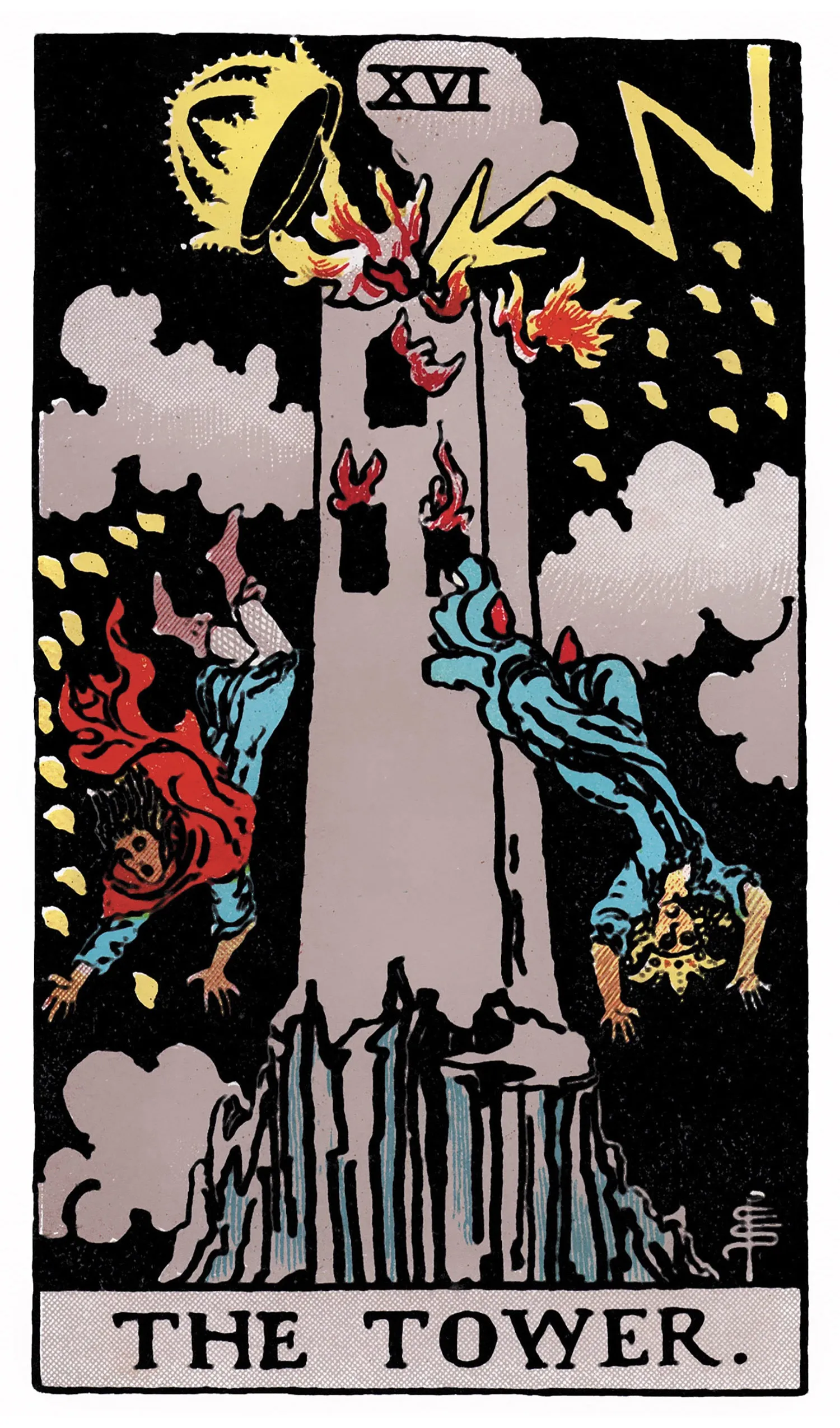
The traditional Rider–Waite–Smith image of The Tower shows a structure being struck from above and losing its stability in a single violent moment. Its symbolism emphasizes the difference between something that appears solid and something that can actually withstand pressure.
The Lightning Strike
Lightning represents sudden force, shock, and an event that occurs too quickly to be managed through gradual adjustment. The structure does not slowly deteriorate in the image; it is struck.
This reflects one of the card's central mechanics: the decisive moment may come with very little warning.
The Falling Crown
The crown being thrown from the top of the Tower represents the collapse of control, authority, status, certainty, or the belief that a position is untouchable.
It shows that power and confidence are not the same as structural security.
The Falling Figures
The people falling from the Tower show forced displacement and loss of control. They are not calmly deciding to leave the structure; circumstances have made remaining where they were impossible.
This is why The Tower frequently appears when change is no longer entirely voluntary.
The Flames
The fire emerging from the Tower shows that the disruption is not only superficial. The structure has been penetrated, and the damage is spreading through it.
Symbolically, this reflects situations in which one event reveals or activates deeper problems that were already present.
The Tower on the Rocky Height
The Tower stands high and isolated, suggesting strength, ambition, separation, and the belief that a structure can protect itself from the outside world.
Its dramatic collapse demonstrates the limits of rigid structures that appear strong but cannot absorb a sufficiently powerful shock.
The Dark Sky
The black background intensifies the sense of uncertainty and lack of preparation. The people in the image cannot clearly see what comes next.
The Tower therefore does not promise immediate clarity after collapse. First comes disruption; understanding and reconstruction belong to later stages.
The Core Symbolism of The Tower
The Tower's visual language is about the sudden destruction of assumed stability. Lightning strikes, the crown falls, people lose their position, and fire spreads through a structure that can no longer protect them.
The central message is not simply that change occurs. It is that when a structure reaches the point where it can no longer withstand reality, the transition may happen abruptly, forcefully, and with consequences that cannot be ignored.