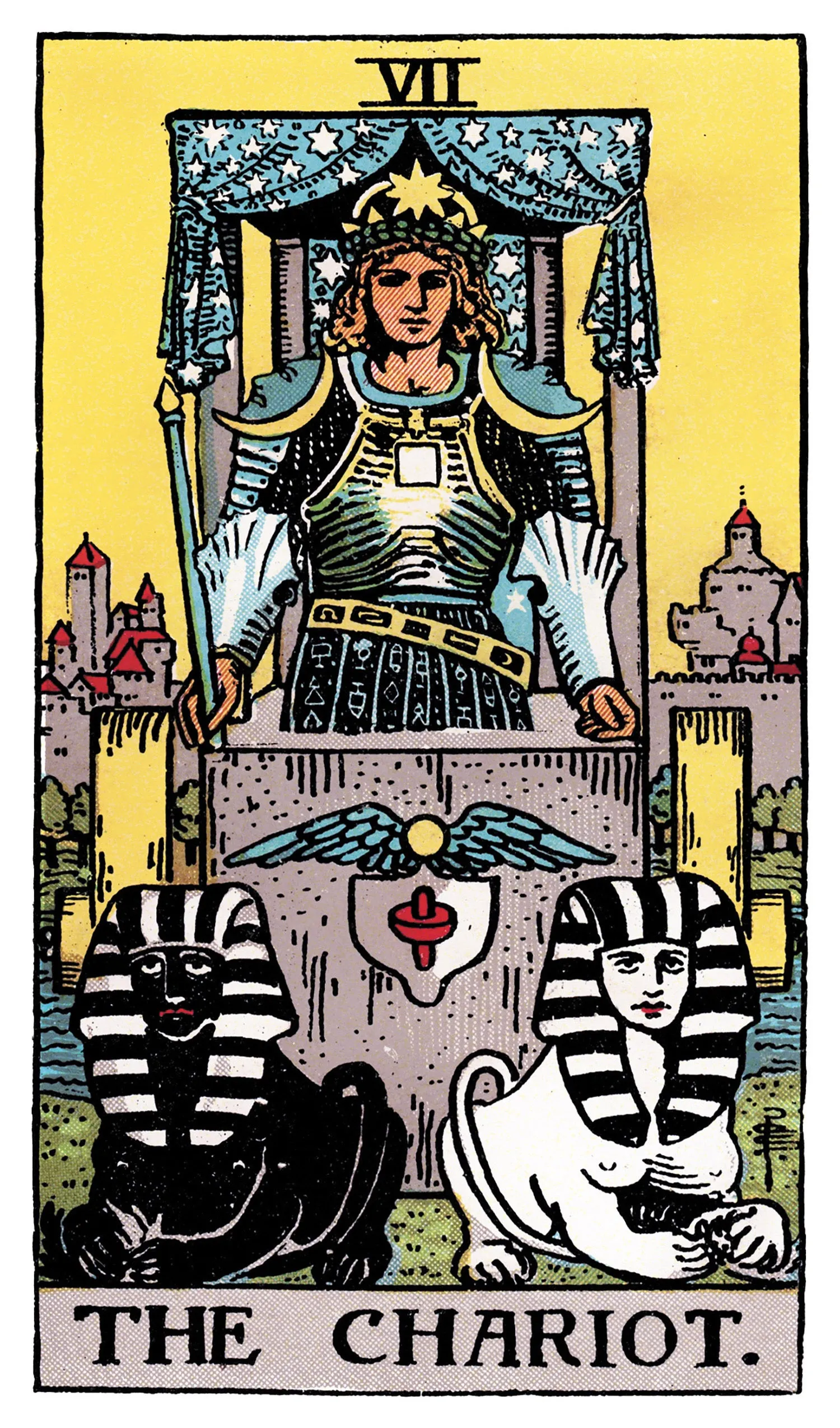
Major Arcana · Card VII
The Chariot Tarot Card Meaning
The Chariot represents movement, determination, control, and progress through obstacles. It appears when a person has a clear direction and must gather their strength, manage conflicting forces, and continue moving despite resistance. The card is strongly connected with achievement and overcoming difficulties, but its power depends on maintaining control over both circumstances and one's own emotional reactions.
Card Meanings
General Meaning
The Chariot represents purposeful movement through resistance.
The goal already exists. The person knows, at least broadly, where they want to go and is prepared to make an effort to get there. What makes the card significant is that the road is not completely clear: there are obstacles, conflicting circumstances, emotional reactions, competing demands, or other forces that have to be brought under control.
The Chariot therefore does not describe easy progress.
It describes progress because the person is capable of overcoming what stands in the way.
This is a strong card when the question concerns achievement, moving a situation forward, completing a difficult task, taking decisive action, travelling, relocating, breaking through limitations, or reaching a goal that requires persistence.
Its strength lies in direction and self-command.
The person does not simply wait for circumstances to improve. They take the reins of the situation and try to determine where it goes.
At the same time, The Chariot carries considerable emotional intensity beneath its controlled exterior. Maintaining direction may require the person to manage strong reactions, fears, frustrations, attachments, or other feelings that could otherwise interfere with the goal.
When the card functions constructively, these forces are not allowed to stop the movement.
The Chariot can therefore indicate successful progress and the ability to overcome difficulties, but it does not automatically describe comfort, emotional ease, or long-term stability. It tells us that the obstacle can be crossed and the destination can be reached.
The Shadow Side of The Chariot
The Chariot becomes difficult when control turns into overcontrol.
A person may become convinced that everything must develop according to their own direction, timing, and decisions. They may push harder than the situation requires, refuse to adjust their course, or experience any resistance as something that has to be defeated.
Strong self-control can also become emotionally exhausting.
The person may carry considerable tension while trying to remain composed and continue moving. If this pressure builds for too long, determination can turn into irritation, harshness, emotional outbursts, or the need to control other people.
Another danger is speed.
The desire to get through an obstacle quickly may lead to unnecessary pressure, impulsive decisions, or an inability to recognize when slowing down would actually create a better result.
The Chariot Reversed
The Chariot reversed shows the same movement, will, control, and determination becoming more difficult to manage.
The person may still want the result very strongly, but the forces involved are no longer working together effectively.
Progress can become chaotic, delayed, exhausting, or poorly directed. The person may push harder without actually getting closer to the goal, lose control of the situation at an important moment, or allow strong emotional reactions to interfere with otherwise purposeful action.
The reversed Chariot can also show excessive control.
Instead of directing the situation effectively, the person begins forcing it. Their determination becomes pressure, impatience, aggression, or an inability to adapt when circumstances change.
The card therefore represents a deterioration of the upright principle: movement remains important, but the person is no longer managing that movement successfully.
Core Message
Choose your direction, take control of what can be controlled, and continue moving through the obstacle.
The Chariot succeeds not because the path is easy, but because the person is capable of maintaining direction despite resistance.
The Chariot as a Person
The Chariot often describes an independent, strong-willed, determined person who prefers to direct their own life rather than follow someone else's decisions.
This is an individualist.
They usually want to remain in control of their direction, choices, pace, and circumstances. They may cooperate with other people, but they are rarely comfortable surrendering the steering wheel completely.
The Chariot person is purposeful and capable of functioning under pressure. Obstacles can activate rather than discourage them, especially when they know exactly what they are trying to achieve.
There can be much more emotion beneath the surface than this person openly shows.
They may experience situations intensely but prefer to keep their reactions under control, particularly when emotion could interfere with their goal.
At their best, they are disciplined, resilient, decisive, courageous, and capable of overcoming difficult circumstances.
At their worst, they can become controlling, impatient, demanding, emotionally tense, or unwilling to accept a direction that they did not choose themselves.
The Chariot as Actions
As actions, The Chariot shows movement.
The person acts, advances, makes a decision, takes control, travels, comes to someone, initiates a process, pushes through an obstacle, or deliberately moves a situation toward a chosen result.
This is not a passive card.
When the question is whether someone will actually do something rather than merely think about it, The Chariot usually shows a willingness to act.
The action may require effort because something stands in the way, but the person is prepared to overcome that resistance.
The Chariot in Love and Relationships
In our practice, The Chariot is more often not a particularly positive card for relationships.
Its central nature is individualistic. The Chariot wants to control its own direction, make its own decisions, and remain the one steering the situation. These qualities can be highly productive in personal achievement, but they are considerably more difficult inside a relationship, where two people must continuously take one another into account.
The card can therefore describe a relationship in which one person tries to determine the direction, pace, or rules of the connection.
It can also show a partnership that requires considerable emotional control.
The Chariot carries strong Water energy, and in relationships this can produce emotional strain rather than emotional comfort. Feelings may be intense, difficult to contain, or accompanied by worry, resentment, inner tension, or other experiences that the person tries to keep under control.
For this reason, The Chariot should not automatically be interpreted as happy romantic development simply because it is a card of movement.
Context matters greatly.
If the question concerns the beginning of a connection, whether someone will take action, whether contact will develop, or whether a person will actively move toward another person, The Chariot may be a constructive sign because it brings movement and initiative.
But if the question concerns the quality and development of an existing relationship, building a stable couple, creating a family, or emotional comfort, The Chariot is considerably less favorable. The relationship may move forward while still carrying control issues, strong emotional pressure, and a lack of ease between the partners.
There is one important exception.
If two people are genuinely united by a strong common purpose and are consciously moving in the same direction, The Chariot can describe their shared progress toward that goal. However, this meaning requires the context to support it and should not be imposed automatically.
The Chariot as Thoughts
As thoughts, The Chariot shows a person thinking about direction, control, and what should happen next.
They may be considering what action to take, how to move the situation forward, how to overcome an obstacle, or how to keep the relationship developing according to the course they consider right.
The person's thinking is active rather than passive.
However, this does not necessarily mean that their primary concern is emotional closeness. They may be thinking more about managing the situation than about surrendering to it emotionally.
The Chariot as Feelings
The Chariot is not a simple card of happy romantic feelings.
It shows strong emotional energy that the person is trying to control.
The feelings involved may be significant precisely because they create internal movement and tension, but the card does not by itself tell us that these emotions are soft, harmonious, or comfortable.
Depending on the surrounding cards and the question, The Chariot can describe attraction, emotional involvement, worry, resentment, frustration, desire, or another strong emotional reaction.
The important mechanism is that the person is not simply resting inside the feeling. They are trying to manage it, direct it, or prevent it from interfering with what they believe they need to do.
For this reason, The Chariot should not automatically be translated into emotional attachment or romantic harmony.
The Chariot as Intentions
As intentions, The Chariot shows a desire to determine the direction of the situation and act accordingly.
The person usually does not intend to remain passive.
They may want to initiate contact, move the relationship into a new stage, overcome an obstacle between two people, arrange a meeting, or otherwise make something happen.
However, their intention may also contain a strong need to remain in control.
They want movement, but preferably movement in the direction they themselves have chosen.
This is therefore a strong card of intention when the question concerns action, but it should not automatically be confused with an intention to build an emotionally comfortable or equal partnership.
The Chariot as an Outcome
As an outcome, The Chariot indicates progress through obstacles and the successful overcoming of difficulties.
Something that has resisted movement can finally be pushed forward.
The card is especially strong when the desired outcome requires determination, active effort, persistence, travel, decisive action, or the ability to remain focused despite complications.
The Chariot can therefore indicate reaching the goal, overcoming the barrier, or successfully moving through a difficult stage.
Its result is achieved rather than simply received.
The person has to participate actively in creating it.
At the same time, The Chariot does not necessarily describe what life looks like after the obstacle has been overcome. It shows successful movement toward the objective rather than permanent stability after arrival.
The Chariot in Career and Work
The Chariot is a strong card for career situations that require determination, discipline, decisive action, management, and the ability to overcome practical difficulties.
It can indicate professional progress, successful movement toward a goal, taking control of a project, achieving an important result, expanding one's responsibilities, or moving through a demanding period successfully.
The card favors situations in which a person knows what they want and is prepared to work through obstacles rather than abandon the objective when complications appear.
It can also be associated with professions or projects involving travel, transport, logistics, vehicles, mobility, coordination, management, or circumstances in which several moving parts must be directed toward one result.
The core career meaning is not competition itself.
Competition may exist in a particular situation, but the deeper mechanism is overcoming obstacles and maintaining direction until the goal is reached.
The Chariot in Money and Finances
In finances, The Chariot indicates that improvement depends largely on active management and purposeful action.
The person may be able to move the financial situation forward by making decisions, solving practical problems, overcoming obstacles, and consistently directing resources toward a specific objective.
It can show financial progress achieved through effort rather than passive accumulation.
However, The Chariot is not primarily a card of stored wealth or quiet material stability.
Its strength lies in movement and control of the situation.
For this reason, it is more useful for questions such as whether a person can improve their financial position, reach a financial target, or push through a difficult material period than as proof of long-term financial security.
The Chariot in Health
Within the Tarovera Tarot health system, The Chariot upright can indicate that the person's condition leaves something to be desired.
It may accompany an exacerbation, injury, or a period in which the body is under considerable strain. Psychological trauma can also be associated with the card.
In an appropriate surrounding context, The Chariot may indicate that an operation or another significant medical intervention needs to be considered.
These meanings are Tarot associations and must not be treated as medical diagnosis or prognosis.
Tarot should not be used as a substitute for medical diagnosis or treatment.
The Chariot Timing — When Will It Happen?
The Chariot is a fast-moving card in the Tarovera timing system.
When the question is “When will it happen?”, the primary calendar correspondence is:
Key Timing Correspondence
Late June / early July
When the question is instead “How long will it take?”, The Chariot usually indicates relatively rapid development of events.
A practical timeframe is:
approximately one month, with a maximum of around one and a half months.
The Chariot as an Event
As an event, The Chariot describes movement through an obstacle or a situation suddenly gaining direction and momentum.
It can indicate a journey, travel, relocation, an important drive, rapid progress, the beginning of active movement, a breakthrough, or a situation in which someone takes control and pushes events forward.
The event usually requires action.
Something is not simply happening around the person; they are actively involved in directing what happens next.
The card may also describe a period in which several difficulties have to be managed simultaneously before progress becomes possible.
The Chariot as Card of the Day
As Card of the Day, The Chariot suggests an active day that requires focus and self-control.
There may be travel, a demanding schedule, an important goal, a difficult task, or a situation in which you need to take responsibility for the direction of events.
Obstacles are possible, but they do not necessarily prevent progress.
The card advises you to keep moving toward the objective instead of allowing temporary difficulties to pull you off course.
The Chariot as Advice
The Chariot advises you to take control of the direction and continue moving toward the goal.
Do not allow temporary obstacles, emotional reactions, or conflicting circumstances to determine the outcome for you.
Decide what matters, gather your resources, and direct your effort toward it consistently.
At the same time, control should remain conscious rather than excessive.
You need to steer the situation, not crush everything that resists you.
The Chariot Reversed as Advice
Do not respond to loss of control by applying even more pressure.
First determine what is preventing the situation from moving properly.
You may need to regain emotional control, clarify the goal, reduce conflicting priorities, or reconsider the way you are trying to reach the result.
More force is not useful when the direction itself has become unstable.
The Chariot as a Warning
The Chariot warns that determination can become excessive control.
You may be trying to decide the direction for everyone involved, moving too quickly, suppressing important reactions, or treating every difficulty as something that must immediately be conquered.
Strong emotions also require attention.
Maintaining control does not mean pretending that emotional pressure does not exist.
If too much tension accumulates beneath the surface, the person can eventually lose the very control they are trying so hard to maintain.
The Chariot — Yes or No
Upright: Yes
The Chariot is generally Yes when the question concerns whether something can move forward, whether an obstacle can be overcome, or whether a person can reach a goal through active effort.
The answer assumes participation.
Progress occurs because someone takes control and moves through the difficulty rather than waiting for the difficulty to disappear.
In relationship questions specifically concerning harmony, emotional comfort, or the quality of a long-term partnership, the card should not be reduced to a simple positive answer merely because it indicates movement.
Reversed: No
The reversed Chariot is generally No because the forces necessary for successful movement are no longer being managed effectively.
There may be strong desire and substantial effort, but loss of direction, excessive control, emotional reactions, or poor coordination interfere with reaching the intended result.
The Chariot Symbolism
The traditional Rider–Waite–Smith image of The Chariot presents movement and victory as the result of control over opposing forces.
The card does not show a completely easy road. Its symbolism emphasizes the ability to maintain direction when different energies could otherwise pull the situation apart.
The Charioteer
The central figure stands upright and controlled.
He represents will, determination, conscious direction, and the person who takes responsibility for where the situation is going.
The Charioteer does not surrender control to circumstances.
He chooses the course.
The Black and White Sphinxes
The two sphinxes represent different and potentially opposing forces.
They do not naturally appear to move as one.
Their presence reflects one of the card's most important ideas: progress often requires a person to manage contradictions, conflicting circumstances, or different internal impulses without allowing them to destroy the chosen direction.
The Absence of Visible Reins
The Charioteer does not visibly control the sphinxes through ordinary reins.
This emphasizes that the deeper control represented by the card comes through will, concentration, discipline, and conscious direction rather than physical force alone.
The Armor
The armor suggests readiness, strength, and protection.
The Charioteer is moving into circumstances that may involve pressure or resistance, so complete openness is not the central quality of the card.
The armor also reflects the emotional self-control characteristic of The Chariot.
The Starry Canopy
The canopy above the Charioteer gives the movement a sense of direction beyond the immediate obstacle.
The card is not merely about moving quickly.
There must be a destination.
Without a clear goal, the enormous energy contained in The Chariot loses its usefulness.
The City Behind Him
The city behind the Charioteer represents what has already been left behind.
Movement requires separation from the previous position.
This supports the card's connection with journeys, travel, relocation, progress, and entering a new stage through deliberate action.
The Core Symbolism of The Chariot
The Chariot symbolizes the ability to move forward by directing powerful and potentially conflicting forces toward one destination.
Its central principle is not simply speed and not simply control.
It is progress through conscious control and the overcoming of obstacles.
The card succeeds because the person remains capable of steering despite resistance.