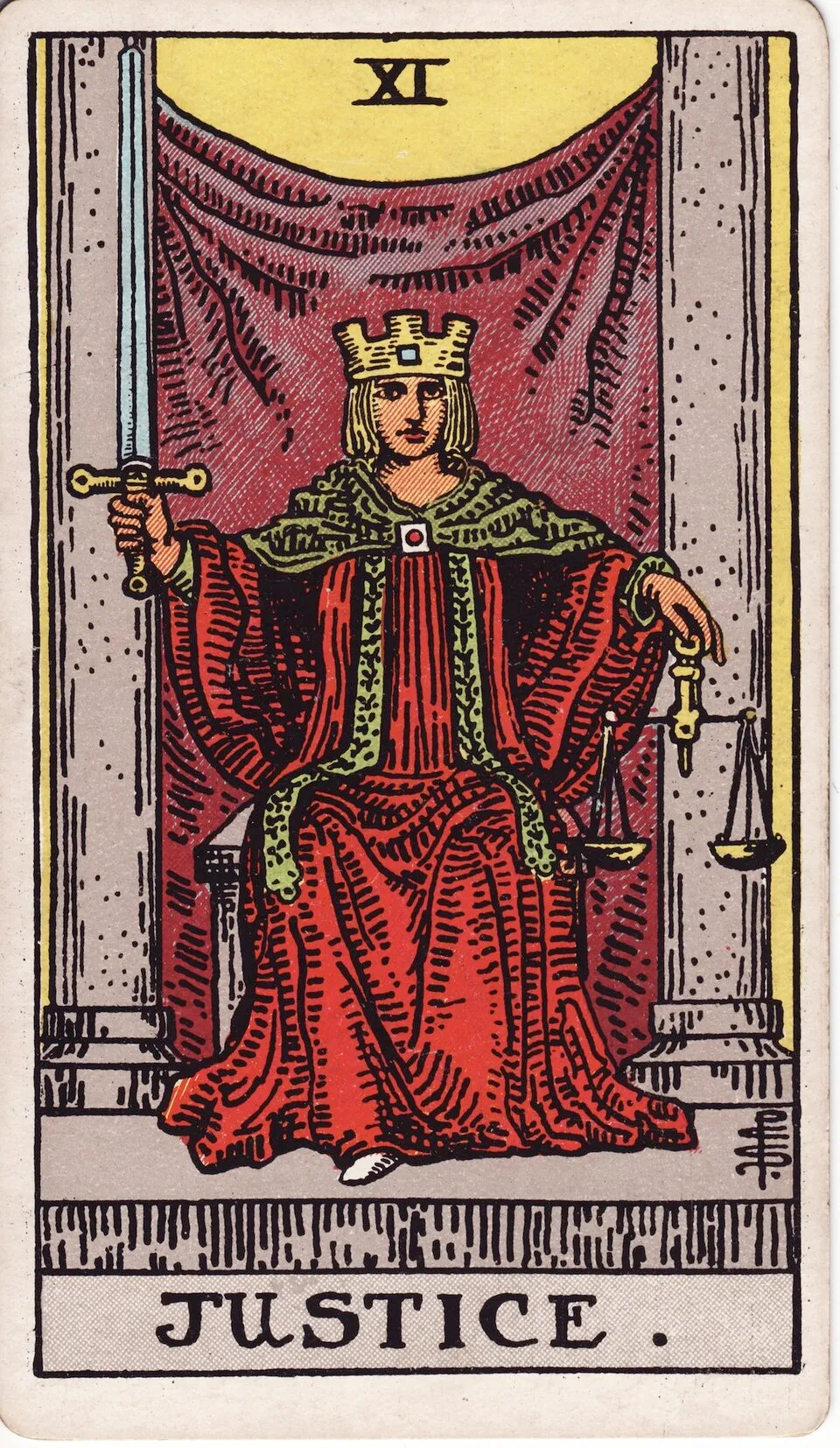
Major Arcana · Card VIII
The Justice Tarot Card Meaning
Justice represents objectivity, fair judgment, responsibility, truth, and the consequences that follow from what has already been done. It appears when a situation must be evaluated according to facts, rules, agreements, or actual merit rather than desire or emotion. Justice can bring a favorable result, but it does not promise one automatically: the outcome depends on what the situation genuinely supports.
Tarovera uses the traditional Tarot de Marseille numbering, in which Justice is Major Arcana VIII and Strength is XI. Later occult systems, including the Golden Dawn and Rider–Waite–Smith tradition, exchanged the positions of these two cards.
Card Meanings
General Meaning
Justice represents the moment when a situation is examined for what it actually is.
It removes wishful thinking, emotional preference, excuses, and attempts to influence the result through appearances alone. Facts, previous actions, responsibilities, agreements, and real circumstances become more important than what anyone would simply like to happen.
For this reason, Justice is often connected with evaluations, negotiations, contracts, legal matters, examinations, professional reviews, official decisions, expert opinions, documentation, disputes, and situations in which responsibility must be clearly established.
It can also describe an internal process. A person may need to examine their own actions objectively, admit where they were right or wrong, reconsider a decision, or determine what must be done to restore balance.
Justice is not automatically a card of reward or punishment. Its deeper principle is correspondence: the result should correspond to the actual circumstances.
If your position is strong, your obligations have been fulfilled, and the facts support you, Justice can be an excellent card. It may confirm that your position is justified and that a fair assessment works in your favor.
If the foundations are weak, rules have been ignored, obligations have not been fulfilled, or someone expects a result they have not actually earned, Justice can be much less comfortable.
The card therefore does not simply say, “Everything will work out.” It says: the situation will be weighed.
Justice also concerns the relationship between words and actions, rights and responsibilities, goals and methods. What a person claims should correspond to what they actually do.
The Shadow Side of Justice
The upright qualities of Justice can become difficult when objectivity turns into excessive judgment.
A person may become rigid, overly formal, emotionally detached, or convinced that everything must fit into clear categories of right and wrong. They may judge people according to rules while failing to consider context, complexity, or ordinary human weakness.
Justice can also become self-righteous. Someone may be so certain that their standards are correct that fairness gradually turns into criticism, severity, or moral superiority.
Its discipline is valuable, but without flexibility it can become cold.
Justice Reversed
Justice reversed shows that the mechanism of fair evaluation has become impaired.
Facts may be interpreted selectively, responsibility may be assigned incorrectly, a decision may be biased, or rules may be applied inconsistently. There can be an unfair judgment, an incorrect conclusion, a procedural problem, a broken agreement, a legal complication, or an attempt to justify behavior that would not withstand objective examination.
The distortion can work in either direction. A person may be acting unfairly themselves, or they may become the victim of someone else's unfair decision.
Justice reversed may also describe self-justification: a person knows what the rules are but creates reasons why those rules should not apply to them.
In other cases, excessive severity becomes the distortion. The person technically seeks justice but applies standards so harshly that the result is no longer genuinely balanced.
The central principle has not disappeared. The problem is that judgment is no longer functioning cleanly.
Core Message
Look at the situation as it is, not as you would prefer it to be. Accept responsibility for your part, distinguish facts from personal preference, and allow the result to reflect the true foundations of the situation.
The Justice as a Person
Justice as a person describes someone objective, principled, responsible, and difficult to manipulate.
This person usually prefers facts to emotional pressure and tries to understand situations from more than one side before reaching a conclusion. They can be highly self-controlled and capable of making decisions even when those decisions are personally uncomfortable.
Their words, beliefs, and behavior usually need to remain internally consistent. If they make a commitment, they tend to take it seriously. If they believe something is wrong, convenience alone may not persuade them to participate.
They often have a strong sense of personal responsibility and may expect the same from others.
This can make them trustworthy, fair, disciplined, and professionally reliable, but not necessarily easy. They may appear emotionally reserved, strict, critical, or less tolerant of excuses than other people.
The Justice as Actions
As actions, Justice evaluates, checks, compares, verifies, documents, negotiates, formalizes, and decides.
A person may review the facts, read the agreement, consult a professional, request evidence, define responsibilities, establish boundaries, sign documents, make an official decision, or bring an unclear situation into a more formal structure.
Justice rarely acts impulsively. It wants to know what is correct, justified, and sustainable before proceeding.
The Justice in Love and Relationships
In relationships, Justice is more concerned with honesty, equality, responsibility, and the actual structure of the partnership than with romantic intensity.
It can describe a relationship in which both people respect boundaries, fulfill their obligations, and treat each other fairly. Problems are more likely to be discussed rationally than hidden behind emotional drama.
Justice can also indicate defining the status of a relationship. Depending on the question and surrounding cards, this may involve marriage, legal registration, a formal commitment, a marriage contract, divorce proceedings, division of property, or simply a serious conversation about what the relationship actually is.
However, Justice is not naturally a warm or passionate love card. It may show respect, reliability, honesty, and commitment without indicating overwhelming emotion.
It can also appear when someone is critically evaluating a relationship and asking whether the partnership remains fair, balanced, and reasonable for both people.
The Justice as Thoughts
In thoughts, Justice shows active evaluation.
The person is weighing facts, comparing actions with words, considering consequences, and trying to reach a conclusion that makes sense rather than simply following emotion.
They may be asking themselves whether the relationship is fair, whether you have behaved consistently, what responsibility each person carries, and what decision would be correct under the circumstances.
This is usually thoughtful rather than impulsive mental activity.
The Justice as Feelings
Justice is not one of the strongest cards for emotional intensity.
As feelings, it more often shows respect, trust, recognition of another person's value, and a desire to treat the connection properly. Feelings are being controlled, assessed, or placed within a larger understanding of what is reasonable and appropriate.
Someone may care deeply but refuse to let emotion alone determine what happens next.
In some readings, Justice indicates that the person values the relationship because they consider it honest, reliable, and worthy of respect rather than because they are overwhelmed by passion.
The Justice as Intentions
As intentions, Justice wants clarity and a properly defined situation.
A person may intend to have an honest conversation, establish clear boundaries, make a fair decision, fulfill an obligation, formalize the relationship, or determine its future based on the real circumstances.
If the relationship no longer works, Justice can also indicate an intention to resolve it cleanly and correctly rather than leave matters indefinitely undefined.
The intention is usually deliberate and considered.
The Justice as an Outcome
Justice as an outcome indicates that the situation reaches a point of assessment, decision, settlement, or formal resolution.
The result will usually depend strongly on what has already been done, what can be demonstrated, what was agreed, and whether the person's position is genuinely supported by the circumstances.
This can be an excellent outcome when the facts are on your side. A dispute may be resolved fairly, an application approved because the requirements were met, an agreement formalized, a justified claim recognized, or a person rewarded according to merit.
But Justice does not guarantee a favorable result merely because it is an upright Major Arcana.
If the situation does not support the desired outcome, Justice may simply confirm a result that is correct under the circumstances even if the person does not like it.
The Justice in Career and Work
Justice is strong in professional situations involving evaluation, responsibility, precision, rules, documentation, or impartial decision-making.
It can indicate performance reviews, interviews, examinations, professional certification, contracts, audits, official approvals, negotiations, disputes, or decisions about promotion and responsibility.
It is particularly natural for legal work, compliance, accounting, auditing, administration, mediation, arbitration, quality control, regulation, and professions where accuracy and professional ethics matter.
Justice can also indicate receiving recognition that corresponds to actual performance. It favors competence that can be demonstrated rather than promises that cannot be supported.
In workplace conflict, it suggests examining responsibilities clearly instead of relying on personal alliances or emotion.
The Justice in Money and Finances
In finances, Justice concerns balance, obligations, agreements, and correct financial settlement.
It can indicate repayment of debts, taxes, compensation, division of assets, financial contracts, insurance matters, inheritance disputes, property settlements, or money received because a legitimate obligation has been recognized.
It can also represent fair distribution of income and the need to bring finances into proper order.
Justice is not primarily a card of sudden profit. Money tends to appear through something that can be justified, documented, earned, owed, or formally settled.
If asking about a financial dispute, the strength of the card depends heavily on whether the person's claim is actually supported.
The Justice in Health
Within the Tarovera Tarot health system, upright Justice indicates that health is generally within the normal range for the person's age, physical constitution, and overall condition.
It does not necessarily indicate exceptional strength or perfect health. Rather, the body's condition corresponds reasonably to the person's individual baseline.
In serious health spreads, Justice may appear alongside cards associated with severe outcomes, but Justice by itself does not indicate death.
Tarot should not be used as a substitute for medical diagnosis or treatment.
The Justice Timing — When Will It Happen?
Justice is not usually a fast-moving card.
It is connected with established timelines, rules, deadlines, formal procedures, and processes in which the necessary stages must be completed correctly before the result can be reached.
If the question is “How long will it take?” or “In how much time?”, Justice commonly indicates a period ranging from several weeks to several months.
The exact duration depends on how many formal stages, requirements, decisions, or procedures must be completed.
Key Timing Correspondence
Late September to early October.
The Justice as an Event
As an event, Justice often brings a situation in which something must be evaluated, decided, documented, or formally settled.
This may be an interview, examination, assessment, professional review, signing of a contract, legal consultation, official decision, court matter, negotiation, tax issue, division of property, compensation, marriage registration, divorce proceeding, or another event involving rules and defined responsibilities.
It can also be less formally legal. A serious conversation may function as a moment of judgment in which both sides examine what has actually happened and decide what follows.
The Justice as Card of the Day
Justice as Card of the Day suggests a day when details, deadlines, documents, decisions, or responsibilities may matter more than usual.
You may receive an answer, evaluation, official communication, request for documentation, or an opportunity to settle something that has remained unclear.
It is a useful day for checking facts, completing paperwork, reviewing agreements, having a serious conversation, or making a decision that requires a clear head.
What happens today may also reflect something you have already done rather than something entirely new.
The Justice as Advice
Look at the facts before deciding what you want the answer to be.
Be precise. Read what you are signing. Keep agreements clear. Fulfill your obligations and expect others to fulfill theirs.
If you have made a mistake, accepting responsibility will usually improve your position more than defending what cannot reasonably be defended.
If you are making an important decision, ask not only what benefits you but what can genuinely be justified.
Where necessary, document the situation, seek an objective professional opinion, or introduce clearer rules and boundaries.
The Justice Reversed as Advice
Correct the distortion before trying to force a result.
Check whether resentment, fear, self-interest, incomplete information, or personal bias is influencing your judgment. Do not manipulate facts or rules simply because the desired outcome feels important.
Review agreements, documents, assumptions, and responsibilities carefully. If necessary, seek an impartial second opinion.
If you have failed to fulfill an obligation, deal with that directly rather than building increasingly complicated explanations around it.
The Justice as a Warning
Justice warns that actions create consequences and that important details cannot always be ignored indefinitely.
Do not assume that good intentions cancel obligations, that personal conviction automatically makes you right, or that an informal promise will protect you where proper documentation is required.
The card also warns against excessive judgment. Being technically correct does not always mean that your way of applying the truth is balanced.
Be especially careful with contracts, deadlines, legal responsibilities, accusations, and decisions that materially affect another person.
The Justice — Yes or No
Upright: Yes, if the conditions are met
Justice is a conditional yes rather than an automatic one.
If your position is justified, the requirements have been fulfilled, and the facts genuinely support the desired result, the answer is yes.
If those foundations are absent, Justice will not create a favorable result simply because you want one. The card gives the result that corresponds to the real circumstances.
Reversed: Most likely no
Justice reversed suggests that something in the situation is currently incorrect, unfair, improperly evaluated, procedurally flawed, or insufficiently supported.
The desired result is therefore unlikely to be reached cleanly in the present circumstances without first correcting the underlying problem.
The Justice Symbolism
Justice presents a visual language of evaluation, clarity, authority, and balance.
Its symbols emphasize that true judgment requires both the ability to weigh different sides and the ability to reach a definite conclusion.
The Scales
The scales represent comparison and evaluation.
Different facts, actions, responsibilities, claims, or interests must be weighed against one another before a fair conclusion can be reached.
They also show that Justice is not based on preference. Something must be measured against something else.
The Sword
The sword represents clarity, judgment, and the final decision.
The scales evaluate; the sword concludes.
It also reflects the intellectual quality of Justice: confusion must eventually be cut through so that the essential truth of the situation becomes visible.
The sword reminds us that a fair decision can still be uncomfortable. Objectivity does not guarantee softness.
The Open Gaze
Unlike the familiar blindfolded image of Lady Justice, the Tarot figure looks directly ahead.
This reinforces one of the card's central principles: seeing what is actually there.
Justice cannot function through denial, selective perception, or deliberate self-deception. The card asks for a clear view of both the external situation and one's own role within it.
The Throne and Pillars
The seated position gives Justice stability and authority.
She does not rush toward the situation or react impulsively. The judgment comes from a fixed center.
The pillars reinforce structure, defined boundaries, and a framework within which the decision is made.
VIII — The Traditional Number of Justice
Tarovera follows the older Tarot de Marseille ordering of the Major Arcana:
VIII — Justice
XI — Strength
Later occult systems associated with the Hermetic Order of the Golden Dawn exchanged the positions of Justice and Strength, and this later ordering was adopted by the Rider–Waite–Smith tradition.
For this reason, many modern English-language decks show Strength as VIII and Justice as XI.
On Tarovera, the traditional ordering is retained consistently: Justice is VIII and Strength is XI.
The Core Symbolism of Justice
The entire image brings together two necessary parts of fair judgment.
The scales require us to examine and compare.
The sword requires us eventually to decide.
Justice therefore represents neither endless hesitation nor rigid punishment. Its deeper symbolism is the ability to see clearly, weigh accurately, accept responsibility, and arrive at a conclusion that corresponds to the reality of the situation.