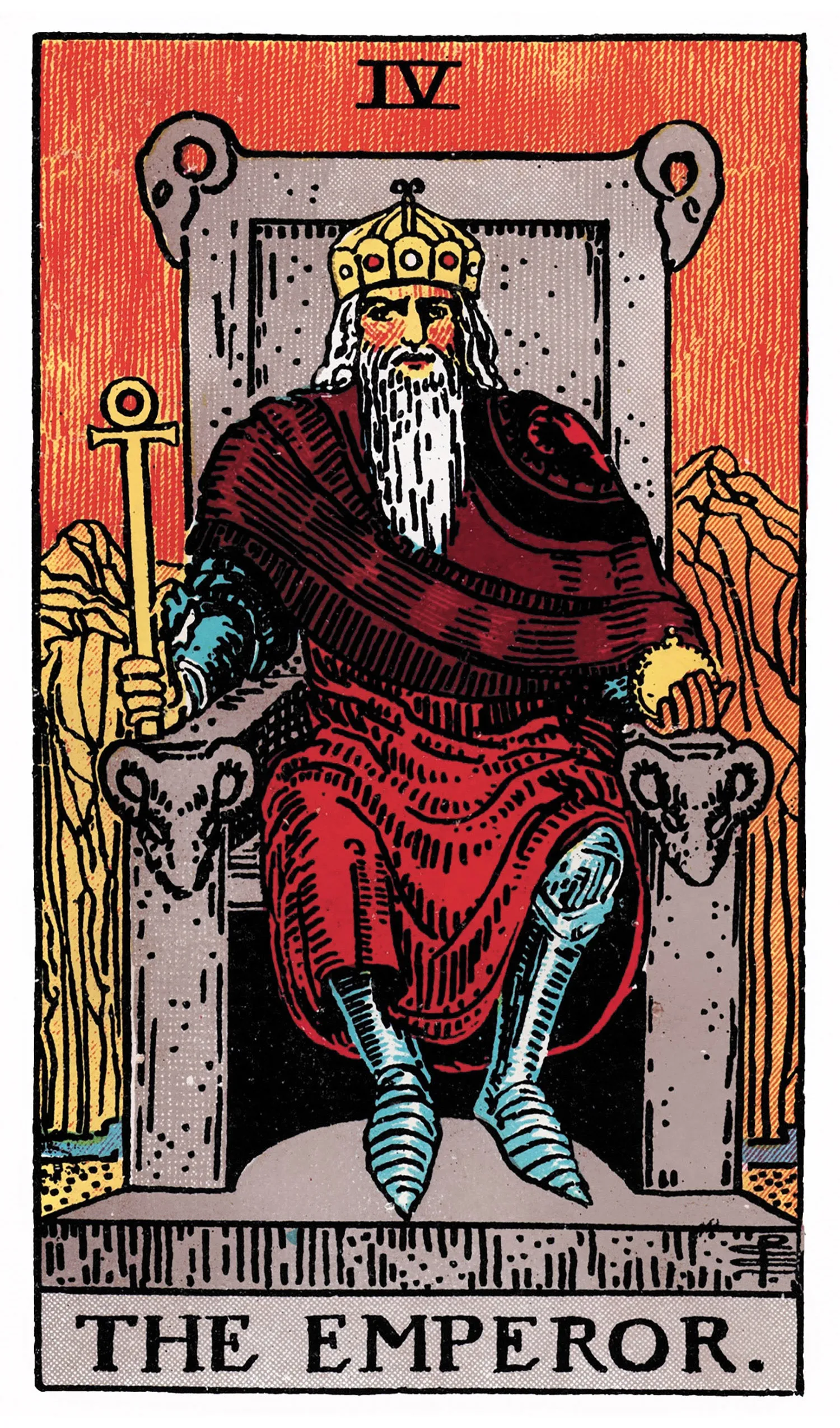
Major Arcana · Card IV
The Emperor Tarot Card Meaning
The Emperor represents realization, authority, responsibility, structure, control, and the ability to turn an intention into an established result. He does not simply create order around an idea — he brings the idea into a form that can exist, function, and produce a concrete outcome.
This is a card of implementation. Where The Empress creates and develops, The Emperor takes what has been conceived and makes it real, organized, defined, and sustainable. His strength lies in responsibility, decisive action, official authority, and the ability to bring a process to a tangible result.
Card Meanings
General Meaning
The Emperor is one of the clearest cards of realization and concrete result.
He appears when an idea, intention, plan, or developing process is ready to become something established in reality. The Emperor does not represent potential alone. He represents the ability to organize resources, make decisions, take responsibility, and bring the process to a result that can actually be maintained.
This makes him particularly important in questions about implementation.
If the question is whether a project can be created, whether a plan can be realized, whether something can be brought into existence, or whether a process will reach a concrete result, The Emperor is an exceptionally strong confirmation.
In a sequence or development position, he can represent the stage at which the plan is no longer merely being considered or developed — it is being implemented and turned into a functioning reality.
The Emperor is also closely connected with authority and official position. He represents someone who has the right or power to make decisions and, equally importantly, carries responsibility for those decisions.
His authority is not merely symbolic. The Emperor is expected to act, organize, decide, establish rules, allocate responsibilities, and answer for the consequences.
For this reason, the card can represent management, formal leadership, institutions, official structures, contracts, legal frameworks, administration, ownership, or any situation in which authority and responsibility are clearly defined.
The Emperor also creates stability, but stability is the consequence of successful realization and management rather than the entire meaning of the card. Something becomes stable because it has been properly established, structured, and brought under effective control.
He is not a card of emotional improvisation or endless experimentation. Once a decision has been made, The Emperor is concerned with carrying it through.
The Shadow Side of The Emperor
The Emperor's strength becomes difficult when authority turns into domination.
A person may become excessively controlling, rigid, demanding, or convinced that because they carry responsibility, they should also have the right to determine everything.
Clear structure can become overregulation. Leadership can become authoritarianism. Firm boundaries can become restrictions that leave no room for another person's needs, judgment, or independence.
The Emperor can also become too attached to his own system. Instead of asking whether the structure still works, he may insist that it must be preserved because it is his structure, his decision, or his established way of doing things.
At his most difficult, he does not merely take responsibility for his sphere — he attempts to control everything within it.
The Emperor Reversed
The Emperor reversed shows damaged authority, damaged responsibility, or failure of realization.
One of its most important manifestations is irresponsibility.
A person may avoid responsibility for their own decisions, actions, promises, or mistakes. They may say that they will do something and then fail to do it. They may create a problem but refuse to take responsibility for the consequences, blame circumstances or other people, or expect someone else to manage the result.
The reversed Emperor can also show a person who wants the privileges of authority without accepting the obligations that should accompany it.
In other cases, the authority itself is weak or nominal. The person may formally occupy a position of power but have little real ability to control events, make independent decisions, or achieve the intended result.
Plans may fail at the implementation stage because there is insufficient discipline, organization, accountability, or effective leadership.
The card can therefore describe both excessive control and ineffective control. In one form, the person abuses authority; in another, they cannot use authority effectively at all.
What deteriorates in both cases is the same principle: the ability to take responsibility, exercise authority, and bring a decision to a concrete result.
Core Message
The Emperor is the point at which intention becomes reality.
He does not merely imagine, begin, or develop. He organizes, decides, implements, and produces a result.
His authority is inseparable from responsibility: the right to make decisions also means accepting responsibility for what those decisions create.
The Emperor as a Person
The Emperor represents a mature, authoritative, responsible, and self-directed person.
This is someone who is comfortable making decisions and accepting responsibility for the consequences. They usually prefer clear roles, clear agreements, and a situation in which everyone understands what they are responsible for.
The Emperor tends to operate through logic, discipline, practicality, and control rather than emotional spontaneity.
He sees what needs to be done, determines the appropriate course of action, and expects the plan to be followed.
This person can be demanding, but they are usually demanding of themselves as well. Responsibility is central to their identity. If they accept a role, obligation, project, family position, or professional duty, they tend to treat it seriously.
The Emperor often represents someone with recognized or official authority: a manager, director, employer, senior professional, official, father, husband, or another person whose position gives them the right and responsibility to make decisions.
He may appear emotionally restrained. This does not necessarily mean an absence of feeling. It means that feelings do not usually determine his behavior when responsibility, duty, or practical necessity requires something else.
He values reliability, competence, discipline, loyalty, and people who keep their word.
The Emperor as Actions
As Actions, The Emperor takes responsibility and brings the plan into reality.
He decides what needs to be done, establishes the structure, organizes resources, defines responsibilities, and moves the process toward a concrete result.
This is not impulsive action. The Emperor acts deliberately and with a specific objective.
He may formalize an arrangement, establish an agreement, take charge of a project, make an official decision, define roles, assume leadership, introduce rules, or create the structure necessary for something to function.
If a process has already been developing, The Emperor can represent the moment when it is finally implemented.
In questions such as “Will this person actually do it?”, “Will the project be realized?”, or “Will the plan reach implementation?”, the upright Emperor is an extremely strong indicator of real action and result.
He does not simply talk about what should happen. He is expected to make it happen.
The Emperor in Love and Relationships
In love and relationships, The Emperor is a card of seriousness, responsibility, commitment, structure, and clearly defined roles.
It is not primarily a romantic or emotionally flexible card.
The Emperor is stronger for commitment and responsibility than for tenderness or emotional expression.
In an established relationship, the card can indicate a strong structure: each partner understands their role, responsibilities are taken seriously, practical obligations are fulfilled, and the relationship has a defined place in both people's lives.
It can indicate marriage, formal partnership, family responsibility, or another arrangement in which the relationship is not casual or undefined.
The Emperor often shows someone who proves their commitment through behavior rather than emotional declarations. They take responsibility, provide practical support, make decisions, solve problems, keep agreements, and maintain the stability of the partnership.
However, the relationship may be hierarchical.
One partner may naturally hold more authority, take more responsibility, manage important decisions, or define the structure of the relationship.
The card itself does not determine whether this arrangement is healthy. The surrounding cards and the actual relationship must show whether authority is accompanied by responsibility and respect or has become domination.
The Emperor also has little natural flexibility. Once roles and expectations are established, changing them may be difficult.
The Emperor as Thoughts
As Thoughts, The Emperor thinks seriously and practically about the relationship.
The person considers what the relationship is, where it belongs in their life, what responsibilities it creates, and what decision should be made about it.
They are likely to think in terms of structure: partnership, exclusivity, marriage, family, obligations, status, practical compatibility, and long-term viability.
Their thinking is usually more rational than emotional.
The Emperor may decide that a person is suitable for a serious relationship and then act according to that decision even if the emotional experience itself is not dramatic or romantic.
He can therefore indicate a very definite mental position:
“I have decided what this relationship is and what I am going to do about it.”
The Emperor as Feelings
As Feelings, The Emperor is serious but restrained.
This is not one of the strongest cards for emotional vulnerability, romantic excitement, or tenderness.
It can show respect, attachment, loyalty, protectiveness, possessiveness, and the sense that another person has an established place in one's life.
The feeling often expresses itself as:
“You are important to me, you are part of my life, and I take this relationship seriously.”
The Emperor may care deeply while showing relatively little emotional flexibility.
He is more likely to express attachment by staying, providing, solving problems, accepting responsibility, or maintaining the relationship than by constantly discussing feelings.
This means that strong intentions and strong commitment can exist even when emotional expression is limited.
The Emperor as Intentions
As Intentions, The Emperor is one of the stronger cards of serious, definite intention.
The person wants to establish a clear structure and bring the relationship into a defined form.
This may mean commitment, exclusivity, marriage, family structure, shared responsibilities, formalization, or simply making the relationship an established part of their life.
The Emperor does not need overwhelming romantic emotion in order to make a serious decision.
He can decide that a relationship is right, appropriate, necessary, or worth building and then deliberately follow through with that decision.
If the relationship is already established, his intention is usually to preserve it, maintain responsibilities, and keep the structure functioning.
He may also intend to take the leading role and determine how the relationship develops.
The Emperor as an Outcome
As an Outcome, The Emperor is an exceptionally strong card of realization and concrete result.
The situation reaches a point where the intended plan becomes established in reality.
If the question concerns whether something will be created, realized, implemented, formalized, or brought to a functioning result, The Emperor is one of the clearest affirmative indicators.
In a sequence, he can represent the actual stage of realization:
the idea has been developed, the necessary decisions have been made, and the process reaches a form that now exists independently as a real result.
The Emperor may indicate implementation of a project, successful completion of a practical plan, formalization, official approval, establishment of a stable structure, obtaining authority or status, or creation of a functioning system.
The exact nature of the result depends on the question, but the core meaning remains the same:
something becomes real, established, and structurally complete enough to function.
The Emperor in Career and Work
The Emperor is one of the strongest Tarot cards for professional realization, management, authority, and successful implementation.
In career questions, it often indicates that plans move from discussion into practical execution.
A project may be approved, structured, formally launched, completed, or brought to a level where it becomes an established part of the organization.
The Emperor strongly favors positions involving responsibility and official authority: management, senior leadership, administration, business ownership, government, large organizations, regulation, legal structures, property management, strategic planning, and roles in which other people's work or resources must be coordinated.
It can indicate promotion into a position with greater authority and greater responsibility.
The card may also represent an employer, director, senior manager, official, or another person whose decision has real consequences for the professional situation.
For business, The Emperor is especially powerful because it describes the stage where an idea becomes an actual working structure.
Plans become procedures. Responsibilities become defined. Agreements become formal. Resources become organized. The business begins to operate as a system rather than merely as an idea.
Contracts, legal matters, official agreements, real estate, and institutional structures can also fall under this card.
The Emperor in Money and Finances
In finances, The Emperor represents an established, controlled, and legally or structurally secure material position.
It favors financial management, budgeting, ownership, contracts, property, legal income, long-term planning, and systems designed to keep resources stable and under control.
The Emperor can indicate financial stabilization because money is being managed deliberately rather than impulsively.
It may also point to property, real estate, legal ownership, official financial agreements, business structures, or financial matters that require documentation and formal decisions.
This is not primarily a card of sudden profit.
Its strength lies in turning financial intentions into a stable material structure.
If the question concerns whether a material plan can be successfully implemented, The Emperor is a strong card because it supports practical realization, control of resources, and the establishment of a sustainable result.
The Emperor in Health
Within the Tarovera Tarot health system, the upright Emperor is associated with strong, robust, and generally good health.
The card suggests physical stability and a solid reserve of strength.
When it appears upright in a Health position, the general condition is considered strong unless surrounding cards significantly alter the interpretation.
Tarot should not be used as a substitute for medical diagnosis or treatment.
The Emperor Timing — When Will It Happen?
The Emperor is not an immediate timing card.
Key Timing Correspondence
When? — Late March to early April.
If the question asks for a calendar period, The Emperor corresponds to the end of March and the beginning of April.
How long? — Approximately two months to six months.
If the question asks how long realization may take rather than for a specific calendar date, The Emperor usually indicates a period of a couple of months up to approximately half a year.
For a more precise time frame, a dedicated timing spread is preferable. A single card can provide a general period, but a separate timing spread allows the timing question to be examined more specifically.
The Emperor as an Event
As an Event, The Emperor often represents realization, formalization, or an official decision that produces a concrete result.
Something may move from planning into implementation.
A project can be approved or completed. An agreement can be formalized. A structure can be established. A person may receive a position, authority, ownership, or official responsibility.
The event may involve an official decision, implementation of a plan, appointment or promotion, signing or formalizing an agreement, establishing a business or organizational structure, property or ownership matters, legal or administrative procedures, or interaction with a manager, official, institution, or authority figure.
The central event is that something becomes established in reality.
The Emperor as Card of the Day
As Card of the Day, The Emperor suggests a day when practical results matter more than discussion.
You may need to make a decision, complete something, take responsibility, formalize an arrangement, establish rules, or finally turn a plan into action.
The day may involve management, official matters, contracts, property, documents, institutions, or someone in a position of authority.
It is a good day to stop leaving an important matter undefined.
If you know what needs to be done, organize the process and bring it to a concrete result.
Responsibility is especially important today. Do what you said you would do, and expect the same standard from others.
The Emperor as Advice
As Advice, The Emperor tells you to produce a result.
Stop leaving the situation at the level of intention, discussion, preparation, or possibility.
Decide what the desired outcome is and organize the practical steps necessary to achieve it.
Take responsibility for your part of the situation. Establish clear roles, clear rules, and clear expectations.
If you have authority, use it responsibly.
If a decision belongs to you, make it.
If a promise has been made, fulfill it.
The Emperor also advises formalization where appropriate. Put agreements into a clear form, define responsibilities, create a system, document important decisions, and make sure the structure can actually function after it has been created.
The Emperor Reversed as Advice
The Emperor reversed advises you to correct your relationship with responsibility.
Do not claim authority over a situation while refusing responsibility for the consequences.
Do not make promises you are not prepared to fulfill.
If you have created a problem, take responsibility for correcting it rather than shifting blame.
At the same time, avoid compensating for uncertainty with excessive control. Becoming more authoritarian will not solve a problem caused by poor leadership or weak responsibility.
Real authority requires accountability.
The Emperor as a Warning
The Emperor warns against turning authority into domination.
Being responsible for a situation does not mean that every person within it must lose their autonomy.
Watch for excessive control, rigidity, authoritarian behavior, pressure, and the belief that your position automatically makes your judgment correct.
The card can also warn against confusing external status with actual competence.
A title, position, or formal authority is not enough if the person holding it cannot take responsibility or produce a result.
Another danger is creating a structure so rigid that maintaining the structure becomes more important than the purpose it was originally created to serve.
The Emperor — Yes or No
Upright: Yes
The Emperor is a strong Yes, particularly when the question concerns realization, implementation, achievement, formalization, responsibility, authority, or obtaining a concrete result.
If the question is:
“Will this plan be realized?”
“Will the project actually be created?”
“Will this reach a real result?”
The Emperor is one of the strongest affirmative cards.
It shows that the process reaches the stage of practical realization rather than remaining merely a possibility.
Reversed: Most likely no
The Emperor reversed is generally Most likely no because the required realization is damaged by poor execution, weak authority, irresponsibility, or refusal to take ownership of the result.
The plan may exist, but the person responsible may fail to carry it through.
Alternatively, formal authority may be present without enough real power or competence to achieve the desired outcome.
The Emperor Symbolism
The Rider–Waite–Smith image of The Emperor emphasizes authority, stability, responsibility, force, and established power.
Unlike cards that describe possibility or movement toward an unknown future, The Emperor is already seated in his position.
His imagery shows a person who has obtained authority and now carries responsibility for what exists within his domain.
The Stone Throne
The Emperor sits on a massive stone throne.
The stone emphasizes permanence, stability, firmness, and a structure designed to endure.
It also reflects the card's lack of flexibility. What provides stability can become rigid if it can no longer adapt.
The throne itself represents established authority. The Emperor is not attempting to gain a position; he already occupies it.
The Rams' Heads
The ram imagery reinforces determination, force, assertiveness, and the willingness to move directly against resistance.
It supports the Emperor's capacity to make decisions and push a plan through the practical obstacles that stand between intention and result.
The Armor
The armor beneath The Emperor's robes shows preparedness and protection.
Authority carries responsibility, and responsibility includes the need to defend what has been established.
The armor also reflects emotional restraint. The Emperor does not expose himself easily and tends to keep vulnerability under control.
The Red Clothing
Red emphasizes will, active force, determination, and the energy required to produce a result.
Although The Emperor is seated, he is not passive.
His stillness represents control, not inactivity.
The Scepter and Orb
The scepter represents authority and the power to direct.
The orb represents the sphere or domain under the Emperor's responsibility.
Together, they express one of the central principles of the card:
authority and responsibility belong together.
To control a domain is also to answer for what happens within it.
The Mountains
The severe mountains behind The Emperor suggest difficulty, endurance, and reality that must be managed rather than idealized.
His position has not been created through softness or convenience.
The landscape reinforces his realism: results require discipline, decisions, and the ability to deal with conditions as they actually are.
The Core Symbolism of The Emperor
The Emperor's symbolism presents authority as realized power.
He has a position, a structure, a domain, and responsibility for maintaining what has been established.
The throne shows the result already achieved. The armor shows readiness to defend it. The scepter shows the ability to direct. The orb shows the sphere for which he is responsible.
Together, these symbols express the card's central principle:
an intention becomes a result when someone has the authority, discipline, and responsibility to make it real.