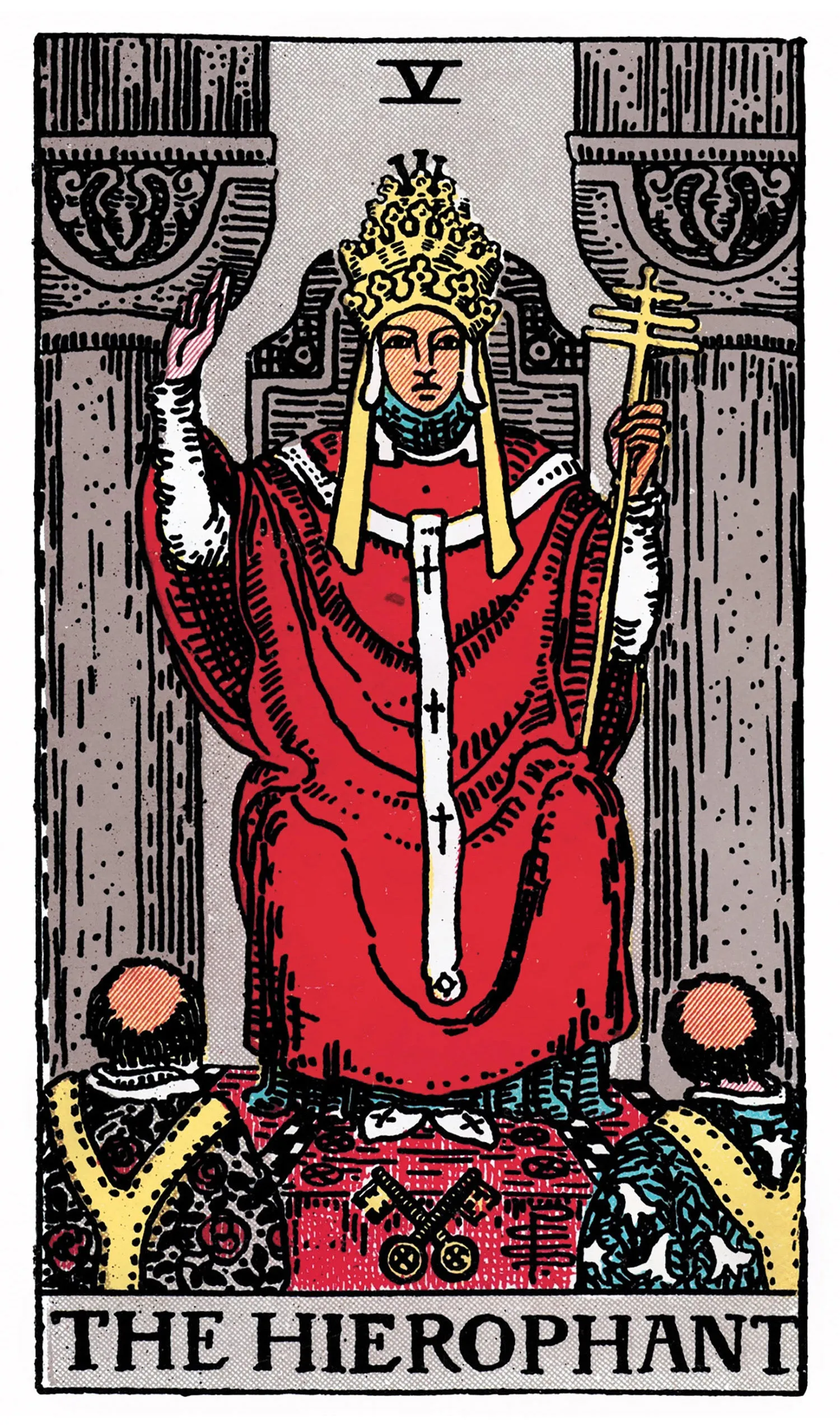
Major Arcana · Card V
The Hierophant Tarot Card Meaning
The Hierophant represents established knowledge, tradition, principles, teaching, and the understanding of what is considered right within a particular system. It often appears when a person needs to learn, gain a new level of knowledge or status, follow a proven path, or rely on experience that already exists rather than inventing everything from the beginning.
The card is closely connected with authority, institutions, education, marriage, social and moral rules, and the transmission of knowledge from teacher to student. It can indicate a positive result and confirm that the chosen direction is correct, especially when progress depends on learning, qualification, guidance, or following the right principles.
Card Meanings
General Meaning
The Hierophant represents knowledge that has already been accumulated, organized, tested, and passed on.
This is not the card of discovering everything independently. The Hierophant assumes that someone has already walked this road before, developed a method, established principles, or created a system that can now be learned and used.
For this reason, the card is strongly associated with teachers, mentors, educational institutions, professional qualifications, traditions, religion, social structures, marriage, formal procedures, and any environment where knowledge or status is transferred according to established rules.
But The Hierophant is not only about following rules.
At a deeper level, it is a card of belief in what is right.
The person does not simply follow a system because it exists. Ideally, they understand the principles behind it and believe that this is the correct way to proceed.
This gives The Hierophant a strong connection with ethics, morality, personal values, conscience, and the distinction between what a person considers right and wrong.
When this card appears, the question may therefore be not only:
“What are the rules?”
but also:
“What is the right way to do this?”
The Hierophant often confirms that the person is moving in the correct direction.
It can be a favorable card when asking whether a plan, decision, career path, course of study, relationship, or other process can lead to a successful result.
However, its positive result usually has a condition: the person must understand what is required, learn what they do not yet know, follow the appropriate method, or reach the necessary level of competence.
The Hierophant is the fifth Major Arcana, and this developmental quality is important.
The card frequently describes movement from one level to another through the acquisition of knowledge, experience, qualification, status, or understanding.
You learn something.
You pass through a stage.
You become qualified to move further.
Eventually, the student may become the person who teaches others.
This is one of the central dynamics of The Hierophant: receiving knowledge, integrating it, reaching a new level, and becoming capable of transmitting it further.
The card can therefore indicate both the teacher and the student.
Its role depends on where the person currently stands within that process.
The Shadow Side of The Hierophant
The strength of The Hierophant is certainty.
Its weakness is also certainty.
A person who has strong principles may become very difficult to persuade that another approach could also be valid.
They may hold firmly to traditions, beliefs, social expectations, or methods they learned many years ago even when circumstances have changed.
This does not always mean open fanaticism.
Sometimes the difficult side of the upright Hierophant is simply profound inflexibility.
The person genuinely believes:
“This is the correct way.”
“This is how it has always been done.”
“This is how people are supposed to behave.”
Their beliefs may be so deeply established that changing them becomes extremely difficult.
At a stronger level, this develops into dogmatism.
The person may stop distinguishing between having principles and assuming that everyone else must share those principles.
Teaching becomes lecturing.
Guidance becomes moral pressure.
Tradition becomes intolerance.
Confidence in one's knowledge becomes an inability to admit that one may be wrong.
The Hierophant can therefore represent a person or system that preserves valuable knowledge, but it can also show the danger of preserving ideas merely because they are old, respected, or socially accepted.
The Hierophant Reversed
The Hierophant reversed shows a damaged expression of knowledge, authority, principles, teaching, or an established system.
The system still exists, but something within it is no longer functioning properly.
A teacher may not actually know enough to teach.
An adviser may give poor guidance.
An institution may formally provide education or support but fail to deliver what it promises.
A person may follow a method incorrectly, misunderstand the principles behind it, or attempt to pass a test without having truly learned what is required.
The card can also describe false authority: someone who expects respect because of age, title, status, education, or position but does not possess the competence or integrity that should support that authority.
Another manifestation is hypocrisy.
The person may publicly defend certain values while privately violating them.
They may demand standards from others that they do not follow themselves.
The Hierophant reversed can also indicate that a person has chosen the wrong teacher, wrong method, wrong educational path, or wrong system and therefore cannot reach the expected result.
It does not automatically mean healthy rebellion, freedom from convention, or becoming unconventional.
The central problem is usually not that the person rejects the system.
It is that the relationship between knowledge, authority, principles, and actual competence has become distorted.
Core Message
The Hierophant teaches that progress often requires learning before acting.
Use the knowledge that already exists.
Understand the rules before deciding whether they should be followed, adapted, or challenged.
Seek guidance from someone who genuinely understands the subject.
And remember that authority has value only when it is supported by knowledge, responsibility, and integrity.
The right teacher, right method, and right principles can help you reach the next level.
The Hierophant as a Person
The Hierophant as a person is usually traditional, principled, knowledgeable, and strongly guided by established beliefs.
They tend to have a clear understanding of how life, work, relationships, society, or morality should function.
They may respect education, qualifications, experience, family traditions, social roles, religion, professional standards, or other systems that give life structure.
This person is often capable of teaching others.
They may naturally become a mentor, adviser, instructor, professor, senior professional, spiritual teacher, consultant, or simply the person others approach for guidance.
They often accumulate knowledge and then feel a need to pass it on.
They can also be strongly connected with a particular profession, institution, tradition, or community.
The Hierophant may describe someone whose status is already established and recognized by others.
It can also be a significator of a married person.
One of the most important traits of this personality, however, is inflexibility.
The Hierophant can be extremely difficult to persuade.
Their beliefs may have been formed over many years and can be deeply rooted in upbringing, culture, education, religion, family tradition, or professional experience.
Even when their views are outdated, they may see no reason to change them.
They do not necessarily argue because they enjoy conflict.
They argue because they genuinely believe they are right.
This creates a particular kind of stubbornness:
not “I want things my way,” but “this is the correct way.”
The Hierophant as Actions
As Actions, The Hierophant acts through knowledge, instruction, established procedures, and recognized methods.
The person may:
- study or seek additional education;
- consult a teacher, mentor, or experienced specialist;
- teach or advise someone else;
- explain how something should be done;
- follow established rules;
- complete an official procedure;
- obtain a qualification or certification;
- take an examination;
- formalize a relationship or agreement;
- seek approval from an institution;
- join an organization or professional community;
- introduce clearer rules or standards;
- act according to personal principles;
- move toward a more serious or officially recognized status.
The person usually prefers a method that has already proved itself to improvisation without a foundation.
The Hierophant in Love and Relationships
In relationships, The Hierophant is strongly associated with commitment, marriage, loyalty, shared values, and a recognized form of partnership.
It can directly indicate engagement, marriage, formalization of a relationship, or movement toward a more serious status.
In an existing relationship, The Hierophant often shows a bond built around common principles.
The partners may have similar ideas about family, fidelity, responsibility, marriage, children, religion, social roles, or what a relationship should look like.
This can create considerable stability.
The relationship has rules and a structure that both people understand.
However, The Hierophant is not primarily a card of emotion or passion.
Two people may remain together because they genuinely love one another, but the card itself emphasizes commitment and values more clearly than romantic intensity.
In some relationships, loyalty exists partly because one or both partners believe that fidelity is simply the correct way to behave.
The person may remain committed not because temptation never exists, but because violating the relationship would violate their own principles.
At its best, this creates reliability and trust.
At its more difficult end, the relationship may become dominated by obligation, convention, family expectations, religion, or ideas about what people “should” do.
The partners may maintain the structure even when emotional closeness has weakened.
The Hierophant as Thoughts
As Thoughts, The Hierophant thinks seriously and evaluates the situation according to principles.
The person may be considering:
Is this relationship serious?
Is this person suitable for a long-term partnership?
Do we share the same values?
Could we build a family?
Should this relationship become official?
Does this relationship fit my beliefs about how partnership should work?
The person may also think about marriage, responsibility, family expectations, social approval, or the long-term meaning of the relationship.
Their thinking is usually structured and not especially impulsive.
The Hierophant as Feelings
The Hierophant is not a strong card for describing emotional intensity.
It tells us more about how seriously the person regards the connection than about the exact emotional content inside them.
The person may feel respect, trust, loyalty, responsibility, or a sense that the other person has an important and legitimate place in their life.
They may consider the relationship worthy of commitment.
They may also feel that the partner is someone with whom they could build a socially or formally recognized union.
But The Hierophant alone does not prove deep romantic love, tenderness, or strong passion.
Those feelings should be supported by other cards.
In some cases, the card describes attachment based on shared values and responsibility more strongly than emotional spontaneity.
The Hierophant as Intentions
The Hierophant usually shows serious intentions.
The person may want to:
- establish a committed relationship;
- make the relationship official;
- move toward marriage;
- introduce the partner to family;
- create clear rules and expectations;
- build a stable partnership;
- remain loyal;
- take responsibility for the connection;
- preserve an existing commitment;
- create a relationship that fits their values.
The intention is normally to give the connection a defined and recognized form rather than keep it vague.
At the same time, the person may expect the relationship to develop according to their own model of what is proper.
The Hierophant as an Outcome
As an Outcome, The Hierophant is often a favorable card.
It can confirm that the chosen direction is correct and that the situation can reach a positive result.
However, this result is usually connected with doing things properly.
The person may need to follow the correct method, obtain additional knowledge, meet established requirements, receive guidance, complete training, or reach a new level before the desired result fully materializes.
The Hierophant often shows successful advancement through development.
Something is gained along the way:
knowledge,
qualification,
experience,
recognition,
status,
or a deeper understanding of the system.
In relationships, the outcome may be marriage, engagement, or another form of official commitment.
In education, it may be qualification or successful progression to another level.
In professional matters, it may show recognition, promotion, certification, or movement into a more authoritative role.
The card can also simply confirm:
Yes, you are moving in the right direction.
The Hierophant in Career and Work
In Career, The Hierophant can be a strong card of professional development and success.
Its central mechanism is reaching a new level through learning or qualification.
The person does not simply receive success without development.
They usually acquire something that makes the next stage possible.
This may be:
- new knowledge;
- professional training;
- higher education;
- certification;
- passing an examination;
- receiving a license;
- completing a course;
- working with a mentor;
- entering a professional organization;
- gaining recognized expertise;
- being promoted into a position with greater authority;
- moving from student to specialist or from specialist to teacher.
The card therefore often indicates a meaningful professional transition.
The person becomes more qualified, more recognized, or more authoritative than before.
It is particularly strong in careers connected with education, consulting, law, government, medicine and other regulated professions, religion, academia, professional institutions, training, mentorship, and fields where qualifications or established standards matter.
The Hierophant can also describe work that feels like a calling.
The person may strongly believe in what they do and feel that their profession expresses their values or allows them to pass knowledge to other people.
In projects, the card can show that more effort is not necessarily the answer.
Sometimes what is missing is a better method, stronger organization, professional guidance, or a system that allows existing effort to produce a result.
The Hierophant in Money and Finances
The Hierophant is not primarily a money or business card.
It can support financial stability, but material profit is usually not its central concern.
In financial matters, the card favors structure, legality, established systems, and competent guidance.
It can point toward:
- banks;
- official salary;
- pensions;
- institutional payments;
- regulated financial systems;
- contracts;
- professional financial advice;
- conservative financial planning;
- money connected with education or professional qualifications.
The card may indicate that financial improvement comes indirectly through reaching a higher professional level.
For example, education, certification, or increased expertise may later improve income.
But The Hierophant itself does not guarantee rapid profit or entrepreneurial success.
When the question is purely about business expansion or making money, the card may be less powerful than it is in questions of education, career, status, or formal structures.
Its message is usually:
follow the rules, understand the system, and build on reliable knowledge.
The Hierophant in Health
Within the Tarovera Tarot health system, The Hierophant does not promise exceptionally strong physical health.
The person may have physical weaknesses or age-related limitations, but they tend to possess considerable inner endurance and psychological strength.
The card frequently appears for older people and pensioners.
Its emphasis is therefore less on high vitality and more on the ability to maintain oneself, endure difficulties, and continue functioning despite limitations.
Tarot should not be used as a substitute for medical diagnosis or treatment.
The Hierophant Timing — When Will It Happen?
The Hierophant is a slow card.
If the question is “When will it happen?”, its primary correspondence is late April to early May.
If the question is “How long will it take?”, The Hierophant usually indicates a long process.
The situation may develop gradually and can take several years, especially when the result requires learning, experience, qualification, institutional progression, or movement through several stages before the final level is reached.
Key Timing Correspondence
Late April to early May
For duration questions: slow development; potentially several years.
The Hierophant as an Event
As an Event, The Hierophant often indicates entering a new level of knowledge, responsibility, status, or formal recognition.
Possible manifestations include:
- beginning or completing education;
- meeting an important teacher or mentor;
- enrolling in a course;
- passing an examination;
- receiving a qualification;
- obtaining certification or a professional license;
- being promoted into a more authoritative position;
- joining an institution or professional organization;
- receiving important advice;
- participating in a formal or religious ceremony;
- engagement or marriage;
- formalization of an agreement;
- receiving institutional approval.
The event often marks a transition from one level to another.
Something becomes more established, recognized, understood, or officially confirmed.
The Hierophant as Card of the Day
As Card of the Day, The Hierophant suggests that today may bring an opportunity to learn something important or to use knowledge you already possess.
You may encounter a teacher, adviser, institution, formal procedure, or situation in which established rules matter.
It can also be a day when someone comes to you for guidance.
If you are trying to solve a difficult problem, do not automatically assume that you need to work harder.
You may simply need a better method, additional knowledge, or someone who already understands the system.
The card can also encourage you to examine whether your actions are consistent with your own principles.
The Hierophant as Advice
Learn before you act.
Use the knowledge that already exists.
If someone with genuine expertise can help you avoid unnecessary mistakes, seek that guidance.
Follow the correct procedure where the situation requires one.
If the next level demands education, qualification, training, or a deeper understanding of the subject, invest in that development rather than trying to bypass it.
The Hierophant also advises acting according to principles you genuinely believe in.
Do not confuse tradition with truth, but do not reject accumulated experience merely because it is old.
Understand why a rule exists before deciding whether to follow it.
The Hierophant Reversed as Advice
Check the quality of the knowledge, teacher, institution, or method you are relying on.
Authority should not be accepted automatically.
A title, reputation, qualification, or long tradition does not guarantee that the information is correct or useful in your particular situation.
You may need to recognize that the current approach has become rigid, ineffective, or disconnected from reality.
Do not continue following a system simply because you have already invested time in it.
At the same time, avoid rejecting all structure merely because one teacher, institution, or method has failed.
The problem may be the quality of the system you are using, not the existence of structure itself.
The Hierophant as a Warning
The Hierophant warns against becoming so certain of your beliefs that you stop learning.
Principles can provide stability, but they can also become walls.
Be careful of assuming that something is automatically correct because:
- it is traditional;
- an older person said it;
- an institution teaches it;
- society approves of it;
- an expert has a title;
- “this is how it has always been done.”
The card can also warn that you are trying to force another person to accept your beliefs instead of allowing them to develop their own.
Knowledge loses value when it becomes dogma.
Authority loses value when it cannot be questioned.
The Hierophant — Yes or No
Upright: Yes
The Hierophant generally gives a positive answer.
It often confirms that the direction is correct and that the desired result can be achieved.
The strongest yes appears when the question involves:
- education;
- qualification;
- professional development;
- marriage;
- commitment;
- institutions;
- official approval;
- teaching;
- mentorship;
- established systems;
- following a proven method.
The result may not be immediate.
The person may first need to learn something, meet certain requirements, or reach another level.
But the card generally supports the path itself.
Reversed: Most likely no
The underlying possibility may exist, but the current method, teacher, system, or level of preparation is not sufficient.
The person may be following the wrong path, receiving poor guidance, misunderstanding what is required, or trying to reach a result before they have acquired the necessary knowledge or qualification.
The problem is usually not that the goal is inherently impossible.
The current approach is unreliable.
The Hierophant Symbolism
The Rider–Waite–Smith Hierophant is presented not as an isolated individual but as a figure whose authority exists within an established tradition.
Everything in the image emphasizes hierarchy, transmission of knowledge, initiation, and the relationship between teacher and student.
The Two Pillars
The Hierophant sits between two stone pillars.
They create a formal, structured environment rather than an open landscape.
The knowledge represented by this card therefore exists within a system.
There are boundaries, rules, traditions, and an established way of entering and understanding that system.
The Raised Hand
The Hierophant raises one hand in a gesture of blessing and instruction.
This emphasizes his role as a teacher.
Knowledge is not meant to remain entirely personal.
It is communicated, explained, and transmitted to others.
The gesture also reinforces the card's connection with authority: the person who teaches is expected to know something that the student has not yet learned.
The Triple Crown
The Hierophant's crown emphasizes recognized authority and a position that exists within a larger tradition.
He does not simply declare himself knowledgeable.
He occupies a role.
This distinction is important to the card: real Hierophant authority is connected with accumulated knowledge, responsibility, and recognition by a system or community.
The Staff
The ceremonial staff reinforces the same idea.
The Hierophant is acting not only as an individual but as the representative of a tradition.
His knowledge belongs to something larger than himself.
This is why the card is so closely associated with institutions, schools, religion, professional systems, and established bodies of knowledge.
The Two Followers
Two figures kneel before The Hierophant.
They represent students, initiates, followers, or people who are receiving knowledge from someone who has already reached another level.
This image contains the developmental mechanism of the card.
The student does not remain a student forever.
They learn.
They pass through the system.
They gain understanding.
Eventually, they may become capable of teaching someone else.
The figures therefore represent both hierarchy and progression.
The Crossed Keys
The crossed keys symbolize access.
Knowledge exists, but the person must learn how to reach it and how to use it correctly.
The keys can represent initiation, qualification, permission, and the opening of a new level of understanding.
They also reinforce the idea that some doors do not open simply because a person wants them to.
Preparation may be required.
The Core Symbolism of The Hierophant
The Hierophant's symbolism describes the transmission of knowledge through an established structure.
The teacher occupies a recognized position.
The students are in the process of learning.
The keys represent access.
The pillars create the system in which the process takes place.
Together, they express the central dynamic of the card:
knowledge is received, understood, integrated, and eventually passed forward.
This is why The Hierophant can indicate teaching, education, tradition, marriage, institutions, qualification, principles, and professional development.
At its best, the system allows a person to reach a level they could not reach through ignorance alone.
At its worst, the same system becomes rigid and begins protecting its own rules rather than the knowledge and values those rules were originally meant to preserve.