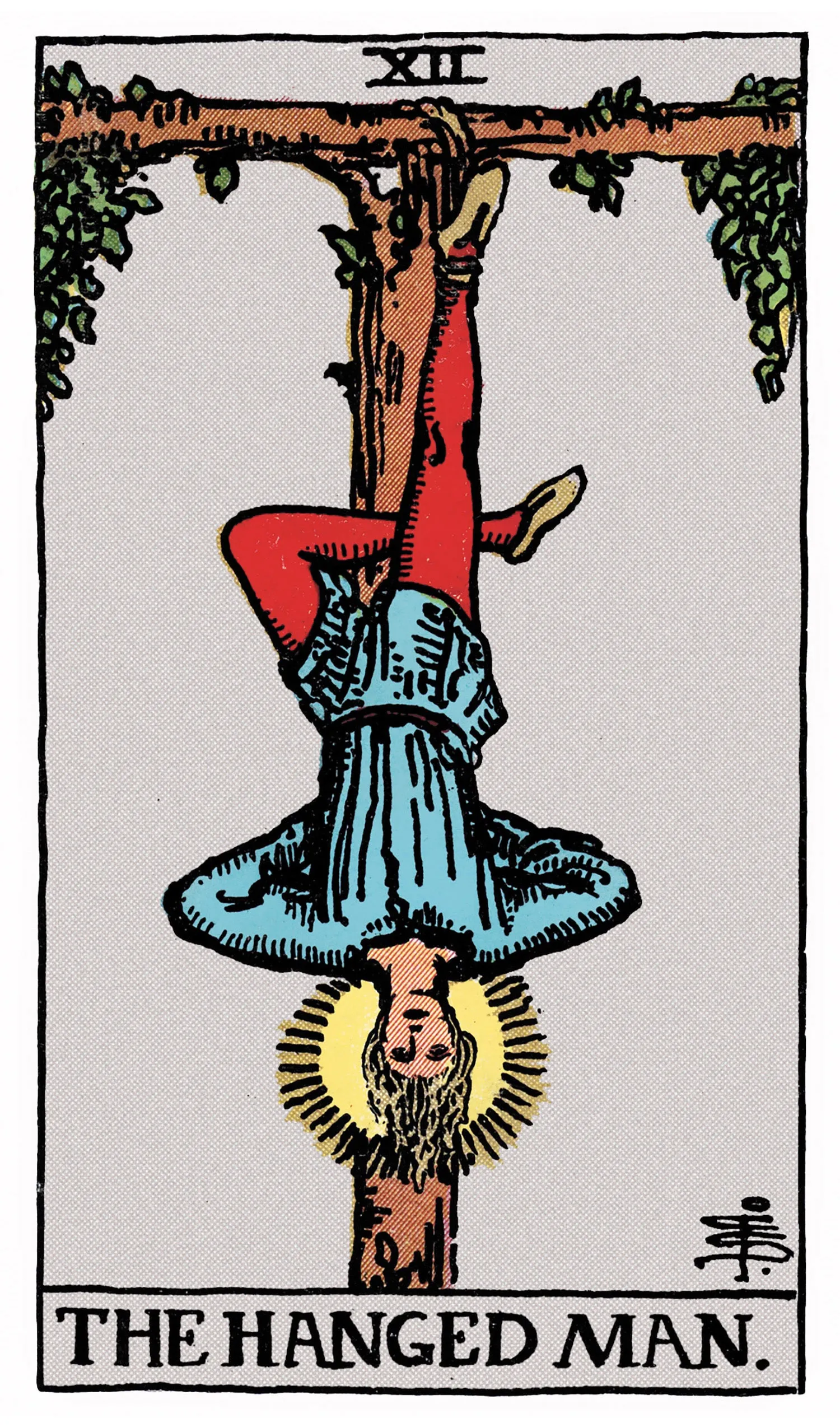
Major Arcana · Card XII
The Hanged Man Tarot Card Meaning
The Hanged Man represents suspension, restriction, waiting, sacrifice, and a situation that cannot move forward through ordinary action. Progress is limited, and the person may have to depend on circumstances, tolerate uncertainty, or consciously accept restrictions because something matters enough to justify the price. A new perspective can emerge during this pause, but the card itself does not guarantee that waiting or sacrifice will eventually produce the desired result.
Card Meanings
General Meaning
The Hanged Man describes a period in which normal progress stops. The situation is not necessarily finished, but it is suspended: something prevents it from developing in the expected direction, and direct effort may have little effect.
This card often appears when a person has limited control over what happens next. They may be waiting for another person's decision, external circumstances, missing information, or a change that simply cannot be forced. Sometimes the restriction is imposed from outside. At other times, the person consciously accepts it because the goal, relationship, responsibility, or path matters enough to justify a temporary loss of freedom.
This distinction is important. The Hanged Man is not always a helpless victim. It can represent considerable endurance and a deliberate willingness to pay a price for something deeply important. A person may knowingly give up comfort, money, time, freedom, or immediate gratification because they have chosen a longer and more difficult path.
However, sacrifice itself is not proof that the goal will be achieved.
The card therefore asks two separate questions: What are you giving up? And is the goal still worth that price?
The Hanged Man can also bring a different perspective. This is often described as enlightenment or seeing things from another angle, but in practical readings the change in perspective frequently happens because the person's previous methods have stopped working. When ordinary action produces no movement, they are forced to reconsider their assumptions, priorities, or strategy.
In spiritual or deeply introspective contexts, the card can describe retreat, meditation, withdrawal from ordinary activity, or an internal process that becomes more important than external achievement.
The Hanged Man does not normally promise quick resolution, decisive progress, or an immediate result. Without a meaningful change in circumstances, priorities, or behavior, the situation can remain suspended for a very long time.
The Shadow Side of The Hanged Man
The shadow side of The Hanged Man appears when patience becomes passivity, sacrifice becomes self-erasure, or waiting continues long after it has stopped being useful.
A person may remain attached to an unsatisfactory situation because they have already invested too much time, energy, emotion, or money to walk away. The greater the previous sacrifice, the harder it becomes to accept that continuing may not improve the outcome.
Another shadow expression is identifying too strongly with suffering itself. The person may begin to believe that endurance automatically makes the situation meaningful or that giving more must eventually produce a reward.
The Hanged Man can also show learned helplessness: the conviction that nothing can be done, even when a difficult choice still exists.
The central danger is not sacrifice itself. It is losing the ability to distinguish necessary sacrifice from pointless suffering.
The Hanged Man Reversed
The Hanged Man reversed is a damaged and less productive expression of the same principle.
The suspension becomes more exhausting, the waiting less meaningful, and the sacrifice increasingly ineffective or badly directed. A person may continue paying a price without addressing the actual reason the situation remains stuck.
This can create a powerful sunk-cost pattern: I have already endured so much that I cannot stop now.
The reversed card can therefore describe prolonged stagnation, burnout, wasted effort, or sacrifice that no longer serves its intended purpose.
In some cases, the person is making sacrifices in the wrong place. They may spend energy, money, or emotional resources on symbolic gestures while avoiding the harder change that would actually be required.
There can also be denial of existing restrictions. The person behaves as though they are free to do whatever they want while the real circumstances continue to limit them.
The Hanged Man reversed does not indicate easy liberation. It shows that the original suspended state has become more distorted, exhausting, or unproductive.
Core Message
Not every situation can be moved forward by trying harder.
Sometimes the only available path is to wait, surrender control, accept a limitation, or consciously pay a price for something that matters.
But The Hanged Man also asks for discernment. A meaningful sacrifice and a pointless sacrifice can look very similar from the outside.
The situation may remain suspended until circumstances change—or until the person finally decides that the price is no longer worth paying.
The Hanged Man as a Person
As a person, The Hanged Man can describe someone with an extraordinary capacity for endurance.
They may tolerate restrictions, uncertainty, discomfort, or delayed gratification far longer than most people. When they truly believe in a goal, they can be willing to give up a great deal in order to pursue it.
This does not necessarily make them weak or passive. Their strength often expresses itself through persistence rather than force. Unlike someone who fights every obstacle directly, The Hanged Man can withstand a difficult situation for a very long time without abandoning what matters to them.
They are often reflective, observant, psychologically deep, and capable of seeing situations from unusual perspectives. They may be drawn to spirituality, introspection, unconventional ideas, or forms of knowledge that require withdrawal from ordinary activity.
The difficult side of this personality is the ability to endure too much.
They may remain in uncomfortable relationships, jobs, financial commitments, or personal situations because they keep believing that the sacrifice must eventually become worthwhile.
They can also struggle to make decisive breaks. Rather than choosing a clear direction, they may remain emotionally or practically suspended between alternatives.
The Hanged Man as Actions
As actions, The Hanged Man usually indicates little visible movement.
The person waits, observes, postpones, tolerates, adapts, or allows circumstances to develop without forcing them.
Sometimes this is deliberate. The person understands that acting now would not improve the situation, so they accept a temporary limitation.
In other cases, inactivity is not a choice. They may want to act but be unable to do so because they depend on another person, lack necessary resources, are waiting for a decision, or cannot influence the circumstances directly.
The card can also describe knowingly accepting inconvenience or restriction in pursuit of a longer-term goal.
The Hanged Man in Love and Relationships
In relationships, The Hanged Man often describes a connection that is suspended rather than naturally developing.
The relationship may exist, but its status remains unclear. A person may be waiting for commitment, waiting for someone to make a decision, or remaining emotionally attached while nothing significant changes.
This is especially characteristic of a long, slow relationship crisis. The card does not necessarily represent the dramatic beginning of a crisis or its final ending. Instead, it can show the exhausting middle stage in which the problem has existed for a long time and neither person knows when or how it will finally be resolved.
One partner can be more dependent on the situation than the other and may sacrifice personal wishes, freedom, time, or emotional comfort simply to preserve the connection.
However, sacrifice can also be conscious. In a committed relationship, a person may willingly accept temporary difficulties because the relationship itself is important enough to them.
The essential question is whether both people understand what they are sacrificing and whether the relationship is actually developing as a result.
The Hanged Man does not automatically mean that there are no feelings. It means that feelings are not necessarily producing movement.
In a new connection, the card can indicate extremely slow development, uncertainty, distance, or circumstances that prevent the relationship from progressing normally.
For someone who is single, it can show a period in which repeated attempts to create a relationship bring little progress until something changes in the person's circumstances, expectations, or approach.
The Hanged Man as Thoughts
In Thoughts, The Hanged Man shows someone mentally occupied with a situation they do not know how to move forward.
They may believe that acting now would not help, so they continue observing, waiting, reconsidering, or trying to understand the situation from another perspective.
They may also think that the outcome depends largely on circumstances outside their control.
There is often awareness that the old strategy is no longer working, even if the person has not yet decided what should replace it.
If they are consciously making a sacrifice, their thoughts may revolve around whether the goal remains worth the price they are paying.
The Hanged Man as Feelings
The Hanged Man is not primarily a card of emotional expression.
Feelings may exist, sometimes strongly, but they are suspended rather than actively expressed. A person can remain deeply attached while simultaneously believing that they cannot do anything useful about the situation.
The card can show emotional waiting, longing without movement, resignation, or willingness to tolerate discomfort because the connection still matters.
It may also indicate that love itself has become connected with sacrifice: the person believes that remaining, waiting, or giving something up is part of what the relationship requires.
This does not automatically make the sacrifice healthy or productive.
The Hanged Man as Intentions
As intentions, The Hanged Man usually indicates no immediate plan to force the situation forward.
The person may intend to wait, preserve the current connection, observe what happens, or postpone a decision until circumstances change.
They can also consciously intend to make sacrifices for the relationship because preserving it matters more to them than immediate comfort.
This is therefore not a strong card of decisive romantic initiative. Even when interest exists, the intention may simply be to remain connected and tolerate the current situation rather than make a major move.
The Hanged Man as an Outcome
As an outcome, The Hanged Man usually shows that the situation does not reach a final resolution within the period being examined.
Instead, it remains suspended.
Plans may be delayed, decisions postponed, or progress blocked by circumstances that cannot currently be controlled.
The expected result may require another stage, a sacrifice, or a fundamental change in approach before it can materialize.
This card is therefore not a strong indicator of successful completion. It does not necessarily show permanent failure, but it does show that the desired result is not arriving in the normal or expected way.
A person may deliberately accept this suspension because they believe the long-term objective is worth it. Even then, The Hanged Man itself does not guarantee that the sacrifice will ultimately be rewarded.
In many cases, the situation remains unchanged until someone alters their behavior, gives something up, or makes a decision they had previously avoided.
The Hanged Man in Career and Work
In career questions, The Hanged Man often indicates professional stagnation, delay, or dependence on decisions made by other people.
A project may be waiting for approval, funding, information, management decisions, or circumstances outside the individual's control.
For someone looking for work, the process may take significantly longer than expected. Applications, offers, negotiations, or promotions can remain unresolved.
The card can also show professional sacrifice. A person may accept reduced freedom, inconvenient conditions, lower immediate reward, years of training, or a difficult period because they believe the long-term professional objective is important enough to justify it.
Another important manifestation is becoming the scapegoat.
The Hanged Man can show a person being blamed for problems they did not create, placed in an uncomfortable position by management, made responsible for someone else's mistakes, or left unable to defend themselves effectively because the power to resolve the situation belongs to someone else.
For business and projects, the card may indicate the need for a different strategy or an unconventional approach, especially when the existing method has completely stopped producing progress.
However, a change in perspective is not the same as a guaranteed solution. Surrounding cards determine whether the new approach can actually work.
The Hanged Man in Money and Finances
Financially, The Hanged Man often represents restriction, sacrifice, loss of financial freedom, or resources that cannot be used as freely as the person would like.
Payments may be postponed. Funds can be tied up. A person may possess resources but be unable to access or redirect them because of existing obligations.
The card can also indicate real financial sacrifice or loss. Money may have to be spent without producing an immediate benefit, expenses may need to be reduced, or a person may have to give up something valuable in order to meet another obligation.
Long-term financial commitments are especially characteristic of this card.
A mortgage, major loan, educational commitment, business obligation, or other continuing payment can restrict a person's ability to use their income freely for years. The commitment may have been entered voluntarily because the goal was considered worth the cost, but it still creates a genuine limitation.
The Hanged Man therefore warns against assuming that an investment is worthwhile merely because a large amount has already been spent.
It can also caution against contracts or financial arrangements that are extremely difficult to leave once entered.
The Hanged Man in Health
In the Tarovera health system, The Hanged Man is associated with illness, injury, difficult physical condition, or significant physical strain.
It can also appear around difficult pregnancy or childbirth situations.
Within this Tarot system, additional associations include stroke-related themes and blood-pressure problems that a person may not notice. In combination with The Tower, the card may be associated with surgery.
These are Tarot-system associations only and should never be treated as medical diagnosis or proof of a specific condition.
Tarot should not be used as a substitute for medical diagnosis or treatment.
The Hanged Man Timing — When Will It Happen?
The Hanged Man is an extremely slow card.
When it appears in a timing question, the situation may remain unresolved for a very long time because the card itself does not naturally create movement.
The event can be delayed until circumstances change or until the person involved becomes tired of remaining in the same suspended position and finally decides to do something differently.
Because of this, The Hanged Man often describes a condition rather than a precise countdown.
The situation continues for as long as the factor keeping it suspended remains unchanged.
Key Timing Correspondence
When? — Autumn.
How soon? — Very slowly. Potentially a very long time, often until the person becomes tired of the situation and finally decides to change something.
The Hanged Man as an Event
As an event, The Hanged Man can indicate a delay, suspension, postponement, forced waiting period, or temporary inability to proceed.
A plan may be put on hold. A decision may be postponed. A person may become dependent on someone else's response or on circumstances they cannot control.
The event can also involve sacrifice or restriction: taking on a demanding commitment, giving something up for a larger objective, accepting inconvenience, or entering a situation that will limit freedom for a long period.
In another manifestation, the card can describe the moment when a person realizes that the old method is no longer capable of moving the situation forward.
Rather than being a dramatic external event, The Hanged Man frequently represents the point at which movement stops and a different approach becomes necessary.
The Hanged Man as Card of the Day
As Card of the Day, The Hanged Man suggests a slower day in which forcing progress may accomplish very little.
Plans can be delayed, responses may not arrive, or circumstances may require patience.
There may also be a situation in which you consciously have to accept inconvenience or give something up because another priority matters more.
Use the day to observe what is actually preventing movement rather than repeatedly pushing against the same obstacle.
It may also become clear where patience is still meaningful—and where sacrifice has already stopped serving a useful purpose.
The Hanged Man as Advice
The Hanged Man advises you not to waste energy trying to force something that cannot currently be forced.
Accept what is genuinely outside your control and observe the situation carefully.
If the goal is important enough, you may need to accept temporary limitations, inconvenience, or sacrifice. Do this consciously rather than seeing yourself only as a victim of circumstances.
At the same time, calculate the price.
A meaningful goal can justify sacrifice, but sacrifice does not automatically make a goal meaningful and does not guarantee success.
Be prepared to reconsider your perspective, strategy, or expectations if the old approach is clearly producing no movement.
Ask yourself what you are waiting for, what you are giving up, and what would genuinely have to change before the situation could move again.
The Hanged Man Reversed as Advice
Stop sacrificing in the wrong place.
If the situation has remained unchanged for a long time, examine whether your patience still serves a real purpose or whether you are continuing only because you have already invested too much to stop.
Do not substitute symbolic effort for the difficult action that would actually address the problem.
The reversed Hanged Man advises distinguishing commitment from self-destruction, patience from stagnation, and meaningful sacrifice from waste.
The Hanged Man as a Warning
The Hanged Man warns against remaining suspended indefinitely.
Patience can become a trap when the person keeps postponing a necessary choice and calling it timing, sacrifice, loyalty, duty, or hope.
The card also warns against giving too much control to another person or to circumstances without regularly reassessing whether the situation remains worth the cost.
Another major danger is the sunk-cost mentality: continuing simply because you have already invested too much to walk away.
At the same time, the opposite mistake is refusing every limitation or sacrifice simply because it is uncomfortable. Some goals genuinely require commitment.
The warning is therefore about misjudging the price—either sacrificing far too much for too little or refusing a necessary sacrifice for something that truly matters.
The Hanged Man — Yes or No
Upright: No
The Hanged Man usually gives a No.
The desired result is not moving toward realization in its current form. The situation is suspended, delayed, or dependent on conditions that have not yet changed.
This does not always mean that the outcome is impossible forever. It means that as things stand now, the answer is no.
Reversed: No
The reversed Hanged Man is also usually No.
The same lack of movement remains, but the delay is more prolonged, exhausting, or unproductive.
The situation is not moving toward an easier resolution. The existing sacrifice, waiting, or effort may simply be failing to change the underlying problem.
The Hanged Man Symbolism
The traditional Rider–Waite–Smith image shows a man hanging upside down by one foot from a wooden structure. Despite the apparently restrictive position, his expression is calm.
The image captures the central contradiction of the card: restriction without complete defeat, sacrifice without automatic helplessness, and external immobility combined with internal awareness.
The Suspended Figure
The man's position shows that ordinary movement is impossible.
He cannot simply walk forward, change direction, or act in the usual way. This reflects situations in which direct action has temporarily lost its effectiveness.
At the same time, he does not appear to be struggling violently against his position. This introduces the possibility of conscious acceptance: some limitations cannot be removed immediately, and fighting them constantly may waste more energy than understanding them.
The Bound Foot
The figure hangs by one foot, emphasizing restriction rather than destruction.
He is not falling and he is not dead. The situation is maintained in a suspended state.
This is one reason The Hanged Man often represents unresolved conditions rather than definite endings.
The Free Leg
The other leg remains bent and relatively free.
This suggests that even in a highly restricted situation, not everything has been taken away.
Some internal freedom remains: the person can observe, reconsider, change priorities, or eventually choose a different response.
The Halo
The halo around the man's head suggests awareness, insight, or realization.
However, this understanding emerges while the person is suspended.
The symbolism therefore connects insight with limitation: a different perspective becomes possible because ordinary activity has been interrupted.
The Inverted Perspective
The upside-down position symbolizes seeing reality from an angle that would not normally be chosen.
This does not mean that changing perspective automatically solves the problem.
Instead, the inability to continue normally forces the person to reconsider what they believed, expected, valued, or planned.
The Living Wood
The figure is suspended from living wood rather than a symbol of complete destruction.
Life continues, but its normal movement has been interrupted.
The image therefore supports one of the most important distinctions of The Hanged Man: suspension is not the same thing as an ending.
The Core Symbolism of The Hanged Man
The entire image represents conscious life held in suspension.
The Hanged Man is neither moving forward nor reaching a final conclusion. He exists between stages, restricted by circumstances but still capable of awareness and choice.
His position can represent imposed limitation, but it can also represent deliberate sacrifice: accepting a temporary loss of freedom because something else has been judged more important.
The card's central symbolism therefore contains both sides of the same principle.
Sometimes we cannot move.
Sometimes we consciously choose not to move.
And sometimes a situation remains suspended until we finally decide whether the thing we are waiting or sacrificing for is still worth its price.