Major Arcana · Card IX
The Hermit Tarot Card Meaning
The Hermit represents withdrawal from external influence in order to follow one's own judgment, experience, and inner truth. It is a card of independence, maturity, concentration, self-knowledge, and a path that cannot be rushed. The Hermit is slow, resistant to pressure, and difficult to redirect once a position has been formed. As the ninth Major Arcana, it can also mark a late stage of a process: something may be true or may already have happened, while the active phase itself is nearing completion or has already ended.
Card Meanings
General Meaning
The Hermit describes a person or situation that turns away from external noise in order to determine what is personally true, necessary, or meaningful.
This is not simply a card of being alone. Its deeper principle is independence from external influence. The Hermit does not easily change direction because other people expect it, because something is socially accepted, or because pressure is being applied. He relies on his own experience and internal standards.
This makes The Hermit highly self-directed but also difficult to influence. Once he has formed a position, changing his mind can take a very long time. Pressure usually strengthens his resistance rather than overcoming it.
The card also represents serious inward work: study, analysis, self-examination, specialization, and the search for an answer that must be personally understood rather than simply accepted from someone else.
Because The Hermit is numbered nine, it often appears when a process is already far advanced. It can represent accumulated experience, maturity, and a late stage of development. In some questions, it may confirm that something happened or was true while simultaneously showing that the active phase has already ended or that the opportunity belongs more to the past than to the future.
The Hermit is also one of the slowest cards in Tarot. Whatever develops under this card usually requires time, patience, depth, and very little external pressure.
The Shadow Side of The Hermit
The Hermit's independence can become stubbornness and inflexibility.
A person may become so committed to their own way of thinking that they stop considering whether another perspective might be useful. Self-reliance can develop into refusal to cooperate or accept help. Privacy can become secrecy, and solitude can become emotional or social isolation.
The Hermit may also remain in reflection for too long. Instead of using time alone to reach clarity, the person can continue withdrawing, analysing, and postponing until the situation no longer has the same possibilities it once had.
His greatest strength is the ability to remain true to himself. His danger is becoming so closed that nothing and no one can reach him.
The Hermit Reversed
Reversed, the qualities of The Hermit become more rigid, isolated, and unproductive.
The person may withdraw without actually reaching clarity, remain trapped inside their own conclusions, refuse appropriate advice, or become increasingly difficult to communicate with. Experience may exist, but they may be unable to use it effectively.
The card can show excessive suspicion, false certainty, emotional disconnection, stubbornness, prolonged isolation, or knowledge that remains theoretical rather than useful.
Its natural slowness may also deteriorate into stagnation. Instead of taking the necessary time to understand something, the person simply does not move.
Core Message
The Hermit asks you to separate your own judgment from external pressure and discover what is actually true for you.
Take the time necessary to understand the situation deeply, but remember that reflection should eventually produce clarity. Wisdom is not only knowing when to withdraw; it is also knowing when the withdrawal has served its purpose.
The Hermit as a Person
The Hermit as a person is independent, private, serious, observant, and strongly guided by personal principles.
This individual does not adapt easily to other people's expectations. They are unlikely to change their lifestyle, beliefs, plans, or behavior simply to maintain social harmony. If others want to remain close to them, it is often the others who must adjust more.
They may be introverted, but introversion alone does not define The Hermit. What matters more is psychological autonomy.
This person usually needs less external approval than most people. They can tolerate solitude, work independently for long periods, and remain committed to something even when nobody around them understands or supports it.
The Hermit may also be unusually mature, highly experienced, or literally older. They can become extremely knowledgeable in a narrow subject because they are capable of years of concentration and study.
Their difficult side is stubbornness. Once they decide what they believe, want, or do not want, persuading them otherwise can be extremely difficult.
They can also be secretive and socially invisible. They may reveal very little about their private life and prefer to keep their inner world inaccessible to most people.
The Hermit as Actions
As actions, The Hermit withdraws, reduces contact, stops participating actively, studies, observes, waits, works alone, or takes distance in order to determine a personal position.
Importantly, The Hermit may produce almost no visible external action.
The person may not call, write, make an offer, explain themselves, or even clearly refuse. Instead, they step back and decide privately what they think, what their boundaries are, and whether they want to continue participating at all.
Pressure rarely speeds this up. Attempts to force a reaction may make the person withdraw even more.
Because The Hermit is associated with a late stage of a process, his actions can also involve reviewing, finishing, quietly leaving, or closing something rather than actively starting a new phase.
The Hermit in Love and Relationships
The Hermit is generally a difficult card for romantic development because its natural movement is toward autonomy rather than increasing closeness.
Relationships require at least some willingness to adapt, compromise, communicate, and make room for another person. The Hermit is strongly attached to his own internal direction and may resist precisely this kind of adjustment.
In an existing relationship, the card can show growing emotional or physical distance, separate lives, reduced communication, or a strong need for individual space. One partner may become increasingly focused on their own path rather than on maintaining the relationship as a shared unit.
The card does not automatically guarantee separation, but it is not naturally supportive of increased intimacy. If the relationship is already unstable, The Hermit can show withdrawal, disengagement, or a decision to continue separately.
For a new relationship, development is usually very slow. The person may not be ready to let someone deeply into their life or may consider their own work, interests, private life, or independence more important than building a partnership.
Because The Hermit is a late-stage card, it can also appear when a romantic chapter is approaching completion rather than expansion.
The Hermit as Thoughts
In thoughts, The Hermit shows serious private reflection.
The person is likely asking what the relationship actually means to them, whether it fits their life, why they are involved in it, and whether continuing it is genuinely right for them.
They are not primarily thinking about pleasing the other person. Their attention is directed toward their own truth, limits, priorities, and experience.
The Hermit may also show someone reviewing the past and trying to understand whether the relationship still has a meaningful future or whether its purpose has already been fulfilled.
This mental process is slow and resistant to pressure.
The Hermit as Feelings
As feelings, The Hermit is emotionally restrained and relatively cold compared with cards that naturally express closeness, passion, or emotional exchange.
Feelings can exist, and they can even be deep, but the person does not necessarily experience those feelings as a need for constant contact or closeness.
The Hermit can care about someone while remaining psychologically independent from them.
The card is also weak as an indicator of strong sexual desire. It can show reduced sexual interest, low need for physical intimacy, or a person who is capable of remaining without sexual or romantic involvement for long periods without experiencing this as a major problem.
In some situations, it indicates emotional cooling or the sense that feelings belong more to a completed chapter than to an expanding relationship.
The Hermit as Intentions
As intentions, The Hermit wants time, distance, autonomy, and freedom from pressure.
The person's first intention is usually not to increase closeness. It is to understand whether the relationship belongs in their life at all.
They may intentionally reduce communication, step away temporarily, or continue living according to their own priorities while deciding what place the other person should have.
If they ultimately conclude that the relationship conflicts with their direction, The Hermit is capable of simply continuing alone rather than compromising in order to preserve the connection.
The Hermit as an Outcome
As an outcome, The Hermit produces an internal result much more readily than an external one.
The person may gain understanding, experience, independence, expertise, or a clear personal position. They may finally know what they want and stop allowing external pressure to determine their direction.
However, if the question requires visible external progress, active cooperation, rapid development, reconciliation, expansion, or strong material results, The Hermit can be disappointing.
Sometimes the external result simply does not happen in the expected form because the energy of the situation turns inward instead.
The card can also show withdrawal from participation or the completion of a chapter. Instead of achieving the expected external objective, the person may decide that they no longer need to continue pursuing it.
This outcome develops slowly.
The Hermit in Career and Work
The Hermit can be an excellent career card when professional success depends on knowledge, specialization, experience, research, analysis, or individual mastery.
It strongly favors the role of the specialist.
Possible areas include research, science, writing, analysis, archives, investigation, teaching, consulting, therapy, scholarship, technical expertise, specialist advisory work, and professions in which depth is more important than visibility.
The Hermit can indicate someone becoming highly respected because they know far more about a specific subject than most people around them.
It is also favorable for independent work and roles where autonomy is important.
However, career success and business success are not the same thing under this card.
The Hermit is much weaker for commercial expansion, aggressive growth, networking-based business, sales, rapid scaling, or ventures that depend on constant external engagement.
A person can be an outstanding specialist under The Hermit while still struggling to turn that expertise into a large or rapidly growing business.
The card may also indicate retirement, reducing professional involvement, stepping away from a position, or completing a long stage of one's career.
The Hermit in Money and Finances
The Hermit is generally restrained in financial matters.
It can indicate limited income, reduced financial activity, modest living, careful spending, or the need to operate with fewer material resources.
This card is much stronger for reducing needs than for increasing wealth.
The Hermit may encourage a person to live more simply, avoid unnecessary purchases, preserve what they already have, or deliberately withdraw from material competition.
However, it is not a strong card for profit, rapid income growth, financial expansion, or material abundance.
In questions about receiving money, higher earnings, profitable agreements, or significant financial growth, The Hermit can indicate less than expected, delays, reduced income, or even a situation in which an agreement does not produce the anticipated financial result.
The Hermit in Health
Within the project's Tarot health system, the upright Hermit can describe a person with considerable inner resilience or a strong internal constitution, while also emphasizing the importance of routine, regular movement, and appropriate physical activity.
The card frequently appears in connection with older people or age-related considerations.
Its constructive expression favors consistency rather than excess: stable habits, movement, appropriate rest, and maintaining a dependable daily rhythm.
Tarot should not be used as a substitute for medical diagnosis or treatment.
The Hermit Timing — When Will It Happen?
The Hermit is one of the slowest cards in Tarot.
It rarely indicates immediate development and often shows that the process requires considerably more time than the person asking the question expects.
If the question is “When?”, the primary timing correspondence is:
Late August / early September.
If the question is “How long will it take?”, the answer is:
Not soon. Approximately two years minimum, and potentially longer.
The Hermit's timing reflects gradual development, accumulated experience, maturation, and a process that cannot be accelerated simply through pressure or impatience.
Key Timing Correspondence
When? — Late August / early September
How long? — Very slow; approximately two years minimum, potentially longer
The Hermit as an Event
As an event, The Hermit can indicate withdrawal from a group, relationship, project, or social environment.
A person may deliberately reduce involvement, spend more time alone, enter a period of intensive study or research, or decide to continue independently.
The card may also indicate consultation with an experienced specialist, adviser, mentor, teacher, or expert.
In other cases, the event is quieter: the person recognizes that a stage of life has already run its course and begins separating from it.
The Hermit often produces a change in participation rather than a dramatic external event.
The Hermit as Card of the Day
The Hermit as Card of the Day suggests a quieter and more focused day.
You may want less social interaction than usual or find that working alone is more productive.
It is a good day for study, analysis, research, reviewing something already in progress, seeking specialist advice, or thinking carefully before making an important decision.
Do not force speed.
The useful expression of this card is concentration and depth.
The Hermit as Advice
Step away from external noise and determine what you genuinely think before acting.
Do not make a decision simply because other people want you to move faster or choose differently.
Study the situation thoroughly. Investigate the details. Gain enough experience or information to make your own informed judgment.
If you are considering beginning something new, The Hermit advises you not to rush into it. Learn first, understand the process, prepare carefully, and only then begin.
The card may also advise reducing unnecessary social or external involvement so that you can concentrate on what is actually important.
Finally, recognize when something has already reached its natural end. Wisdom sometimes means accepting that a chapter does not need to be reopened.
The Hermit Reversed as Advice
Do not allow useful reflection to become permanent withdrawal.
If you already have enough information, use it.
Question whether independence has turned into stubbornness or whether caution has become an excuse for never moving forward.
Allow appropriate advice, information, and human contact back into the situation when they can genuinely help.
The Hermit as a Warning
The Hermit warns against excessive isolation, rigidity, and refusal to adapt.
A strong internal position is useful, but becoming completely unreachable can damage relationships, opportunities, and cooperation.
The card also warns about time.
The Hermit moves extremely slowly, and some situations will not remain available forever. Waiting too long can mean that by the time you decide to act, the opportunity has already passed.
If the result depends on another person's agreement, flexibility, return, permission, or willingness to change their established position, The Hermit warns that this person may be extremely difficult to move.
Do not underestimate stubbornness.
The Hermit — Yes or No
The Hermit does not work well as a completely mechanical Yes or No card because its answer changes significantly depending on what the question actually asks.
Its basic upright tendency can be Yes, but its slowness, independence, withdrawal, and stubbornness must always be applied to the wording of the question.
Upright: Yes — but strongly dependent on context
If the question is about whether something is worth exploring, studying, trying, or pursuing carefully, The Hermit can answer yes.
For example:
“Should I explore this field?” — Yes. But study it deeply, do not rush, and prepare before committing.
“Should I try doing this?” — Yes. But approach it patiently and understand the process first.
The card can also answer yes when confirming a fact, particularly something connected with the past.
However, because The Hermit is a late-stage card, this can sometimes mean:
Yes, it happened — but the process may already be over.
The fact is confirmed while the active stage itself is already closing or closed.
At the same time, questions containing a time condition may produce a practical no.
“Will I get married soon?” — No, not soon.
The Hermit is too slow to support the word “soon.”
Questions that depend on another person's willingness to return, change their mind, give permission, compromise, or become more flexible are also much less favorable.
“Will he come back?” — Unlikely.
The Hermit can describe someone who has withdrawn, made their own decision, and is extremely difficult to persuade.
Therefore, the correct Yes or No interpretation must preserve the mechanism of the card rather than applying the word “yes” mechanically.
Reversed: No
The reversed Hermit generally answers no.
Its slowness, withdrawal, rigidity, and disconnection have become too impaired for constructive development. The situation is more likely to remain stuck, closed, isolated, or unable to progress normally.
The Hermit Symbolism
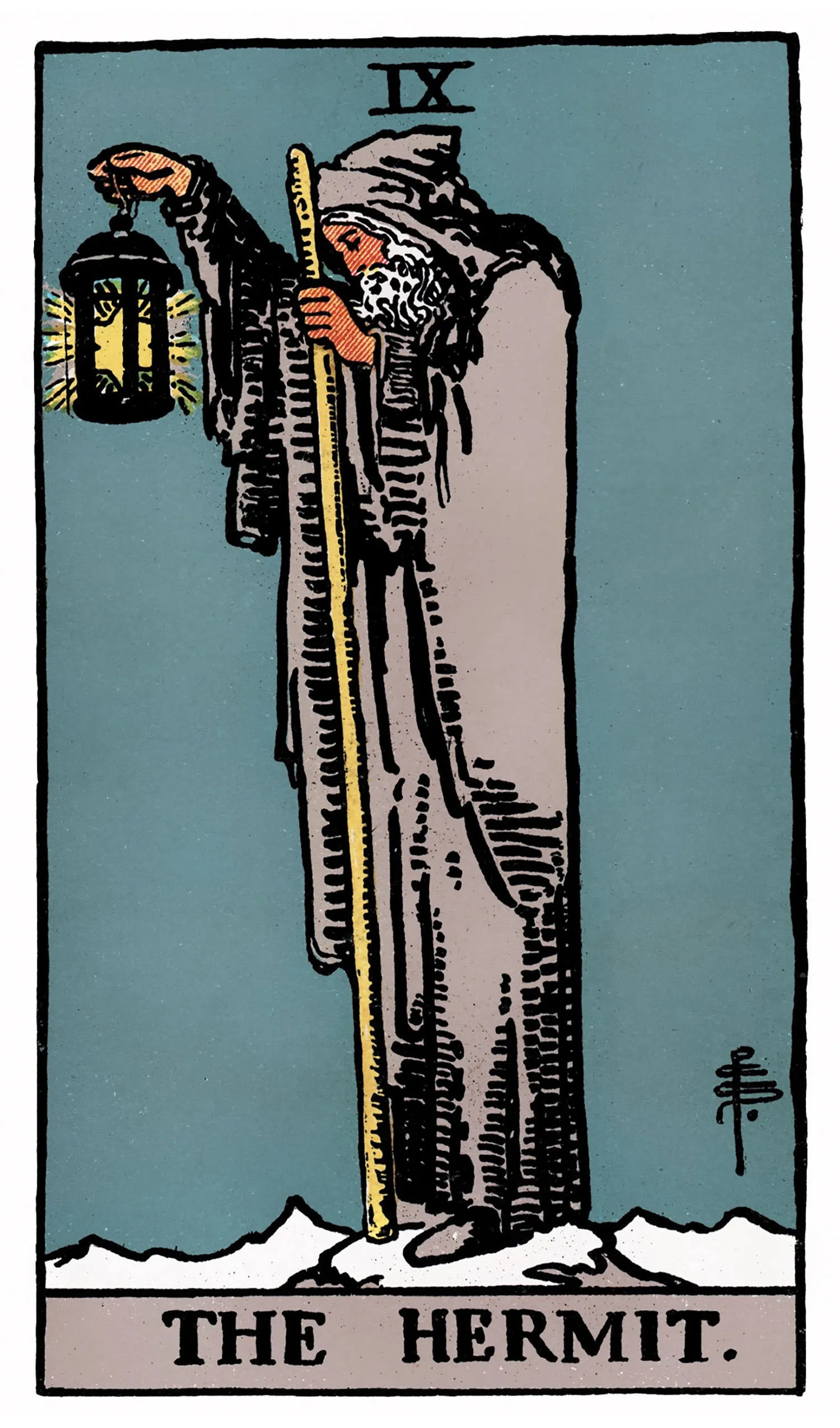
The Rider–Waite–Smith image presents The Hermit alone at a great height, carrying a lantern and a staff.
The image emphasizes maturity, independence, accumulated experience, personal direction, and a path that must be travelled at one's own pace.
The Number IX
Nine represents a late stage of development.
Much has already happened before this point, and the process is closer to completion than beginning.
For The Hermit, this supports maturity, accumulated experience, and the possibility that something has already run most of its course.
This is why the card can sometimes confirm a past fact while simultaneously suggesting that the corresponding phase is already over.
The Elderly Figure
The Hermit is traditionally shown as an older man.
His age represents knowledge and experience accumulated over time.
He is not rushing to discover the world for the first time. His perspective is based on what he has already lived, studied, and understood.
Age also reinforces the card's slowness and caution.
The Lantern
The Hermit's lantern illuminates only a limited part of the road.
It does not reveal the entire future.
This symbolizes focused understanding: enough light to see the next meaningful step, but not necessarily the whole journey at once.
The Hermit carries the light himself, reinforcing the principle of internal rather than borrowed guidance.
The Staff
The staff represents support, endurance, stability, and self-reliance.
The Hermit continues by leaning on his own accumulated strength and experience.
He does not expect other people to carry him forward.
The Grey Cloak
The muted cloak reflects restraint and lack of interest in external display.
The Hermit does not need attention in order to know his own value.
His identity is not built around being seen, admired, or approved of by others.
The Mountain
The mountain shows that a significant part of the journey has already been completed.
The Hermit has reached a place that offers greater perspective, but this height also separates him from ordinary social life.
Experience gives him understanding, but it can also make him increasingly distant from those who have not travelled the same path.
The Core Symbolism of The Hermit
The Hermit's symbolism combines maturity, solitude, personal guidance, endurance, and a late stage of the journey.
He is not standing at the beginning of the road.
He has already travelled far enough to rely on his own experience and to know that external pressure cannot replace personal understanding.
The card therefore represents much more than solitude.
It is the ability to withdraw from external influence, remain loyal to one's own truth, study what must be understood deeply, move at one's own pace, and recognize when a long stage of the journey has already reached its natural end.