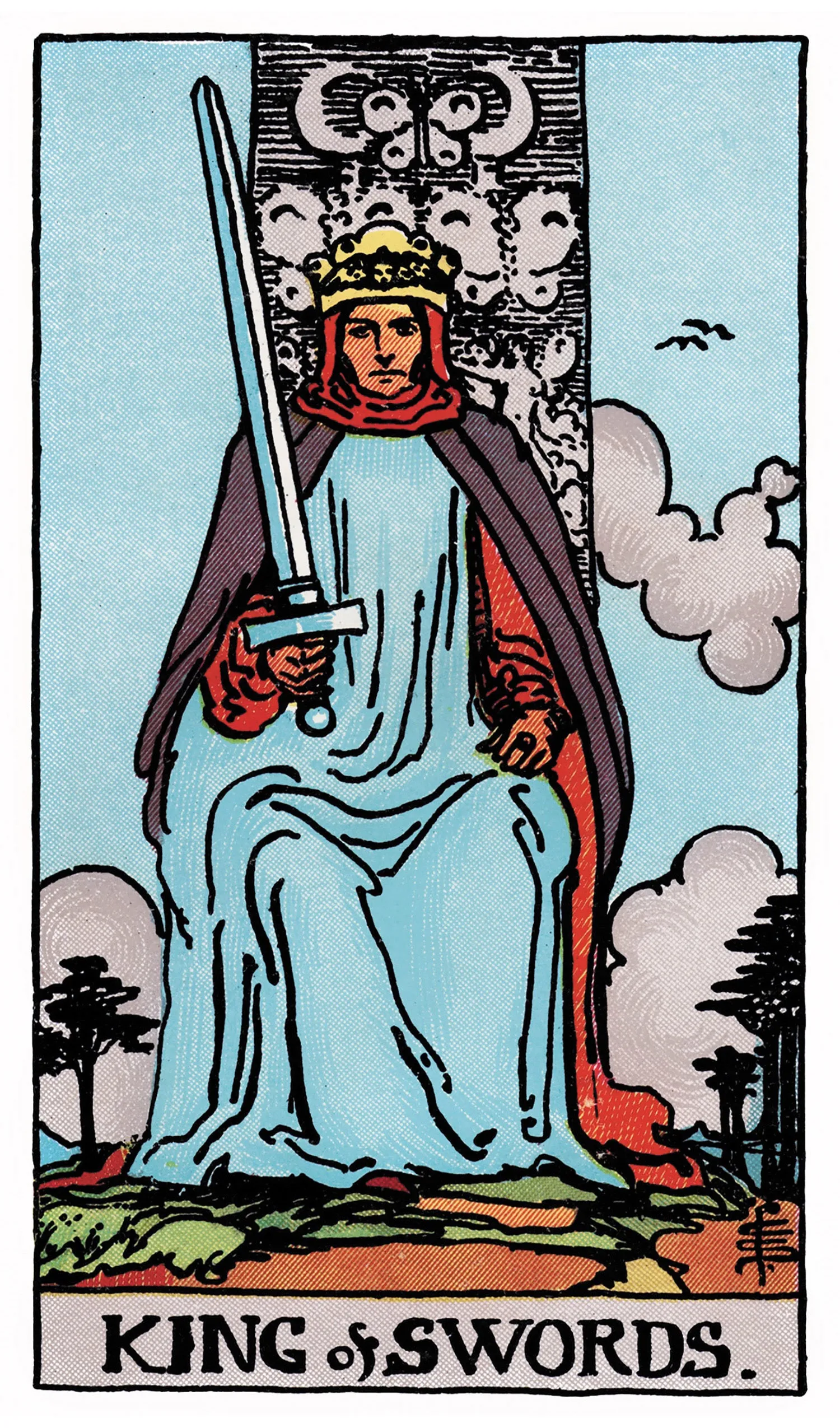
Minor Arcana · Swords · King
The King of Swords Tarot Card Meaning
The King of Swords represents the highest expression of structured intellect within the suit of Swords: strategy, rules, authority, judgment, planning, control, and the power to determine how a system should operate.
He is not simply “a good leader” or “a highly skilled professional.” His central quality is mental authority. He understands systems, establishes principles, defines rules, determines strategy, and makes decisions that other people may be required to follow.
Even upright, this is not a soft or comfortable card.
The King of Swords is strict, formal, demanding, powerful, and often emotionally unsympathetic in the way he applies reason. His decisions may be logical, necessary, lawful, or technically correct while still being deeply unpleasant for the person on the receiving end.
Card Meanings
General Meaning
The King of Swords represents a mature and highly structured form of mental power.
He does not simply understand the immediate problem.
He sees the system surrounding it.
Where the Knight of Swords identifies the target and acts quickly, and the Queen of Swords evaluates, regulates, and applies an existing structure, the King operates at a higher level:
he defines the principle, determines the strategy, and establishes the order according to which others must proceed.
His power lies in:
- strategic thinking;
- long-term planning;
- understanding systems;
- establishing rules;
- defining standards;
- controlling processes;
- making final decisions;
- determining the correct course of action;
- exercising authority.
The King of Swords is especially capable of identifying not simply an action, but the action he believes is objectively required by the situation.
He may know when to intervene, when to refuse, when to punish, when to restructure, and when to end discussion and issue a decision.
This card can represent a person.
But it can also represent an entire structure.
A ministry.
A court.
A government office.
An immigration department.
A regulatory body.
A corporate authority.
A legal framework.
A formal institution.
Any system in which the individual must operate according to established rules may be represented by the King of Swords.
He can also represent the final authority within that system — the level at which a decision is no longer simply reviewed but determined.
This is important because the King is not naturally concerned with whether the rules feel comfortable.
His question is:
“What is the correct procedure?”
not:
“How does this make you feel?”
This does not automatically make the King unfair.
Upright, he may be intelligent, competent, disciplined, lawful, objective, and entirely legitimate.
But legitimacy does not guarantee kindness.
The King of Swords is generally more inclined to enforce consequences than to overlook violations simply because circumstances were difficult.
The Shadow Side of The King of Swords
The King of Swords becomes difficult when structure turns into domination and discipline becomes inflexibility.
His intelligence may become arrogance.
His authority may become control for its own sake.
His standards may become absolute.
His rules may become more important than the people affected by them.
He can become severe, authoritarian, emotionally detached, punitive, or convinced that superior logic gives him the right to override everyone else's position.
Unlike the Knight of Swords, the King does not need open aggression to exert pressure.
He can create conditions.
He can define procedures.
He can change the framework.
He can use regulations.
He can determine who receives approval and who does not.
He can arrange the system in such a way that another person has almost no room to maneuver.
His harshness is therefore often more powerful than the Knight's because it is organized, strategic, and supported by authority.
The King of Swords Reversed
Reversed, the King of Swords retains intelligence, strategy, authority, judgment, and the desire to control the structure — but these qualities become distorted, excessive, biased, poorly directed, or actively harmful.
He may become authoritarian, manipulative, oppressive, vindictive, rigid, intellectually dishonest, or abusive of his position.
He may misuse:
- rules;
- law;
- hierarchy;
- information;
- authority;
- bureaucracy;
- formal procedures.
A reversed King may still possess considerable real power.
He does not need to become weak.
One of the most difficult manifestations of this card is precisely a powerful person or system using authority badly.
The strategy may also be intellectually sophisticated but fundamentally wrong.
The King may build an impressive chain of logic on a false assumption and then mistake the internal consistency of his reasoning for proof that the original assumption was correct.
In other words:
the logic may be excellent while the premise is false.
This can produce extremely confident but seriously mistaken decisions.
In another manifestation, the system of control becomes so rigid and overcomplicated that it stops functioning effectively. The desire to calculate every possibility and eliminate every risk creates strategic paralysis.
The problem is still the same:
the King's mental authority is no longer functioning well.
Core Message
Use reason to create order, not oppression.
Think strategically.
Understand the structure.
Make the decision that is actually required.
But remember that intelligence, authority, and internal logical consistency do not automatically make a decision fair or correct.
The King of Swords as a Person
Explore all 78 Tarot cards as personality →
The King of Swords describes a highly intelligent, strategic, disciplined, authoritative, powerful, and mentally controlled person.
They usually think in systems rather than isolated details.
They consider:
- structure;
- consequences;
- hierarchy;
- responsibility;
- rules;
- risk;
- long-term strategy;
- who has authority;
- what can realistically be enforced.
This person may naturally occupy a position where their decisions have consequences for other people.
They may be:
- an executive;
- government official;
- judge;
- lawyer;
- senior manager;
- regulator;
- authority figure;
- strategist;
- senior specialist;
- institutional decision-maker.
However, the King of Swords is not defined by job title alone.
A person can carry this energy whenever they are accustomed to establishing the framework and expecting others to operate inside it.
They are often difficult to influence emotionally.
Facts, evidence, logic, authority, procedure, and strategy are usually more effective with them than emotional appeals.
They can be highly effective.
They can also be severe.
They may inspire respect.
They may also inspire fear.
The King of Swords is not naturally oriented toward mercy, indulgence, or emotional accommodation.
If a rule exists, he expects it to be followed.
If a consequence has been established, he may enforce it even when doing so is unpleasant.
The King of Swords as Actions
The King of Swords acts through authority, strategy, structure, and decision.
He may:
- make a final decision;
- set conditions;
- define rules;
- issue instructions;
- approve or reject;
- create a strategy;
- change a policy;
- intervene from a position of authority;
- establish formal boundaries;
- sign or terminate an agreement;
- initiate legal or official action;
- summon someone for a serious discussion;
- regulate a process;
- determine how others must proceed;
- punish a violation;
- impose a solution.
His actions are usually less impulsive than the Knight's.
He does not need to rush.
He may already control the framework.
And because of that, a single decision from the King can change the position of many other people.
The King may also act as a powerful third party between opposing sides.
He can intervene as:
- a judge;
- arbitrator;
- manager;
- senior authority;
- official mediator.
But even when he resolves a conflict, he usually does so from a position of power.
He does not simply help the sides understand each other.
He may determine what the resolution will be.
The King of Swords in Love and Relationships
Explore all 78 Tarot cards in Love & Relationships →
The King of Swords is generally **not a favorable card for soft, emotionally mutual relationships**.
His energy is too rigid, hierarchical, controlled, and power-oriented to naturally support emotional equality, tenderness, openness, and easy mutual understanding.
In relationships, he often creates a structure in which one person has more authority than the other.
This can manifest as:
- strict expectations;
- rules imposed by one partner;
- emotional control;
- dominance;
- criticism;
- pressure;
- rigid boundaries;
- suppression of the other person's needs;
- decisions made unilaterally;
- a strong imbalance of power.
The relationship may function.
It may even appear stable from the outside.
But stability is not the same as emotional comfort.
The King of Swords can describe a relationship in which everything has a rule, a consequence, or a condition.
One partner may effectively determine:
- what is acceptable;
- how conflict is handled;
- what the future should look like;
- what the other person is expected to do.
There may be very little softness.
There may be limited emotional understanding.
And in difficult manifestations, there may be genuine suppression.
The partner represented by the King may believe that they are simply being logical or maintaining order while the other person experiences the relationship as controlling or emotionally oppressive.
Feelings may still exist.
This is important.
The King of Swords is not automatically incapable of love.
He may feel loyalty, attachment, passion, responsibility, or even very strong desire.
Sometimes there is considerable internal passion beneath an extremely cold exterior.
But feelings do not automatically soften his behavior.
He may love someone and still make a severe decision if he believes that the relationship conflicts with his principles, plans, responsibilities, career, status, or other priorities.
For this reason, the King of Swords can contribute to separation, divorce, formal breakup, or a definitive restructuring of the relationship when supported by cards of ending, distance, legal matters, conflict, or closure.
He may terminate a relationship not because all feeling has disappeared, but because he has decided that the relationship no longer fits the structure of his life.
The King of Swords as Thoughts
The King of Swords thinks strategically.
He does not focus only on the next move.
He considers:
- where the situation is going;
- what consequences each option creates;
- who has power;
- what rules apply;
- what risks exist;
- what structure is most effective;
- what the long-term objective is;
- how control can be maintained;
- which action is actually necessary.
This is one of the strongest cards for organized, rational, systemic thinking.
Where the Knight asks:
“What should I do now?”
the King asks:
“How must this entire situation be structured to produce the required result?”
The King of Swords as Feelings
The King of Swords is not a strong indicator of emotional softness or emotional abundance.
Feelings may exist, including:
- loyalty;
- respect;
- attachment;
- responsibility;
- attraction;
- strong passion;
- genuine care.
But they are heavily controlled.
The person may experience considerable internal intensity while presenting themselves as calm, distant, cold, or entirely rational.
This can create a “fire under ice” effect: strong internal feeling with very little visible emotional expression.
However, the card alone does not prove deep love.
It tells us more reliably how the person governs and suppresses emotional expression than how much they feel.
The King of Swords as Intentions
The King of Swords usually has a defined objective.
He may intend to:
- establish control;
- clarify the situation;
- define the relationship;
- create rules;
- formalize an arrangement;
- make a final decision;
- determine responsibilities;
- impose order;
- eliminate uncertainty;
- secure a strategic advantage;
- bring the situation under a clear structure;
- enforce a principle.
His intentions are typically long-term and systematic.
He is less interested in improvisation than in determining how the entire situation should operate.
The King of Swords as an Outcome
Explore all 78 Tarot cards as Outcomes →
As an outcome, the King of Swords is a strong indicator of a defined, structured, and often formal result.
The situation may reach:
- a final decision;
- an official ruling;
- a legal or administrative outcome;
- an established strategy;
- a formal agreement;
- a clear hierarchy;
- a regulated process;
- a management decision;
- a defined status;
- an authoritative resolution.
The King is stronger for final structure than either the Knight or Queen of Swords.
He may also indicate the intervention of a powerful third party who resolves a conflict or determines the outcome from above.
This may be:
- an arbitrator;
- judge;
- executive;
- regulator;
- official;
- institutional authority.
However, the existence of a decision does not mean that the decision favors the querent.
The King may bring clarity.
But clarity can mean:
“The decision has been made, and there is little room left to negotiate.”
The card can also represent a matter of principle.
The final result may be determined not by convenience or emotion but by a rule, principle, legal standard, strategy, or position that someone refuses to compromise.
The King of Swords in Career and Work
Explore all 78 Tarot cards in Career & Work →
In career and work, the King of Swords represents strategy, formal authority, systems, regulation, high-level planning, and decision-making.
He may indicate:
- senior management;
- executive authority;
- legal or regulatory work;
- government structures;
- policy;
- strategic planning;
- organizational restructuring;
- formal negotiations;
- contracts;
- compliance;
- institutional authority;
- final approval.
The King may certainly describe an expert or highly accomplished professional.
However, professionalism is not the central meaning of the card.
His defining strength is the ability to understand how an entire structure should operate.
He thinks in:
- systems;
- responsibilities;
- consequences;
- hierarchy;
- chains of command;
- regulation;
- long-term planning.
He does not simply perform well within the system.
He may determine how the system operates.
This can make him exceptionally effective in complex organizations.
It can also make him a harsh superior.
Human flexibility may be treated as secondary to procedure and performance.
The King of Swords in Money and Finances
Explore all 78 Tarot cards in Money & Finances →
The King of Swords is not inherently a card of wealth.
His financial strength lies in structure, intellectual capital, strategy, and control.
He may indicate:
- financial planning;
- contracts;
- legal agreements;
- business strategy;
- cost control;
- restructuring;
- taxation;
- formal financial decisions;
- regulation;
- negotiations;
- professional financial advice;
- money generated through knowledge, information, or intellectual systems.
A favorable financial result under this card usually comes through disciplined planning and an effective structure rather than luck.
The card may also indicate money controlled by an institution, regulator, senior executive, bank, court, or other authority.
The King of Swords in Health
Explore all 78 Tarot cards in Health →
Within the TAROVERA Tarot health system, the King of Swords is associated with the axillary area and the breast.
Upright, the card is associated with severe head injuries and meningitis.
Tarot should not be used as a substitute for medical diagnosis or treatment.
The King of Swords Timing — When Will It Happen?
Explore Timing for all 78 Tarot cards →
The King of Swords is not necessarily impulsive, but once a plan, procedure, or decision has been established, events tend to follow the defined structure.
When the question is “When?”, the King of Swords corresponds to:
September 23 — December 23.
When the question is “How long will it take?”, the card often indicates:
the event will happen according to the existing plan or schedule, or within approximately two months.
This is an important part of the card's timing.
The King of Swords follows structure.
If a date, schedule, procedure, or formal sequence has already been established, the event often occurs according to that arrangement rather than unpredictably.
Key Timing Correspondence
September 23 — December 23
Approximate waiting period: as planned / according to the established schedule, or up to 2 months
The King of Swords as an Event
Explore all 78 Tarot cards as Events →
The King of Swords is a strong event card, especially when the situation involves authority, official structures, rules, law, regulation, or formal decision-making.
He may represent:
- contact with a government office;
- immigration authorities;
- legal institutions;
- management;
- regulators;
- courts;
- official departments;
- senior decision-makers;
- formal negotiations;
- policy changes;
- regulatory decisions;
- legal or administrative procedures;
- serious official conversations;
- decisions issued by a powerful institution;
- the intervention of a senior authority between conflicting sides.
The King can represent not only a person but an entire system.
This is one of the most important TAROVERA meanings of the card.
The querent may encounter a structure where everything is done according to rules and where individual circumstances receive little emotional consideration.
Even upright, this can be unpleasant.
The system may function correctly.
The official may act within their authority.
The procedure may be legitimate.
But no one is required to be especially sympathetic.
The tone is often:
formal, strict, cold, serious, and non-negotiable.
A conversation with the King of Swords is rarely casual.
It may involve:
- a decision;
- condition;
- requirement;
- warning;
- rejection;
- formal instruction;
- legal consequence;
- authoritative resolution.
The King may also appear as a powerful third party that enters a conflict and imposes order.
This can resolve the situation, but it is not necessarily collaborative mediation.
The resolution may simply be determined from above.
The King of Swords as Card of the Day
Explore all 78 Card of the Day meanings →
Today may involve rules, authority, planning, serious decisions, or contact with someone who has the power to determine what happens next.
You may need to:
- deal with an official structure;
- follow a procedure;
- prepare documents;
- negotiate seriously;
- accept formal conditions;
- make a strategic decision;
- interact with a strict authority figure;
- wait for a decision from someone above you.
Do not expect emotional flexibility.
Facts, preparation, rules, procedure, and clear reasoning matter more than personal appeal.
The King of Swords as Advice
Explore Advice from all 78 Tarot cards →
Think strategically.
Do not react only to the immediate problem.
Look at the entire structure.
Define:
- the rules;
- the objective;
- the risks;
- the responsibilities;
- the hierarchy;
- the long-term consequences.
Determine which action is actually necessary rather than simply choosing the fastest or most emotionally satisfying response.
Create a system that works.
If a serious decision must be made, make it based on facts rather than emotional pressure.
Where formal procedures exist, understand them before acting.
The King of Swords Reversed as Advice
Do not attempt to solve the situation by controlling everything.
Do not use authority simply because you have it.
Do not hide personal motives behind logic, rules, or “objectivity.”
Check the assumptions underneath your strategy.
A perfectly logical plan built on a false premise is still a bad plan.
If you are dealing with a powerful system, do not assume that direct confrontation alone will help.
Understand the rules, hierarchy, procedure, and actual balance of power before challenging it.
The King of Swords as a Warning
Explore Warnings from all 78 Tarot cards →
The King of Swords warns that power, rules, systems, and principles can become more important than the individual.
Be careful of:
- authoritarian behavior;
- rigid planning;
- excessive control;
- intellectual arrogance;
- overconfidence in strategy;
- misuse of authority;
- bureaucracy;
- punishment without proportion;
- assuming that rules are automatically fair;
- assuming that logical consistency proves the underlying assumptions;
- making decisions without considering human consequences.
The card also warns that another person or institution may have substantially greater formal power than you do.
In such situations, understanding the system may matter more than arguing with it.
The King of Swords — Yes or No
Explore Yes or No meanings for all 78 Tarot cards →
A single Tarot card should not normally be treated as a complete substitute for a full spread. Yes-or-No interpretations are simplified reference points and should be read together with the question, card position, surrounding cards, and the overall direction of the reading.
Upright: Yes
The King of Swords gives a **Yes**.
The card indicates that a decision, structure, plan, authority, or formal process can be established and carried through.
However, the Yes may depend on:
- meeting requirements;
- following rules;
- satisfying formal conditions;
- receiving approval;
- operating within the established system.
This is not necessarily a pleasant Yes.
It may come through strict procedure rather than goodwill.
Reversed: No
The reversed King of Swords gives a **No**.
The same mechanism of authority, strategy, regulation, and formal decision-making works badly or directly against the desired result.
The outcome may be blocked by:
- rejection;
- rigid rules;
- abuse of authority;
- poor strategy;
- false assumptions;
- an unfavorable decision;
- hostile bureaucracy;
- misuse of power.
The King of Swords Symbolism
Explore Symbolism for all 78 Tarot cards →
The Rider–Waite–Smith King of Swords sits upright with his sword held vertically, facing directly forward.
Unlike the Knight, he is not charging.
Unlike the Queen, he is not primarily receiving and evaluating what approaches him.
He sits in command.
His symbolism emphasizes authority, order, strategy, judgment, law, and the formal power of the mind.
The Upright Sword
The sword represents logic, truth, judgment, law, decision, and intellectual authority.
In the King's hand, the sword is no longer simply an instrument of attack or analysis.
It becomes a symbol of governance.
The King does not merely use the sword.
He represents the principle determining when and how the sword should be used.
The Throne
The throne emphasizes formal authority.
The King operates from a position of established power rather than temporary influence.
He does not need to chase control.
He already occupies the position from which control is exercised.
The Forward Gaze
The King faces forward.
This creates a strong sense of direct judgment and accountability.
He is not avoiding the situation.
He is evaluating it from the position of someone expected to make a decision.
The Structured Environment
The relative stability of the King's posture contrasts with the movement associated with the Knight.
This reflects strategic rather than impulsive power.
The King does not need to move quickly because the system itself can move on his command.
The Core Symbolism of The King of Swords
The King of Swords represents intellect transformed into authority.
The sword gives him logic, law, judgment, strategy, and the ability to define principles.
The throne gives those principles power.
Together they create a figure who does not simply understand a system or operate within it.
He can determine how the system should function.
This is the strength of the King of Swords.
It is also his danger.
When reason is balanced, he creates order.
When reason becomes absolute, order becomes domination.