Minor Arcana · Swords · Page
The Page of Swords Tarot Card Meaning
The Page of Swords represents an intense process of learning, observation, information gathering, and mental adaptation.
This is rarely comfortable learning. Something unfamiliar, confusing, critical, or unpleasant appears, and the person now has to understand what is really happening. New information may arrive sharply, expose a problem, challenge an assumption, or force someone to become mentally stronger very quickly.
The Page of Swords often learns because life gives them no choice but to learn.
They may receive information they do not particularly like — but that information makes them smarter.
Card Meanings
General Meaning
The Page of Swords represents the beginning of real intellectual engagement with a situation.
Something is not fully understood yet.
That lack of understanding creates movement.
The person begins to watch.
Ask.
Read.
Investigate.
Compare.
Check.
Listen.
Question what they were previously told.
Because this is a Swords card, information frequently arrives through tension rather than comfort.
A criticism may expose a weakness.
An unpleasant message may reveal something important.
A contradiction may force the person to reconsider their assumptions.
A problem may suddenly appear and require them to learn a new subject much faster than they expected.
This is one of the central mechanics of the Page of Swords:
life throws something mentally uncomfortable at you, and now you have to understand what is really going on.
The experience itself may be irritating, stressful, embarrassing, disappointing, or unpleasant.
But it creates intelligence.
The Page of Swords often receives information they would rather not hear — yet that information becomes precisely what helps them develop.
This makes the card very different from peaceful study.
It is learning under stimulation.
Learning under pressure.
Learning because something suddenly matters.
The Page also represents a newly developing thought.
The person has understood enough to begin forming opinions, but not enough to possess true mastery.
This creates both intelligence and danger.
They may learn quickly.
They may notice what other people miss.
They may ask excellent questions.
But they may also overestimate how much they already understand.
A beginner who has learned the first important principle often feels much more certain than someone experienced enough to understand the complexity behind it.
The Page of Swords therefore represents growing intelligence, not completed intellectual maturity.
Another important feature is that their worldview is still being assembled.
New information can quickly change their opinion.
A fact appears — the interpretation changes.
Another fact appears — the picture changes again.
This is not necessarily weakness or dishonesty.
The Page is still learning how reality fits together.
The Shadow Side of The Page of Swords
The shadow begins when intelligence becomes sharp before it becomes mature.
The Page can be extremely observant.
They notice weaknesses.
Contradictions.
Changes in tone.
Inconsistencies in stories.
Things people would rather keep private.
But they do not always know what should be done with that information.
This can create a difficult personality.
The Page of Swords may be:
- sarcastic;
- critical;
- intrusive;
- nosy;
- suspicious;
- argumentative;
- eager to expose contradictions;
- interested in other people's affairs;
- inclined to gossip;
- inclined to collect information about people.
They may watch others carefully and remember useful details.
In some cases, they can behave like a false friend: appearing interested or communicative while quietly gathering information, judging, comparing, or waiting to see how that information may later be useful.
This does not make every upright Page malicious.
But the card absolutely contains the capacity to observe people strategically.
The Page may also enjoy proving that someone else is wrong.
They can become intellectually combative, picky, or unnecessarily sharp because discovering weaknesses makes them feel clever.
The central problem is not stupidity.
It is intelligence that has developed faster than wisdom.
The Page of Swords Reversed
Reversed, the Page's relationship with information deteriorates.
The mind is still active.
Questions remain.
Suspicion may even become stronger.
But the ability to understand information correctly weakens.
The person may:
- misread a situation;
- misunderstand instructions;
- repeat something they never verified;
- distort facts;
- gossip;
- spy;
- exaggerate;
- provoke;
- accuse;
- lie;
- interpret fragments as proof;
- spread information they do not properly understand.
The reversed Page can be particularly difficult because they may feel extremely certain while operating with incomplete information.
They do not know enough.
But they already believe that they know.
The card may also show practical informational errors:
- the wrong address;
- the wrong password;
- incorrect data entered into a form;
- a message sent to the wrong person;
- instructions misunderstood;
- an important sentence overlooked;
- information read too quickly;
- a document interpreted incorrectly.
Learning itself can also go badly.
The person may absorb incorrect information, misunderstand the subject, rush through the basics, or become too mentally scattered to develop real competence.
Core Message
The Page of Swords says:
Something important still has to be understood.
The information may not be pleasant.
The criticism may be uncomfortable.
The discovery may challenge what you wanted to believe.
But if you are willing to look carefully and learn from it, you become smarter because of it.
The Page of Swords as a Person
Explore all 78 Tarot cards as personality →
The Page of Swords as a person is mentally fast, observant, curious, alert, skeptical, and highly sensitive to information.
They rarely accept things blindly.
They ask questions.
They notice changes.
They want explanations.
They often detect contradictions before other people do.
This person may be young literally, but more importantly they have the mentality of someone who is actively learning how the world works.
Their intelligence can be impressive.
Their maturity may be less impressive.
They may be witty, sharp, sarcastic, critical, and difficult to fool.
They may also be restless, suspicious, intrusive, argumentative, or overly interested in other people's affairs.
This is someone who may read between the lines — sometimes accurately and sometimes too aggressively.
They can collect information quietly.
Observe how people behave.
Remember details.
Notice vulnerabilities.
Ask seemingly casual questions that actually have a purpose.
At their best, this makes them an excellent student, researcher, investigator, observer, or analyst.
At their less mature end, it can make them a gossip, watcher, critic, provocateur, or someone who knows far too much about everybody else's business.
The Page can also adapt their opinion very quickly.
As new information arrives, they update their interpretation of the situation.
This flexibility is useful while learning, although other people may sometimes experience it as inconsistency.
The Page of Swords as Actions
As Actions, the Page of Swords actively tries to obtain information.
This card is not passive observation.
The Page may watch — but they also do things in order to find out more.
They may:
- ask questions;
- initiate a conversation;
- research online;
- check social media;
- read documents;
- compare sources;
- contact someone for clarification;
- investigate inconsistencies;
- monitor developments;
- verify details;
- collect evidence;
- search for explanations;
- test another person's reaction;
- learn a new system;
- prepare for something by studying it intensively.
The difference between the Page and the Knight of Swords is important.
The Page acts primarily to understand.
The Knight acts because they already believe they know what must be done.
The Page investigates the battlefield.
The Knight enters it.
The Page of Swords in Love and Relationships
Explore all 78 Tarot cards in Love & Relationships →
In Love and Relationships, the Page of Swords creates a mentally active but often tense atmosphere.
This is not a naturally soft emotional card.
Someone may be interested in another person while simultaneously watching them, questioning them, analyzing them, and assessing whether they are safe to trust.
The Page evaluates emotional risk.
They may think:
“Does this person's behavior match what they say?”
“Why did their tone change?”
“Where were they?”
“What does this message really mean?”
“Is there something I am not being told?”
This can create very attentive communication.
It can also create arguments.
The Page of Swords may ask uncomfortable questions.
Challenge inconsistencies.
Criticize.
Pick apart another person's explanation.
Become irritated when something seems illogical.
They can rationalize emotional situations instead of simply experiencing them.
In an existing relationship, the card can show a phase where something must be clarified.
A difficult discussion may occur.
Someone may discover something.
A contradiction may surface.
The relationship may be forced to confront information that one person would rather avoid.
The truth can improve understanding — but the process itself may be unpleasant.
The card can also show surveillance in the ordinary modern sense:
watching social media;
checking whether someone is online;
noticing likes, follows, messages, or behavioral changes;
trying to understand someone indirectly before confronting them directly.
The Page of Swords as Thoughts
As Thoughts, the Page of Swords is one of the strongest cards for active mental analysis.
The person thinks:
“What is really happening?”
“What am I missing?”
“I need more information.”
“Something does not quite add up.”
“I need to check this.”
Their mind is highly engaged.
They observe.
Compare.
Reconstruct conversations.
Notice details.
Search for meaning.
Their opinion may also change rapidly as new information arrives.
This is important.
The Page's understanding is still developing in real time.
They may genuinely believe one thing today and revise it tomorrow because they have discovered something new.
The Page of Swords as Feelings
The Page of Swords is not a strong indicator of deep emotional attachment.
It shows:
- interest;
- curiosity;
- fascination;
- nervous attraction;
- mental stimulation;
- heightened attention.
The person may think about someone constantly without necessarily feeling deep emotional intimacy.
They can also analyze their feelings instead of surrendering to them.
Rather than simply experiencing attraction, they may ask themselves what it means.
Whether it is safe.
Whether the other person can be trusted.
Whether the relationship makes sense.
Whether there is evidence of reciprocity.
This creates emotional distance.
The person may care while simultaneously standing outside their feelings and studying them.
The Page of Swords as Intentions
As Intentions, the Page of Swords wants to understand more before making a major move.
The person may intend to:
- ask something;
- investigate;
- watch;
- test a reaction;
- clarify an inconsistency;
- check information;
- talk;
- learn the truth;
- understand someone's motives;
- gather enough information to decide what comes next.
The intention is active.
But it is primarily informational.
The person does not necessarily intend to commit, withdraw, or take decisive action yet.
First, they want to know.
The Page of Swords as an Outcome
Explore all 78 Tarot cards as Outcomes →
As an Outcome, the Page of Swords usually gives knowledge, clarification, or a new stage of understanding rather than final completion.
Something becomes known.
A question gets asked.
A contradiction appears.
A message arrives.
A difficult truth becomes harder to ignore.
The person learns something they did not know before.
Sometimes the information is exactly what they needed.
Sometimes it is not what they wanted to hear.
Either way, the situation becomes intellectually clearer.
The card is especially strong as an Outcome when the question itself concerns:
- learning;
- research;
- information;
- investigation;
- understanding;
- studying something new.
In those areas, the Page is operating inside its natural sphere.
Outside those areas, it is much weaker as proof of final realization.
It often means:
“You will understand more, but understanding is not yet the same thing as completion.”
The Page of Swords in Career and Work
Explore all 78 Tarot cards in Career & Work →
In Career and Work, the Page of Swords is particularly strong for preparation, learning, training, and the rapid acquisition of professional information.
It can describe:
- studying a new field;
- learning unfamiliar software;
- training;
- internships;
- junior roles;
- research;
- investigation;
- journalism;
- writing;
- editing;
- analysis;
- data work;
- documentation;
- monitoring;
- technical learning;
- preparation before an important professional evaluation.
The card does not represent the exam itself.
Its role is the period before the test:
learning the material;
preparing;
studying;
asking questions;
finding gaps in knowledge;
becoming mentally ready.
Professional development under the Page can be intense.
The person may receive critical feedback.
Discover that they misunderstood something.
Be corrected.
Have to learn something unexpectedly fast.
Enter a competitive or mentally demanding environment.
This is not always pleasant.
But it can be extremely educational.
A difficult colleague, sharp criticism, or uncomfortable professional feedback may reveal exactly what the person still needs to improve.
The Page therefore often develops through challenge.
The Page of Swords in Money and Finances
Explore all 78 Tarot cards in Money & Finances →
In Money and Finances, the Page of Swords is primarily a card of information, investigation, and due diligence rather than material profit.
It advises:
- read the terms;
- compare offers;
- check fees;
- study the contract;
- verify the numbers;
- research the company;
- ask questions;
- understand the conditions;
- investigate before committing money.
A new financial fact may change the decision entirely.
You may begin with one plan, receive additional information, and then realize that the original plan should be modified or abandoned.
This is not failure.
Sometimes the value of the Page is precisely that you learn enough before making the expensive mistake.
The card can also indicate a financial message, calculation, notice, document, or piece of information that requires attention.
It does not by itself promise profit.
The Page of Swords in Health
Explore all 78 Tarot cards in Health →
In the TAROVERA Health system, the Page of Swords is generally associated with bone fractures and the shoulder joint.
Upright, it can indicate hidden or difficult-to-diagnose conditions.
The problem may not be immediately obvious and may require further investigation before it is understood correctly.
Tarot should not be used as a substitute for medical diagnosis or treatment.
The Page of Swords Timing — When Will It Happen?
Explore Timing for all 78 Tarot cards →
For the question “When?”, the Page of Swords corresponds to the period from May 21 to June 22.
For the question “How soon?” or when describing the development period, the card indicates a process that begins sharply and develops intensively.
It usually unfolds within approximately two weeks.
The Page of Swords rarely describes a slow intellectual process.
Something appears.
Attention switches on.
Information begins arriving.
The person has to learn, understand, or adapt quickly.
Key Timing Correspondence
May 21 – June 22
Development period: up to approximately 2 weeks.
The Page of Swords as an Event
Explore all 78 Tarot cards as Events →
As an Event, the Page of Swords often brings information, criticism, a question, discovery, or unexpected complication that forces someone to think quickly.
The information is frequently not especially pleasant.
This may be:
- an uncomfortable message;
- a criticism;
- a difficult conversation;
- an unexpected question;
- a contradiction;
- a request for clarification;
- a document that reveals something important;
- an unpleasant fact;
- new information that changes the person's understanding;
- a problem that suddenly requires research or learning.
Someone may challenge you.
Correct you.
Ask something you were not prepared to answer.
Reveal something.
Point out a weakness.
This is often uncomfortable in the moment.
But it can also be extremely useful.
The Page of Swords event frequently creates development through uncomfortable understanding.
You know more afterward than you knew before.
The Page of Swords as Card of the Day
Explore all 78 Card of the Day meanings →
As Card of the Day, expect a mentally active and potentially tense day.
You may need to:
- learn something quickly;
- investigate;
- verify information;
- deal with criticism;
- ask questions;
- read carefully;
- correct something;
- reconsider an assumption.
You may also receive information you do not particularly enjoy hearing.
Do not dismiss it automatically.
There may be something important inside it.
The day may make you smarter precisely because it forces you to look more carefully.
The Page of Swords as Advice
Explore Advice from all 78 Tarot cards →
Get the facts.
Ask questions.
Research.
Observe.
Read carefully.
Learn what you do not yet understand.
Do not avoid information simply because you suspect you will not like it.
Sometimes the uncomfortable fact is exactly the fact that helps you grow.
The Page of Swords also advises paying attention to criticism.
This does not mean accepting every criticism as true.
It means checking whether the uncomfortable comment contains useful information.
Even badly delivered feedback may reveal something worth learning.
Stay mentally flexible.
Allow new facts to change your opinion.
And double-check important details before you:
- send;
- sign;
- submit;
- confirm;
- publish;
- transfer;
- agree.
Preparation matters.
The Page of Swords Reversed as Advice
Stop treating assumptions as facts.
Do not gossip.
Do not provoke simply to obtain a reaction.
Do not spy because anxiety has replaced evidence.
Check what you actually know.
Read again.
Verify the address.
Verify the name.
Verify the number.
Verify the instruction.
If you do not understand something, admit it and learn.
More information can solve the problem.
More speculation cannot.
The Page of Swords as a Warning
Explore Warnings from all 78 Tarot cards →
The Page of Swords warns:
being clever is not the same as understanding everything.
You may notice a contradiction correctly and still misunderstand its meaning.
You may uncover one fact and assume it explains the entire situation.
You may receive criticism and become defensive before checking whether part of it is true.
The Page also warns against the darker uses of information:
watching people too closely;
collecting private details;
gossiping;
using someone's weakness against them;
provoking people to expose information;
speaking confidently before the facts are complete.
Curiosity can become intrusion.
Observation can become surveillance.
Critical thinking can become constant criticism.
The card's central warning is:
The sword is already in your hands, but you are still learning how to use it.
The Page of Swords — Yes or No
Explore Yes or No meanings for all 78 Tarot cards →
Upright: Yes — For Learning, Information, and Mastering Something New
When the question concerns:
- study;
- learning;
- mastering a new skill;
- preparation;
- research;
- receiving information;
- investigation;
- understanding;
- clarification;
- checking facts;
the upright Page of Swords answers:
Yes.
The process may be intense.
It may be uncomfortable.
You may discover things you would rather not know.
But the card strongly supports learning and obtaining the information necessary to understand the situation.
For questions outside this sphere, the answer is approximately:
50/50.
The Page does not confirm the final result strongly enough.
Instead, it says:
You need more information before a reliable answer can be given.
Reversed: No
The reversed Page of Swords answers:
No.
The information is insufficient, incorrect, distorted, poorly understood, or being handled badly.
The Page of Swords Symbolism
Explore Symbolism for all 78 Tarot cards →
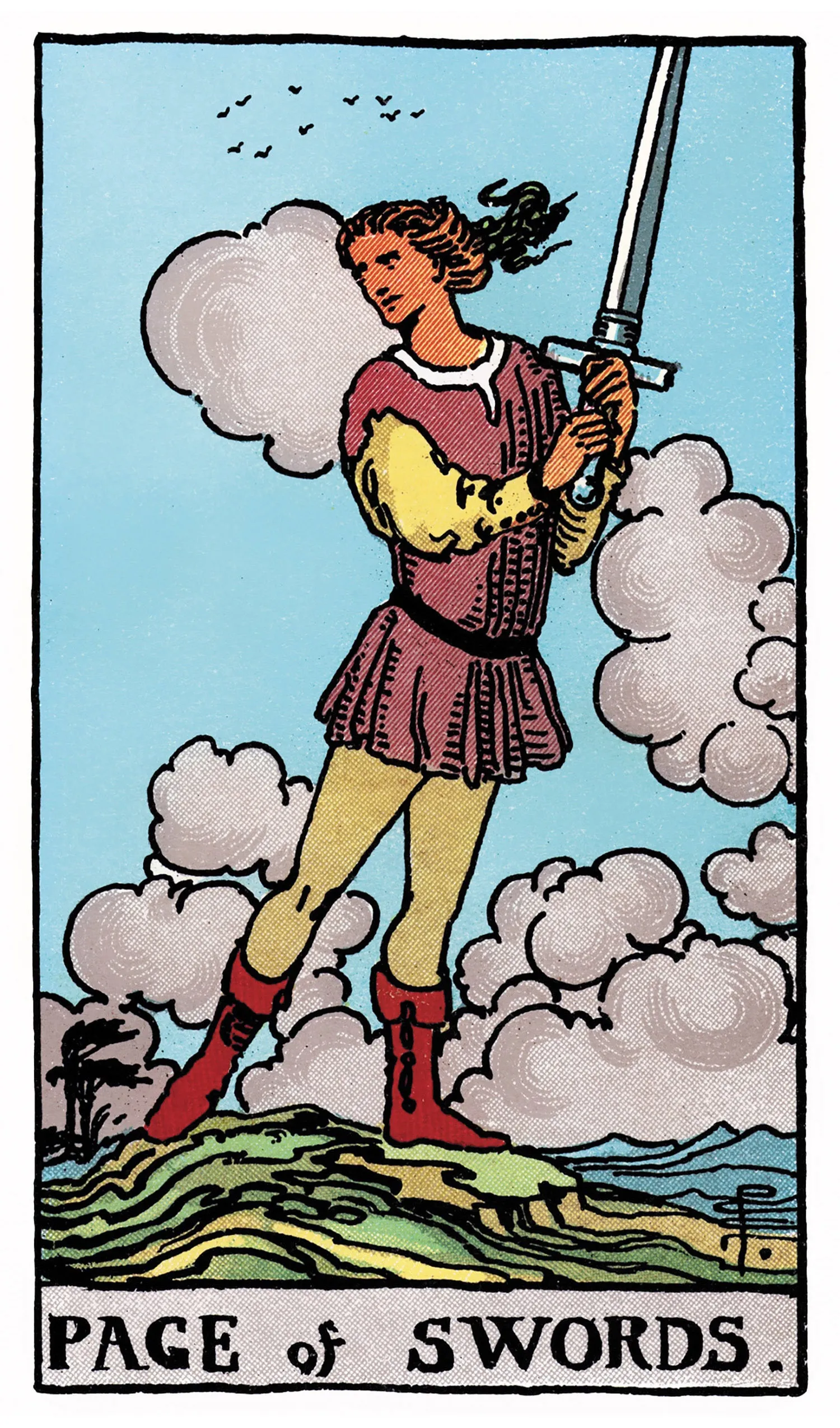
The Rider–Waite–Smith Page of Swords shows intellectual power in its early stage: the mind is awake, the tool is already present, but mastery is still developing.
The Raised Sword
The Page holds the sword high.
The sword represents thought, truth, analysis, language, judgment, and the ability to separate one idea from another.
The important detail is that the Page holds the sword with both hands.
He has the weapon of the suit.
But unlike a fully developed master, he still appears to need his full attention and effort simply to control it.
This captures the essence of the card perfectly:
He already has the Sword — but he has not mastered the Sword.
Intelligence is present.
Skill is developing.
Experience is still limited.
The Page's Gaze
The Page looks away from the sword and toward his surroundings.
He is alert.
Something may happen.
Someone may speak.
New information may appear.
His attention is not settled because his understanding is not settled.
The gaze reflects vigilance, suspicion, curiosity, and continuous observation.
The Wind
The wind moves strongly through the scene.
This reinforces the Air quality of the suit.
Information moves.
Ideas move.
Opinions change.
The mind is stimulated.
The Page has to respond quickly.
The wind also makes the atmosphere less peaceful.
This is not quiet academic contemplation.
Learning happens inside movement and tension.
The Uneven Ground
The Page stands in an environment that is not completely calm or stable.
This supports the TAROVERA mechanism of the card:
learning happens because circumstances demand it.
The person develops while already dealing with something unfamiliar, difficult, or uncomfortable.
The Birds in the Sky
The multiple birds emphasize the movement of thoughts, information, messages, ideas, and mental possibilities.
The Page's mind may be full of ideas at once.
The challenge is not simply to receive information.
It is to learn which information matters.
A young mind can notice many things and still struggle to organize them correctly.
The Core Symbolism of The Page of Swords
The Page of Swords represents a mind that has awakened and is beginning to test itself against reality.
The sword is already present.
The eyes are open.
Information is moving.
Questions are forming.
But mastery has not yet arrived.
This is the stage where a person becomes smarter because reality keeps challenging what they thought they knew.
The Page therefore symbolizes:
intensive learning, uncomfortable discovery, rapid information gathering, vigilance, criticism, developing intelligence, and the early struggle to separate fact from assumption.
Its central question is:
“What is reality trying to teach me that I still do not understand?”