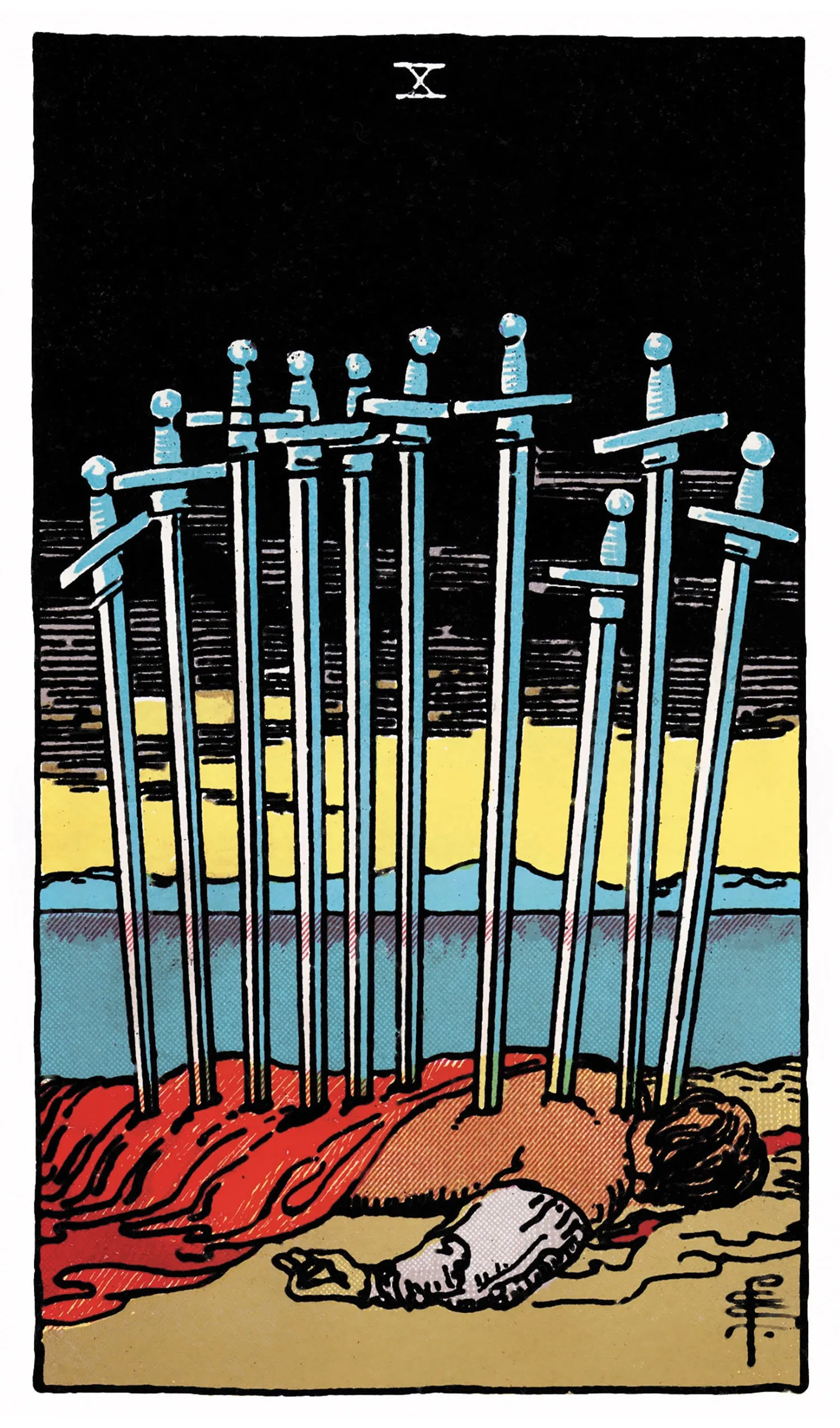
Minor Arcana · Swords · Ten
The Ten of Swords Tarot Card Meaning
The Ten of Swords represents the final exhaustion of a situation. A process has reached its limit, its potential has been used up, and the existing line can no longer continue in the same form.
This is one of the clearest closing cards in TAROVERA. It can indicate defeat, collapse, a painful ending, a radical final decision, or the realization that there is nothing meaningful left to save within the current situation.
However, the Ten of Swords is not always negative in the same way. When the process being examined is already destructive, painful, or unwanted, the same finality can mean something important: the difficult situation itself is finally coming to an end.
Card Meanings
General Meaning
The Ten of Swords represents the point at which a process has reached its absolute limit.
There is no meaningful potential left inside the existing line.
Something has already developed as far as it can, accumulated its consequences, and arrived at a stage where continuation in the same form is no longer possible.
This is what distinguishes the Ten of Swords from the earlier closing cards.
The Eight of Swords says:
“My hands are tied. I cannot change this now.”
The Nine of Swords says:
“This situation has become psychologically unbearable and is reaching its final stage.”
The Ten of Swords says:
“The ending has already happened. This line is finished.”
The Nine often describes fear, anticipation, or mental suffering around a difficult outcome. With the Ten, the feared point has already been reached. The person is no longer simply worrying about what might happen — the decisive event, realization, collapse, or conclusion has arrived.
The Ten of Swords can describe:
- the end of a relationship;
- the collapse of a project;
- the failure of a plan;
- dismissal;
- closure of a business;
- an irreversible decision;
- a final refusal;
- the exhaustion of a conflict;
- an ending that can no longer realistically be reversed.
Importantly, this ending is not always gentle or naturally gradual.
Sometimes a process simply exhausts itself.
But sometimes the Ten of Swords represents a forced, abrupt, or deliberately imposed ending.
Someone may say:
“Enough.”
A relationship may be cut off.
A project may be cancelled.
An employee may be dismissed.
Negotiations may be terminated.
A person may make a radical decision and intentionally close the door rather than allowing the situation to fade naturally.
This is an important distinction. The Ten of Swords can describe both collapse through exhaustion and finality imposed through a decisive cut.
Its primary function is therefore not simply “something terrible happens.”
Its primary function is:
finality.
If the question concerns something the querent wants to develop, the card is usually highly unfavorable because the desired line has no remaining developmental potential.
But if the question concerns something already painful or destructive, finality may be exactly what is needed.
A crisis can end.
A destructive relationship can end.
A prolonged conflict can end.
A difficult period can finally exhaust itself.
The card must therefore always be read in relation to what exactly is ending.
The Shadow Side of The Ten of Swords
The shadow side of the Ten of Swords is not only the ending itself.
It is also excessive finality.
The card can produce all-or-nothing thinking:
- one relationship failed, therefore love itself is over;
- one project collapsed, therefore the entire career is ruined;
- one betrayal happened, therefore no one can ever be trusted;
- one conflict occurred, therefore everything must be destroyed;
- one failure means complete personal defeat.
This is the psychology of turning one ending into total annihilation.
The reaction can become stronger than the situation itself requires.
A person may not simply close one door — they may burn the entire building around it.
This can create:
- overly harsh decisions;
- unnecessary destruction;
- extreme statements;
- irreversible actions taken in anger;
- excessive punishment;
- complete rejection where a more proportionate response might have been possible.
Another shadow manifestation is refusing to recognize that the ending has already happened.
A person may continue:
- trying to revive a dead process;
- negotiating after the decision is final;
- returning to a relationship that has exhausted itself;
- investing money into a failed project;
- fighting after the result can no longer be changed;
- searching for one more solution when the original line is already finished.
Both extremes belong to the Ten:
ending too radically and refusing to let an ending become final.
The card can also create temporary devastation. The person may believe that because this line has ended, nothing meaningful will ever exist again.
That conclusion is too broad.
The Ten closes the current cycle.
It does not mean that life itself has no future.
The Ten of Swords Reversed
Reversed, the Ten of Swords does not automatically mean recovery, rebirth, or “the worst is over.”
The ending has still occurred.
What deteriorates is the ability to complete it cleanly.
The reversed card can indicate:
- a prolonged ending;
- repeated attempts to save what is already over;
- delayed acceptance;
- a painful process being stretched out;
- temporary improvement that does not restore the original line;
- false hope that the previous situation can still return;
- emotional or practical agony lasting longer than necessary.
The person may understand on some level that the situation is finished but continue behaving as if one more attempt might reverse the result.
The reversed Ten can therefore create a strange state in which the ending is obvious, yet the person keeps postponing its final acceptance.
This does not restore the original potential.
It merely prolongs the process.
Core Message
This situation has reached its final limit.
Recognize what has truly ended.
Do not assume that every ending must be prevented, and do not assume that the end of one line means the destruction of your entire future.
Sometimes the necessary action is to stop trying to revive what has already reached completion.
The Ten of Swords as a Person
Explore all 78 Tarot cards as personality →
As a person, the Ten of Swords has two very different but equally important expressions.
The first is someone who has already been through a severe ending, defeat, betrayal, loss, or period of extreme exhaustion.
They may feel:
- drained;
- defeated;
- emotionally finished with something;
- deeply disappointed;
- cynical;
- unable to continue fighting;
- ready to close a chapter completely.
But the Ten of Swords can also describe a very different personality:
a radical, categorical, uncompromising person.
This individual may operate by the principle:
“All or nothing.”
Once they decide that something is finished, they can become extremely decisive.
They may:
- cut contact completely;
- end relationships without prolonged negotiation;
- make sudden final decisions;
- refuse to reconsider;
- burn bridges;
- reject compromise once their personal limit has been reached.
They can be highly convinced of their own judgment and may believe that once a conclusion has been reached, there is little reason to continue discussing it.
This person may be willing to pay a high price simply to achieve final freedom from a situation they consider finished.
At their strongest, they are capable of ending what genuinely needs to end.
At their worst, they can become excessively harsh, absolutist, unforgiving, or destructive.
The Ten of Swords as Actions
As Actions, the Ten of Swords often means bringing something to an end.
The person may:
- end the relationship;
- resign;
- dismiss someone;
- close the project;
- cancel the plan;
- withdraw completely;
- stop fighting;
- abandon further attempts;
- cut off communication;
- issue a final refusal;
- make a definitive decision.
Sometimes the person does not simply surrender.
They actively deliver the final conclusion.
This can be the moment of:
“Enough. This ends now.”
The action may be abrupt and uncompromising.
A person can intentionally terminate something even when doing so is painful, expensive, or emotionally difficult because they believe continuation would be worse.
In other situations, circumstances themselves terminate the process.
There may also be one final effort — a last attempt, confrontation, presentation, negotiation, or push — but it does not restore the future of the line. It is the last battle after the strategic outcome is already effectively decided.
The Ten of Swords in Love and Relationships
Explore all 78 Tarot cards in Love & Relationships →
In Love and Relationships, the Ten of Swords is one of the strongest cards of ending.
It can indicate:
- separation;
- breakup;
- emotional collapse;
- complete exhaustion of the relationship;
- betrayal that permanently changes the dynamic;
- a final conversation;
- a radical decision to leave;
- a connection reaching the point where the previous relationship model can no longer continue.
The crucial wording is:
the previous relationship model.
The Ten of Swords does not necessarily mean that two people can never speak again for the rest of their lives.
It means that this particular line has reached its end.
If something ever develops between them later, it would require a genuinely new basis rather than merely continuing the old situation.
For a new relationship or desired romantic development, the Ten of Swords is extremely weak. It usually closes the possibility rather than describing a difficult but successful beginning.
If the relationship itself is already destructive or deeply painful, however, the Ten can show that the suffering finally reaches its endpoint.
Another important manifestation appears after a painful relationship.
The person may decide:
“Never again.”
They may emotionally freeze themselves after betrayal or severe disappointment and temporarily close the door not only on one relationship but on intimacy itself.
This is another example of the Ten's all-or-nothing tendency.
One painful ending can become:
“I will never allow anyone close again.”
The Ten of Swords as Thoughts
As Thoughts, the Ten of Swords is:
“It is over.”
The person may think:
- there is nothing more I can do;
- this has gone too far;
- I cannot continue like this;
- the result is already clear;
- there is no point trying again;
- this cannot return to what it was;
- I need to end this completely.
Unlike the Nine of Swords, where the person may still be afraid of what is going to happen, the Ten often shows that the conclusion has already been mentally accepted.
At its harsher expression, thinking becomes absolute:
- “Everything is ruined.”
- “Nothing can ever be fixed.”
- “I will never trust anyone again.”
- “There is no future after this.”
This is where the card's all-or-nothing shadow appears.
The Ten of Swords as Feelings
As Feelings, the Ten of Swords indicates emotional exhaustion.
The person may feel:
- devastated;
- defeated;
- deeply hurt;
- emotionally empty;
- betrayed;
- finished with the situation;
- unable to keep feeling or fighting in the same way.
Sometimes the card represents the point beyond active emotional conflict.
The person has suffered so much that almost nothing remains to spend emotionally.
This can look like numbness rather than dramatic grief.
In other cases, the feeling is relief.
If the person has been trapped in a destructive or exhausting situation, the ending can create:
“Thank God, it is finally over.”
The emotional meaning therefore depends strongly on whether the ending itself is experienced as a loss or as release from something painful.
The Ten of Swords as Intentions
As Intentions, the Ten of Swords rarely shows a desire to build the existing situation further.
The person may intend to:
- end things;
- walk away;
- stop trying;
- cut contact;
- close the issue;
- stop investing effort;
- make a final decision;
- remove themselves from the situation permanently.
The intention is usually toward termination, not development.
In its more radical form, the person may intend to end the matter completely and leave no room for further negotiation.
The Ten of Swords as an Outcome
Explore all 78 Tarot cards as Outcomes →
As an Outcome, the Ten of Swords means final closure of the current line.
For desired developments, this is usually a highly unfavorable result.
If the question concerns:
- whether a relationship will develop;
- whether a project will succeed;
- whether a plan will proceed;
- whether a trip will happen;
- whether an opportunity will materialize;
the Ten of Swords generally indicates that the existing route reaches a dead end.
There is no meaningful continuation.
However, context is essential.
If the process itself is already negative — for example:
- a prolonged conflict;
- a crisis;
- a destructive relationship;
- a painful period;
- a difficult dispute;
- an exhausting problem;
then the Ten of Swords can indicate something beneficial:
the negative process finally ends because it has nowhere further to go.
The card closes the line regardless of whether that line was desirable or undesirable.
Therefore:
Desired line ends → negative outcome.
Negative line ends → potentially favorable closure.
The Ten is especially final compared with the Nine.
With the Nine, the process may be reaching its painful conclusion.
With the Ten, the conclusion itself is already established.
The Ten of Swords in Career and Work
Explore all 78 Tarot cards in Career & Work →
In Career and Work, the Ten of Swords indicates the end or complete exhaustion of a professional line.
Possible manifestations include:
- dismissal;
- resignation;
- closure of a department;
- cancellation of a project;
- business failure;
- the end of a contract;
- professional defeat;
- collapse of a strategy;
- inability to continue under the existing workload.
One of the strongest Career meanings of the Ten of Swords is professional burnout.
The person may feel like a completely squeezed-out resource.
There may have been:
- extreme workload;
- impossible deadlines;
- prolonged intellectual pressure;
- too much responsibility;
- constant crisis management;
- chronic overwork;
- a project that demanded more than the person could sustainably give.
At some point, nothing more can be extracted.
The person may literally feel:
“There is nothing left in me.”
For intellectual or creative work, this can represent complete mental depletion — the state where the person cannot generate another idea, solution, report, presentation, or strategic response because the system has been pushed beyond its limit.
There can also be a final heroic effort.
A person may work all night, fight for the project, present one last argument, or make one final attempt to save the situation.
But if the Ten truly describes the line, this last effort does not restore the strategic future of the project.
The battle may still happen.
The war is already lost.
For a job application, promotion, or new project, the card is usually highly unfavorable.
If the current work situation is already intolerable, however, the Ten can indicate the end of that destructive professional chapter.
The Ten of Swords in Money and Finances
Explore all 78 Tarot cards in Money & Finances →
Financially, the Ten of Swords represents exhaustion or collapse of a particular financial line.
It can indicate:
- significant loss;
- failed investment;
- business collapse;
- loss of income;
- closure of a financial project;
- inability to continue funding something;
- depletion of available resources;
- financial defeat;
- loss connected with a legal or contractual dispute.
In some contexts, it can correspond with losing a financial or legal battle, including an unfavorable court decision with material consequences.
This is not automatically a prediction of lifelong poverty.
It describes:
the ending of the current financial structure or process.
What comes afterward depends on the rest of the spread.
If the question concerns an already damaging financial commitment, the card can show that the loss finally stops because the process itself is terminated.
The Ten of Swords in Health
Explore all 78 Tarot cards in Health →
In the TAROVERA health system, the Ten of Swords is associated with extremely severe and critical health situations.
Upright, it can symbolically correspond with a condition between life and death, including coma.
The TAROVERA system also gives a specific severe combination with the Eight of Cups. In elderly or seriously ill people, that combination is treated as especially grave; in younger people it may instead represent an extremely critical condition.
The source system also associates the card with leukemia.
These are Tarot-system associations and must never be treated as a medical diagnosis or prognosis.
The TAROVERA source also associates the reversed card with erythropenia.
Tarot should not be used as a substitute for medical diagnosis or treatment.
The Ten of Swords Timing — When Will It Happen?
Explore Timing for all 78 Tarot cards →
The Ten of Swords is a weak timing indicator and also a weak indicator of realization.
Its meaning depends first on whether the surrounding spread actually confirms that the event will happen.
If the overall spread is positive and clearly supports realization, the Ten of Swords can indicate a very long waiting period — approximately one year.
This should not be treated as a highly precise mathematical prediction.
The main message is that realization, if it occurs at all, is distant.
If the surrounding spread does not confirm realization, the Ten of Swords should not be converted into “one year.”
In that context, the card means:
the situation does not realize or develop as intended.
Key Timing Correspondence
If realization is clearly confirmed: approximately 1 year.
If realization is not confirmed: the event does not develop or materialize.
The Ten of Swords as an Event
Explore all 78 Tarot cards as Events →
As an Event, the Ten of Swords often represents a definitive ending.
Possible manifestations include:
- breakup;
- cancellation;
- dismissal;
- project closure;
- business closure;
- final refusal;
- collapse of negotiations;
- ending of communication;
- abandonment of a plan;
- a conflict reaching its final stage;
- a difficult process finally stopping;
- a decision that permanently changes the previous situation.
The card can also appear around events where an old physical structure is being dismantled or radically changed, such as moving out or major renovation, because the previous state of the environment is being completely destroyed and cannot continue in its old form.
This is a secondary manifestation, not the card's primary meaning.
For desired future events, the Ten of Swords is weak because it can indicate that the event never develops into reality.
For already negative events, however, it can show their termination.
The defining question is:
What exactly is ending?
The Ten of Swords as Card of the Day
Explore all 78 Card of the Day meanings →
As Card of the Day, the Ten of Swords may bring a clear ending, cancellation, final decision, or realization that something can no longer continue in its previous form.
A plan may fail.
A conversation may close an issue.
You may decide that you have had enough.
Someone else may make a decision that ends the matter.
Or a difficult process may finally reach its endpoint.
The day is less about creating new development and more about recognizing what has already exhausted itself.
The Ten of Swords as Advice
Explore Advice from all 78 Tarot cards →
The Ten of Swords advises you to recognize when a process is truly finished.
Do not continue investing effort simply because you have already invested a great deal.
Do not confuse persistence with refusing reality.
If the current line has exhausted all meaningful potential, allow it to end.
This may mean:
- stop fighting;
- stop negotiating;
- stop trying to restore the old version;
- close the project;
- accept the loss;
- leave the exhausted situation behind;
- make the final decision that has already become necessary.
The advice is not necessarily:
“Give up on everything.”
It is:
“Stop trying to save this particular line when there is nothing substantial left inside it to save.”
Sometimes the most constructive expression of the Ten is a decisive:
“Enough.”
The Ten of Swords Reversed as Advice
Do not prolong the ending.
If you already know that something is finished, another attempt may only extend the pain.
Be especially careful of false hope created by temporary improvement.
A short pause in the collapse does not necessarily mean that the original potential has returned.
Accept the finality of what has ended before deciding what a genuinely new beginning would require.
The Ten of Swords as a Warning
Explore Warnings from all 78 Tarot cards →
The Ten of Swords has two major warnings.
The first is:
do not ignore an ending that is already inevitable.
Continuing in the same way can result in complete exhaustion.
Be careful of:
- investing further into a dead project;
- refusing to end a destructive relationship;
- fighting a decision that is already final;
- exhausting yourself trying to prove that failure can still be reversed;
- treating temporary survival as proof that long-term potential remains.
But the second warning is equally important:
do not create a final ending where one was not yet necessary.
The Ten of Swords can become excessively radical.
In a warning position, it may say:
- do not cut everything off in anger;
- do not make an irreversible decision from temporary pain;
- do not destroy an entire relationship because of one conflict;
- do not turn disappointment into total rejection;
- do not punish more severely than the situation requires;
- do not burn bridges simply because you want immediate emotional relief.
The card warns against the principle:
“If it is not perfect, destroy everything.”
One ending does not need to become universal destruction.
The Ten also warns against the martyr position.
A person may begin to define themselves entirely through defeat:
- “Everything is against me.”
- “My whole life is ruined.”
- “Nothing ever works for me.”
- “I am the one who always suffers.”
The pain may be real.
But turning one painful ending into an identity can keep the person psychologically inside a process that is already over.
The Ten of Swords — Yes or No
Explore Yes or No meanings for all 78 Tarot cards →
Upright: No
The Ten of Swords is a clear No.
The current line has reached or is approaching complete exhaustion. The card does not support meaningful development or successful realization of the desired situation.
Reversed: No
The reversed Ten of Swords is also No.
The ending has not been reversed.
It has merely become prolonged, harder to accept, or more exhausting.
This card does not become Yes when reversed.
The Ten of Swords Symbolism
Explore Symbolism for all 78 Tarot cards →
The Rider–Waite–Smith Ten of Swords shows a figure lying face down with ten swords in their back. Above them is a dark sky, while the horizon in the distance is beginning to brighten.
The image is severe because the card represents an ending that has already reached its absolute limit.
The Fallen Figure
The figure is no longer standing, fighting, or attempting to defend themselves.
The active phase is over.
This visually expresses the central principle of the card:
there is no remaining movement inside the existing line.
At the same time, the extreme image also contains the card's theme of excess.
One sword would have been enough to stop the figure.
There are ten.
This exaggeration visually supports the shadow meaning of overkill, extreme reaction, absolute judgment, and the tendency to turn an ending into total destruction.
The Ten Swords
Ten swords are already present.
Nothing further needs to be added for the process to be complete.
The image emphasizes total exhaustion rather than an early-stage problem that still has room to develop.
The number itself marks the completion of the numbered sequence.
The swords can also suggest that the situation has been mentally, verbally, strategically, or conflictually pushed to its absolute extreme.
The Dark Sky
The dark sky reflects the severity of the ending.
The situation may feel devastating, final, or emotionally overwhelming.
However, darkness belongs to the current scene.
It should not automatically be interpreted as a permanent description of the entire future.
The Brightening Horizon
The distant light is important, but it must not be used to turn the Ten of Swords into a positive card prematurely.
The light does not restore the fallen figure or revive the completed situation.
Instead, it suggests that once this ending is fully accepted, something beyond the finished cycle may eventually exist.
That future belongs to another stage.
It does not erase the finality of this one.
The Still Water
The calm water in the distance contrasts with the violence of the foreground.
Once the active struggle ends, the situation can eventually become still.
Again, this is not restoration of the previous line.
It is the stillness that becomes possible after the line has ended.
The Core Symbolism of The Ten of Swords
The Ten of Swords is the image of absolute completion through exhaustion or decisive termination.
The figure has fallen.
All ten swords are already present.
Nothing remains to be added to the existing process.
The excessive number of swords also reminds us that finality can become disproportionate: a person can sometimes destroy more than was actually necessary simply because they have reached the psychological state of “enough.”
The bright horizon does not undo the ending.
It simply reminds us that the end of one line is not necessarily the end of every possible future.
The central question of the card is:
“What has already reached the point where it can no longer continue — and what are you in danger of destroying simply because you want everything to be final?”