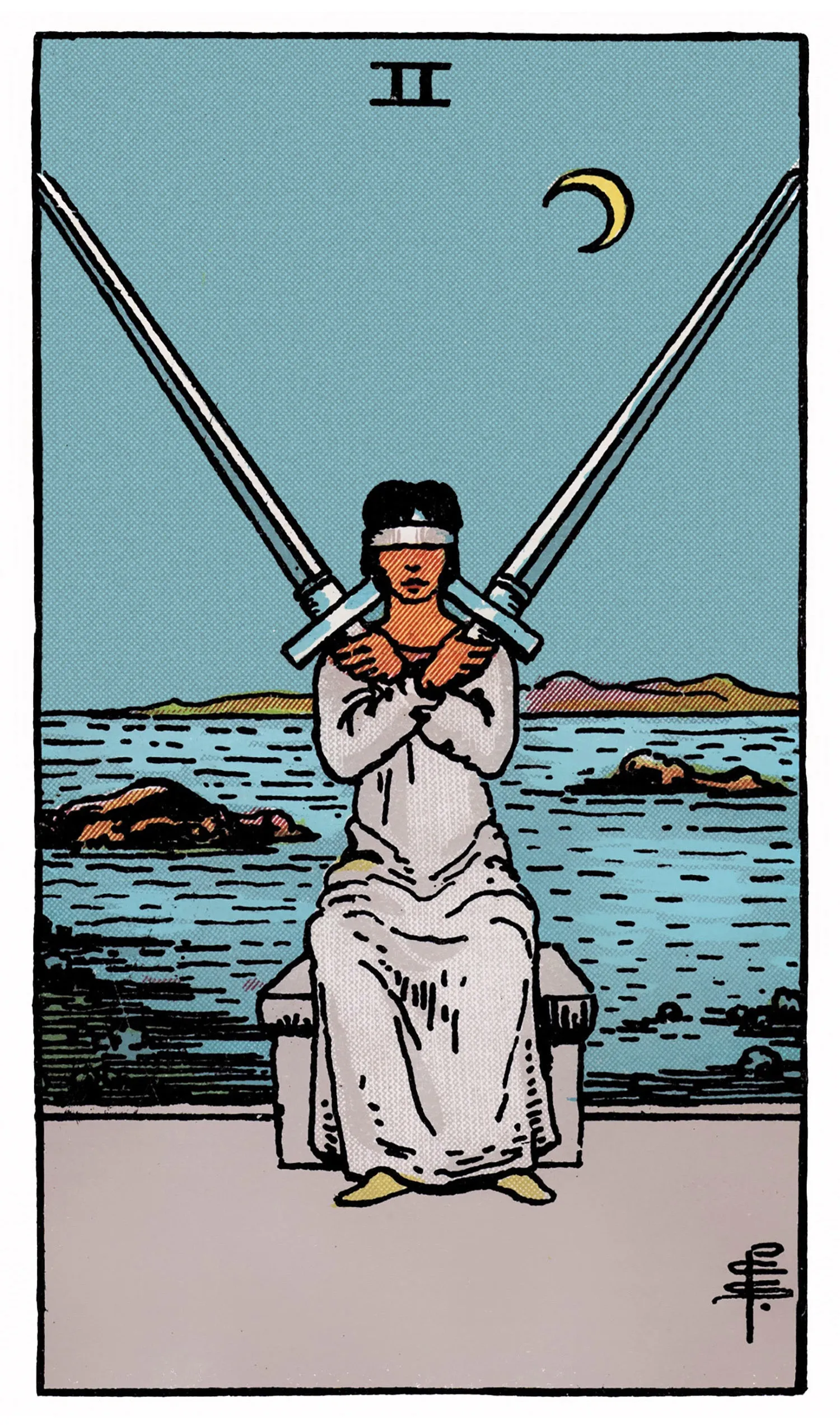
Minor Arcana · Swords · Two
The Two of Swords Tarot Card Meaning
The Two of Swords represents a stalemate, a difficult pause, and a choice that is hard to make because no available option feels genuinely good. It is often a choice without a choice: alternatives exist, but each carries a cost, risk, loss, or consequence that makes movement difficult.
The card does not simply describe indecision. Sometimes the situation itself does not currently offer a satisfactory solution. In that case, the pause can serve as temporary protection — a way to preserve balance, avoid premature action, and prevent a fragile situation from breaking before a better path becomes visible.
Card Meanings
General Meaning
The Two of Swords represents a situation in which movement has stopped because a decision cannot easily be made.
There may be two possibilities, two competing positions, two obligations, two people, or simply two incompatible realities that cannot be reconciled comfortably.
The important point is that this is not always an ordinary choice between a good option and a bad one.
Very often, the Two of Swords is a choice without a good choice.
Both directions may involve loss.
Both may create consequences.
Neither may give the person what they truly want.
This is why the card can describe an extremely difficult decision even when the person involved is intelligent, rational, and fully aware of the situation.
Sometimes there genuinely is no satisfactory solution yet.
The natural response becomes a pause.
Instead of choosing, the person holds the existing position for as long as possible. They delay the conversation, postpone the decision, avoid taking sides, wait for more information, or hope that circumstances will change enough to make the choice easier.
This pause is not always weakness.
Sometimes it is a form of self-protection.
The person may need to temporarily shut out pressure, emotional noise, other people's demands, or conflicting opinions in order to restore internal balance before making a serious decision.
In this sense, the Two of Swords can genuinely indicate:
this is not the best moment to force a decision.
The card also has an important meaning of fragile peace.
Two opposing sides may temporarily stop fighting without actually resolving the conflict.
They may agree not to push the issue.
They may establish a compromise that allows both sides to coexist for the moment.
They may preserve a working arrangement because open confrontation would currently make the situation worse.
This is not true harmony.
It is a truce.
The underlying disagreement still exists.
The Two of Swords therefore often represents a stalemate held together by restraint.
Nothing has necessarily collapsed.
But nothing is truly progressing either.
The balance survives because nobody makes the move that would disturb it.
This can be useful temporarily.
But the card always carries the question:
How long can this remain suspended?
If the underlying conflict does not disappear, delaying the choice eventually becomes a choice of its own.
The Shadow Side of The Two of Swords
The shadow of the Two of Swords appears when a necessary pause becomes chronic avoidance.
A person may continue telling themselves that they “need more time” even when no new information is actually coming.
They may refuse to address a conflict because maintaining the current situation feels safer than facing the consequences of either available choice.
Neutrality can become avoidance.
Compromise can become false peace.
Self-protection can become emotional shutdown.
The person may preserve a fragile arrangement long after it has stopped being useful simply because they fear what will happen if the balance breaks.
Another shadow expression is the refusal to acknowledge that no perfect solution exists.
The person may wait indefinitely for an option that carries no cost, no disappointment, and no risk.
But some situations do not offer that.
Eventually, the real decision becomes not:
“Which option is perfect?”
but:
“Which consequences am I most realistically prepared to accept?”
The Two of Swords can also describe a conflict that remains hidden beneath politeness.
People may look calm.
They may stop arguing.
They may even cooperate.
But the real issue has not been resolved.
The peace exists only because nobody is touching the wound.
The Two of Swords Reversed
The reversed Two of Swords shows the stalemate becoming harder to maintain.
The upright card can still hold the situation in suspension.
Reversed, the same strategy begins to fail.
The person may become increasingly confused, overwhelmed, anxious, or mentally exhausted by a problem that has remained unresolved for too long.
The available options may deteriorate.
Opportunities may narrow.
Deadlines may approach.
Outside circumstances may begin to force movement.
The fragile compromise can also begin to break down.
A temporary truce may no longer work.
Two sides that had managed to coexist may lose patience.
A relationship that appeared calm may become openly tense.
A professional agreement may collapse.
A neutral position may become impossible to maintain.
Another deterioration is the loss of objectivity.
The upright Two of Swords can still attempt to hold two opposing positions in balance.
Reversed, the person may become increasingly unable to evaluate both sides fairly.
They may fixate on one argument, reject uncomfortable information, become defensive, or stop considering alternatives altogether.
The person can also shut down further.
Instead of using the pause to restore clarity, they use it to avoid reality.
Another manifestation is a forced or badly timed decision.
Because the choice was postponed for too long, the person eventually has to act under pressure, without enough time and without a genuinely satisfying option.
The reversed Two of Swords therefore does not automatically mean that the blockage has finally ended.
It more often means that the blockage itself is becoming unstable.
The upright card says:
“I cannot choose, so I will pause and hold the balance.”
The reversed card says:
“I still do not have a good solution, but the balance is starting to break.”
Core Message
Not every difficult decision has a good answer.
Sometimes the wisest immediate response is to pause rather than force a choice that is not ready to be made.
Sometimes temporary neutrality or compromise genuinely prevents unnecessary damage.
But a pause must remain temporary.
A truce is not the same as resolution.
And if nothing changes, refusing to choose eventually becomes a decision in itself.
The Two of Swords as a Person
Explore all 78 Tarot cards as personality →
The Two of Swords as a person describes someone cautious, controlled, private, and reluctant to commit before they feel sufficiently certain.
They usually dislike being pressured.
They may prefer to observe both sides of a situation, maintain neutrality, and avoid making a decision until they understand the consequences.
This can make them diplomatic.
They may be good at keeping conflict from escalating and capable of maintaining calm between people who strongly disagree.
They can also be emotionally self-controlled.
When overwhelmed, they may temporarily distance themselves from other people's opinions, emotions, or demands in order to regain internal balance.
At their best, this person understands that not every decision should be made quickly.
They know how to wait.
They know how to avoid unnecessary conflict.
They can hold opposing viewpoints without immediately attacking one side.
However, caution can become excessive.
They may remain undecided for far too long, avoid responsibility for difficult choices, postpone uncomfortable conversations, or preserve an unsatisfactory situation simply because every alternative appears worse.
They can also confuse emotional suppression with objectivity.
The Two of Swords as Actions
As actions, the Two of Swords usually shows deliberate non-action.
The person waits.
They postpone.
They do not give a final answer.
They avoid taking sides.
They may delay signing something, refuse to commit, avoid initiating a difficult conversation, or keep an existing arrangement unchanged because any decisive move would disturb the current balance.
Typical manifestations include:
- postponing a decision;
- waiting for more information;
- maintaining neutrality;
- avoiding confrontation;
- refusing to choose between two options;
- preserving the status quo;
- temporarily withdrawing;
- delaying commitment;
- withholding a definite answer;
- accepting a temporary compromise;
- agreeing to a truce;
- avoiding escalation.
This is one of the clearest cards where not acting becomes an action in itself.
Sometimes this is sensible.
Sometimes the person knows that acting now would make the situation worse.
The Two of Swords in Love and Relationships
Explore all 78 Tarot cards in Love & Relationships →
In relationships, the Two of Swords represents emotional and relational limbo.
Something needs to be decided, clarified, or confronted, but neither person — or one important person — is ready to move the situation forward.
The relationship may continue outwardly while the central issue remains unresolved.
This can appear as:
- not knowing whether to stay or leave;
- avoiding a necessary conversation;
- refusing to define the relationship;
- maintaining emotional distance;
- choosing between two incompatible needs;
- protecting oneself from emotional pressure;
- keeping a conflict frozen rather than resolving it;
- remaining in the connection because neither staying nor leaving feels good.
The Two of Swords is particularly important when there genuinely is no obviously good relationship decision.
Leaving may hurt.
Staying may also hurt.
Talking may trigger conflict.
Remaining silent preserves temporary peace but solves nothing.
This is why the card describes relationship paralysis better than simple lack of interest.
The relationship is not necessarily over.
But it is not developing naturally either.
It is paused.
The card can also represent a fragile truce between partners.
Two people may stop arguing.
They may agree not to discuss a painful subject.
They may function together, cooperate, or maintain politeness.
From the outside, the relationship may even look calm.
But this can be a false peace.
They are not fighting because the real issue is being avoided.
The underlying conflict remains unresolved.
So:
“We are not arguing” does not automatically mean “everything is fine.”
Sometimes it simply means:
“We both know that if we touch this subject, we will have to make a decision.”
The Two of Swords as Thoughts
As thoughts, the Two of Swords shows a person who cannot reach a satisfactory conclusion.
They can see reasons for more than one position.
They may understand exactly why one option could work and exactly why it could fail.
The problem is not necessarily lack of thinking.
There may actually be too much awareness of the consequences.
The person can think:
“I do not know which decision will make this better.”
or:
“Neither option gives me what I really want.”
They may also deliberately avoid reaching a conclusion because once the decision is made, they will have to act on it.
Sometimes the person mentally withdraws because they need distance from pressure before they can think clearly.
The Two of Swords as Feelings
As feelings, the Two of Swords represents emotions that are contained, blocked, or deliberately held at a distance.
This does not automatically mean that no feelings exist.
The person may feel attraction, attachment, anxiety, hurt, concern, or emotional vulnerability but resist allowing those feelings to determine what happens next.
They may be protecting themselves from the consequences of feeling too much.
A common internal position is:
“I feel something, but I do not know what to do with it.”
or:
“I am not ready to let these feelings force me into a decision.”
The card can also show emotional self-protection after conflict.
The person needs quiet.
They may temporarily close off because their emotional system feels overloaded.
The Two of Swords as Intentions
The primary intention is to avoid making a final decision for now.
The person may want to preserve the current situation, prevent escalation, maintain emotional distance, or wait until more information becomes available.
They may intend to:
- keep things as they are;
- avoid confrontation;
- delay commitment;
- remain neutral;
- preserve a fragile peace;
- avoid choosing between competing possibilities;
- wait until circumstances become clearer.
This is not necessarily manipulation.
Sometimes the person genuinely believes that acting now would make the situation worse.
In some cases, the intention is specifically to create a temporary truce:
“Let us stop fighting for now, even if we cannot solve everything yet.”
The Two of Swords as an Outcome
Explore all 78 Tarot cards as Outcomes →
As an outcome, the Two of Swords indicates that the situation remains unresolved.
A final decision is not reached.
Progress slows or stops.
The parties may maintain the status quo, accept a temporary compromise, avoid confrontation, or postpone the issue rather than bring it to a genuine conclusion.
This is not necessarily a catastrophic result.
Sometimes keeping the situation still is temporarily preferable to choosing badly.
A fragile truce may even be the best available short-term outcome.
But it is important not to confuse stabilization with resolution.
The fundamental issue remains.
If the question asks whether a desired development will actually occur, the Two of Swords is weak because it does not show sufficient movement toward realization.
The outcome is:
stalemate, pause, temporary compromise, no final decision, unresolved situation.
The card often means:
“Not now — and possibly not at all unless something changes.”
The Two of Swords in Career and Work
Explore all 78 Tarot cards in Career & Work →
In career and work, the Two of Swords often represents a blocked professional decision.
Management may be unable to choose between two options.
A hiring decision may remain pending.
A project may stall because two strategies conflict.
Negotiations may reach an impasse.
The person themselves may be unable to decide whether to stay, resign, change direction, accept an offer, or reject it.
This card can appear when:
- a decision is postponed;
- approval is delayed;
- two parties cannot agree;
- important information is missing;
- neither professional option is genuinely attractive;
- a project cannot move until someone makes a choice;
- a candidate remains under consideration without a final answer;
- two groups reach a temporary compromise;
- negotiations continue without either side revealing its full position.
The card can also question the project itself:
“Is this even worth continuing?”
The person may not simply be choosing how to proceed.
They may be unsure whether the entire direction makes sense.
For questions such as “Will I get the job?” the card can sometimes show that the employer has not made a decision rather than that the candidate has already been rejected.
But from the querent's perspective, the practical result remains negative for now: the desired movement is not happening.
The Two of Swords in Money and Finances
Explore all 78 Tarot cards in Money & Finances →
In finances, the Two of Swords represents hesitation, caution, and a difficult financial choice.
The person may have two options and dislike both.
They may hesitate to:
- invest;
- sell;
- buy;
- borrow;
- lend;
- transfer money;
- sign a financial agreement;
- choose between competing financial strategies.
This does not necessarily mean that there is no money.
The central problem is often decision quality.
The person does not know which move is safer, or both available options involve an unacceptable compromise.
The card can also manifest very literally as:
- delayed payments;
- a transfer that remains pending;
- a deal that is not finalized;
- a contract waiting for approval;
- negotiations stalled over conditions;
- two parties refusing to commit;
- money being temporarily frozen while a decision is pending.
The Two of Swords also advises careful attention to the conditions of financial agreements.
A deal may not necessarily be bad, but there may be clauses, obligations, or unresolved details that make one or both parties hesitate.
The card can therefore support a temporary decision to preserve resources until the situation becomes clearer.
However, indefinite avoidance can create problems of its own.
The Two of Swords in Health
Explore all 78 Tarot cards in Health →
In the TAROVERA health system, the upright Two of Swords may describe a situation in which addressing one health problem creates difficulty elsewhere — a symbolic pattern of “one thing improves while another is affected.”
The card is also associated in this system with allergies and furunculosis.
The Two of Swords Timing — When Will It Happen?
Explore Timing for all 78 Tarot cards →
The Two of Swords corresponds to approximately two months, but its timing is unreliable.
The central problem is the nature of the card itself.
The Two of Swords represents a stalemate, blocked decision, pause, fragile compromise, and lack of a satisfactory way forward.
Therefore the question may not simply be:
“When will it happen?”
The more important question may be:
“Can it happen at all while the current deadlock remains unresolved?”
The event may occur within approximately two months if the blockage is removed.
But the card can also show that the situation remains suspended and the expected development does not happen within a predictable timeframe.
Key Timing Correspondence
Approximately two months — but timing is uncertain because the situation may remain blocked.
The Two of Swords also indicates that this may not be the best moment to force action or a decision.
A pause can be appropriate if the current options are poor or important information is still missing.
The Two of Swords as an Event
Explore all 78 Tarot cards as Events →
The Two of Swords is not a highly active event card.
It often describes the absence, postponement, suspension, or temporary freezing of the event that someone expected.
Possible manifestations include:
- a delayed decision;
- no final answer;
- negotiations ending without agreement;
- a postponed choice;
- a meeting that produces no conclusion;
- someone refusing to commit;
- a situation being temporarily frozen;
- two sides reaching an impasse;
- a temporary ceasefire or truce;
- an agreement to postpone the real conflict;
- an expected development failing to move forward;
- a delayed payment or pending approval.
Sometimes the “event” is simply that nothing definitive happens because the necessary decision has not been made.
In other situations, the event is the establishment of a temporary compromise that prevents escalation without resolving the underlying issue.
The Two of Swords as Card of the Day
Explore all 78 Card of the Day meanings →
The Two of Swords can bring a day of pause, uncertainty, difficult choices, or fragile balance.
You may encounter a situation where there is no obvious best answer.
Two options may both have drawbacks.
Someone may delay giving you a decision, or you may realize that you are not ready to make one yourself.
This is not necessarily the best day to force a conclusion.
If important information is missing or every available option creates unnecessary damage, a temporary pause can be useful.
You may also find yourself maintaining neutrality between two people or keeping a fragile peace in a situation that could easily escalate.
The key is to distinguish a productive pause from avoidance.
The Two of Swords as Advice
Explore Advice from all 78 Tarot cards →
Do not force yourself into a bad choice simply because you believe you must decide immediately.
If neither option is genuinely good, acknowledge that reality.
Pause.
Gather more information.
Restore your internal balance.
Step away from pressure if necessary.
Look for what has not yet been considered.
A third possibility may exist outside the two options currently visible.
If the situation allows time, use the pause strategically rather than emotionally.
You also do not always have to take a side immediately.
Temporary neutrality may be appropriate when the situation is unclear or when choosing too early would only intensify the conflict.
A temporary compromise may also be useful if it prevents unnecessary damage while a better solution is being developed.
But remember:
a truce is not a resolution.
A pause should eventually create greater clarity.
It should not become a permanent hiding place from consequences.
The Two of Swords Reversed as Advice
The current stalemate has probably lasted too long.
Avoiding the decision is no longer protecting you as effectively as it once did.
Review what has changed.
Ask whether you are genuinely waiting for useful information or simply hoping that the choice will disappear.
Examine whether the compromise you have been maintaining still serves a purpose or has become an excuse not to deal with the real conflict.
Try to see both sides again.
Pressure may have made your thinking increasingly one-sided.
If no perfect solution exists, you may eventually need to choose the option whose consequences you are most realistically prepared to accept.
Do not wait until circumstances make the decision for you.
The Two of Swords as a Warning
Explore Warnings from all 78 Tarot cards →
The Two of Swords warns against allowing a temporary pause to become permanent paralysis.
Waiting can be wise when information is missing or every available option is poor.
But waiting does not automatically improve the situation.
Be careful of:
- endless postponement;
- refusing to acknowledge the real problem;
- hiding behind neutrality;
- expecting someone else to choose for you;
- protecting the status quo at any cost;
- confusing a temporary truce with genuine resolution;
- ignoring tension because nobody is currently arguing;
- emotionally shutting down instead of thinking clearly;
- waiting for a perfect solution that may not exist;
- allowing a fragile compromise to survive long after it has stopped being useful.
The most dangerous illusion of the Two of Swords is the belief that not choosing means nothing has been chosen.
Sometimes preserving the current situation is itself a choice.
Sometimes peace exists only because nobody is discussing the issue that could break it.
The Two of Swords — Yes or No
Explore Yes or No meanings for all 78 Tarot cards →
Upright: No
The Two of Swords gives a no.
The situation is blocked.
A necessary decision has not been made, there is no clear path forward, or the available options do not currently support the desired result.
This “no” can sometimes mean not now rather than absolutely never, but something must change before meaningful progress becomes possible.
Reversed: No
The reversed Two of Swords also gives a no.
The stalemate has not been resolved constructively.
Instead, pressure, confusion, loss of balance, deteriorating circumstances, or breakdown of the existing compromise make a satisfactory result even more difficult to achieve.
The Two of Swords Symbolism
Explore Symbolism for all 78 Tarot cards →
In the Rider–Waite–Smith Two of Swords, a blindfolded woman sits with two swords crossed in front of her.
The composition is remarkably still.
Nothing is actively attacking her, yet nothing is moving forward either.
The image captures the central paradox of the card:
maintaining the current position provides temporary protection, but movement requires a decision.
The Blindfold
The blindfold represents limited perception, deliberate withdrawal from information, or the inability to see a complete solution.
It does not necessarily mean ignorance.
Sometimes the person already knows enough to understand that every available option is difficult.
The blindfold can therefore also symbolize self-protection.
Not looking directly at the problem allows the person to temporarily shut out pressure, emotional noise, and outside influence.
This can help restore internal balance.
But if maintained too long, the same protection becomes avoidance.
The Crossed Swords
The two swords form a closed defensive structure across the body.
They represent competing positions, opposing arguments, conflicting choices, or two alternatives that appear equally difficult to resolve.
The crossed position is important.
The swords are not moving.
Their power is being used to block, not to cut.
This is the essence of the Two of Swords.
The suit's natural qualities of thought and decision have reached a temporary deadlock.
The crossed swords can also symbolize a fragile balance between opposing forces.
Neither side has won.
Neither side has surrendered.
For the moment, both remain suspended.
The Seated Position
The figure remains seated.
She is not pursuing either direction.
This reinforces the card's connection with suspension, waiting, neutrality, and deliberate non-action.
The position may be temporarily necessary.
But it cannot create long-term development by itself.
The Sea
Water lies behind the figure.
The sea introduces an emotional dimension beneath the apparently rational stalemate.
The decision may look intellectual on the surface, but fear, attachment, vulnerability, hurt, or emotional consequences often make the choice much harder than logic alone would suggest.
This is one reason why the person cannot simply “calculate” the correct answer.
The Rocks and Distant Land
Rocks rise from the water behind the figure.
They suggest obstacles, complications, and a path that is not entirely safe whichever direction is chosen.
The landscape reinforces the card's central meaning:
the difficulty does not exist only inside the person's mind.
Sometimes the environment itself is genuinely complicated.
Sometimes there really is no easy path.
The Crescent Moon
The crescent moon suggests incomplete development and limited illumination.
Not everything has reached its final form.
More may still emerge.
This supports the card's association with waiting when the current information or circumstances are insufficient for a good decision.
But the crescent also implies change.
The present state will not remain suspended forever.
The Core Symbolism of The Two of Swords
The Two of Swords shows a person protecting a fragile equilibrium between two difficult possibilities.
The blindfold limits outside influence and protects against overload.
The crossed swords block movement and hold opposing forces in balance.
The seated posture preserves the pause.
The water reveals the emotional complexity beneath the rational surface.
The rocks show that the difficulty may be real rather than imagined.
Together, these symbols express the card's central principle:
sometimes the problem is not choosing between right and wrong, but choosing between two imperfect outcomes.
In that situation, a pause may be necessary.
A compromise may be useful.
A temporary truce may prevent unnecessary damage.
But none of these is the same as resolution.
Eventually, something must change enough for real movement to become possible.