Minor Arcana · Swords · Three
The Three of Swords Tarot Card Meaning
The Three of Swords is a card of painful realization. Something becomes clear, is finally spoken aloud, or can no longer be ignored — and the truth hurts.
It can describe heartbreak, disappointment, rejection, conflict, failed expectations, or separation, but its deeper mechanism is not pain alone. The Three of Swords shows pain caused by understanding: a person sees what is really happening, recognizes an incompatibility, hears an unpleasant truth, or realizes that a hoped-for outcome is not going to unfold as expected.
Card Meanings
General Meaning
The Three of Swords represents the moment when an unpleasant reality becomes consciously understood.
This is one of the most important distinctions of the card. The pain is not vague. The person may not yet know what to do about the situation, but they usually understand what is wrong and why it hurts.
A truth may be revealed. A difficult conversation may expose what people really think. Plans may fail to develop as expected. Someone may receive rejection, criticism, or unpleasant information. Two people may finally discover that their interests, expectations, or positions are fundamentally incompatible.
Because this is a Swords card, the source of pain is often connected with the mind: words, facts, decisions, conclusions, communication, and awareness.
The Three of Swords can therefore describe a situation in which the mind has accepted something that the heart does not want to accept.
This is also an important development from the Two of Swords.
In the Two of Swords, a person can still postpone a decision, maintain a fragile peace, avoid the painful subject, or temporarily protect themselves from pressure.
In the Three of Swords, that pause is broken.
The issue comes into the open.
What could previously be avoided must now be acknowledged.
This can lead to a direct confrontation, harsh exchange, argument, or open clarification of the relationship. People may stop pretending that everything is fine and say exactly what has been building underneath the surface.
The Three of Swords can also represent a painful choice against one's feelings.
A person may know that a particular decision is reasonable, necessary, or unavoidable while emotionally wishing that another outcome were possible. The mind understands what must be done, while the heart resists the conclusion.
This is why the card can indicate separation or ending something — but separation is not mandatory.
Sometimes the relationship, job, project, or agreement continues. What changes is the person's understanding of it.
They can no longer relate to the situation through the same assumptions they had before.
The Shadow Side of The Three of Swords
The shadow of the Three of Swords appears when painful clarity stops being useful and becomes fixation.
A person may understand exactly what happened but continue replaying it again and again.
They revisit the same conversation, rehearse the same arguments, return to the same betrayal, or continually reconstruct what they should have said or done differently.
Truth can also become a weapon.
Someone may use the language of honesty to justify cruelty, believing that because something is true, it must be said in the harshest possible way.
Another shadow expression is allowing one painful realization to define the entire situation.
A disappointment may be real, but the person can begin interpreting everything through that wound until there is no room for nuance, context, or anything that contradicts their hurt.
The Three of Swords Reversed
The reversed Three of Swords does not automatically mean healing, forgiveness, reconciliation, or recovery.
It is a more difficult, blocked, prolonged, or distorted expression of the same painful principle.
The truth has still been encountered.
The person has understood something painful, heard something hurtful, or recognized that reality differs from what they hoped.
The deterioration lies in what happens after that realization.
They may become stuck in the pain, repeatedly return to the same event, accumulate resentment, or allow one wound to produce additional layers of anger, guilt, humiliation, bitterness, or regret.
The reversed card can also show resistance to acknowledging one's own emotional response.
The person knows what happened intellectually but does not want to admit how deeply it affected them.
They may suppress grief, become emotionally cold, insist that they do not care, or try to freeze the pain instead of processing it.
Another possible manifestation is an unpleasant or hurtful conversation that may be less openly explosive than the upright Three of Swords but leaves a very strong internal impact.
The person walks away understanding something they did not want to understand.
The pain remains.
Core Message
The Three of Swords is painful clarity.
The truth has become visible, spoken, or understood.
What matters now is not pretending that the realization did not happen — but also not turning one painful truth into endless self-inflicted suffering.
The Three of Swords as a Person
Explore all 78 Tarot cards as personality →
The Three of Swords can describe a person who has been shaped by disappointment, difficult experiences, or a recent painful realization.
They may be serious, emotionally guarded, sharp-minded, or unusually direct.
Because they have already experienced the consequences of misplaced expectations, they may have little patience for idealization or comforting illusions.
At their best, they are capable of facing truths that other people prefer to avoid.
They can recognize problems early, speak openly about difficult subjects, and understand when two positions simply cannot be reconciled.
At their worst, their realism becomes pessimism.
They may expect disappointment, focus heavily on what can go wrong, or become cutting and emotionally insensitive because they believe softness only creates more pain.
The Three of Swords as Actions
As Actions, the Three of Swords is direct and confrontational.
A person may initiate a difficult conversation, expose a problem, express criticism, reject something, announce an unpleasant decision, or tell someone a truth they know will be painful.
They may stop maintaining a false peace.
In interpersonal conflict, this card can indicate a very open confrontation.
People may argue, accuse one another, swear, say things they have been holding back, or finally clarify what each side actually thinks.
The action can also be a difficult but rational decision.
A person may do what they believe is necessary even though emotionally they do not want to do it.
This can mean ending an arrangement, declining an offer, drawing a boundary, or acknowledging that two people want fundamentally different things.
The Three of Swords in Love and Relationships
Explore all 78 Tarot cards in Love & Relationships →
In love, the Three of Swords represents emotional pain connected with something that has become clear.
A couple may finally discuss an issue that has been avoided.
One partner may discover an unpleasant truth.
Expectations may collapse.
Two people may realize that they want different things, interpret the relationship differently, or hold positions that cannot easily be reconciled.
This is why the card frequently accompanies open conflict and painful clarification of a relationship.
The argument itself is not always the deepest issue.
What hurts is what the argument reveals.
The Three of Swords can certainly represent heartbreak, rejection, separation, or a breakup, but none of these outcomes should be treated as automatic.
People can remain together after the card.
What may be lost instead is an illusion about the relationship.
The card is also traditionally associated with a love triangle, but three swords alone are not enough to conclude that a third person is involved. The question and surrounding cards should confirm that interpretation.
Another important meaning is the painful realization of incompatibility.
Partners may care about one another and still discover that their needs, values, intentions, plans, or expectations do not fit.
The pain comes precisely because feelings do not automatically solve the underlying contradiction.
The Three of Swords as Thoughts
As Thoughts, the Three of Swords shows painful understanding.
The person may be thinking about what went wrong, what was said, why expectations failed, why two positions are incompatible, or what unpleasant conclusion now has to be accepted.
They are often mentally focused on a fact they would rather not know.
This card can also indicate a difficult decision.
The person may already understand what the rational choice is, even if emotionally they strongly resist it.
They may think:
“This is going to hurt, but I know what this means.”
The Three of Swords as Feelings
As Feelings, the Three of Swords represents hurt, sadness, disappointment, grief, resentment, or heartbreak.
Because this is a Swords card, these feelings often have a clear mental trigger.
The person is hurt because of something they learned, understood, heard, decided, or concluded.
They may feel rejected.
They may feel that expectations have been destroyed.
They may be grieving the fact that reality is different from what they wanted it to be.
The card does not necessarily indicate absence of love.
A person can love someone and still feel deeply wounded by them.
They can also love someone while recognizing that the relationship itself may be incompatible or impossible in its current form.
The Three of Swords as Intentions
As Intentions, the Three of Swords often shows a desire to bring a difficult issue into the open.
The person may intend to tell the truth, ask a painful question, demand an explanation, expose what is not working, or stop participating in a false peace.
They may also intend to make a decision that they know will hurt.
The card can show the intention to choose what appears rationally necessary even when the emotional part of the person wishes for another solution.
In some readings, this can include separation, rejection, or ending an agreement, but the surrounding cards should confirm the exact action.
The Three of Swords as an Outcome
Explore all 78 Tarot cards as Outcomes →
As an Outcome, the Three of Swords points toward a result that brings disappointment, painful clarity, or recognition that expectations were unrealistic.
The person may not receive the result they hoped for.
A contradiction may become impossible to ignore.
Two sides may recognize that their interests or positions do not fit.
A decision may have to be made that is intellectually understandable but emotionally painful.
Plans can fail or develop differently from what was expected.
However, the Three of Swords does not necessarily mean that the entire situation is destroyed.
Sometimes the outcome is simply the truth becoming known.
The project may continue.
The relationship may continue.
The agreement may continue.
But the person now sees the situation differently and can no longer return to the previous illusion.
The Three of Swords in Career and Work
Explore all 78 Tarot cards in Career & Work →
In Career, the Three of Swords can indicate professional disappointment, criticism, rejection, conflict, unpleasant feedback, or bad news.
An application can be declined.
A project may fail to meet expectations.
A workplace disagreement can become open.
Colleagues, partners, or management may discover that their interests are incompatible.
The card can also indicate the breakdown of a professional agreement, collaboration, contract, or working relationship when the surrounding cards support that development.
Another important expression is disillusionment with a career itself.
A person may finally recognize that a job, profession, company, or professional path they once valued does not actually suit them.
The realization can hurt because it forces them to reconsider plans in which they had invested time, effort, identity, or hope.
In this sense, the Three of Swords can be useful because it exposes what is not working.
But clarity does not make the experience pleasant.
The Three of Swords in Money and Finances
Explore all 78 Tarot cards in Money & Finances →
In Finances, the Three of Swords indicates disappointment, stressful information, financial conflict, or an unpleasant realization about money.
Expected funds may not arrive.
A financial plan may prove unrealistic.
An application can be rejected.
An expense can expose a problem that had previously been ignored.
The card can also indicate disputes involving money, property, division of assets, compensation, or financial obligations.
Because Swords are not primarily material cards, the Three of Swords should not automatically be interpreted as catastrophic financial loss.
Its strongest emphasis is often on the conflict, decision, information, or realization surrounding money, rather than on the absolute size of the loss.
A person may simply have to accept that the financial reality is worse than they hoped or that two parties have incompatible interests regarding money.
The Three of Swords in Health
Explore all 78 Tarot cards in Health →
Within the TAROVERA Tarot health system, the Three of Swords is associated with heart and cardiac conditions, the chest area, and the thoracic spine.
The card can also correspond to psychosomatic states in which emotional distress and worsening mood are reflected in physical well-being.
Dermatitis is another association within this Tarot system.
The underlying symbolic mechanism is especially characteristic of the Three of Swords: emotional and mental distress can be experienced through the body.
The Three of Swords Timing — When Will It Happen?
Explore Timing for all 78 Tarot cards →
The Three of Swords is not a reliable indicator that the desired event will happen at all.
Its primary meaning is disappointment, painful realization, and expectations that may not be fulfilled.
For this reason, timing should only be taken from the card when the wider spread already clearly confirms realization.
If the spread is positive, the event itself is supported by other cards, and the Three of Swords appears specifically as an answer to the question “When?”, it can indicate a period of approximately three months.
If realization has not already been established, the Three of Swords should first be interpreted as a warning that the expected result may not happen in the desired form.
Key Timing Correspondence
Approximately three months — only when the wider spread already confirms realization.
The Three of Swords as an Event
Explore all 78 Tarot cards as Events →
As an Event, the Three of Swords often describes a concrete moment of painful clarification.
This can be an argument, open confrontation, difficult conversation, rejection, criticism, unpleasant news, or disclosure of something the person would rather not know.
People may finally say what they really think.
A hidden incompatibility can become explicit.
Someone may hear that plans will not proceed as expected.
A person may receive information that forces them to abandon a previous assumption.
The event can also be the moment when a difficult decision is finally made despite the emotional cost.
A breakup or separation is possible, but it is only one manifestation.
The essential event is:
something happens that forces the person to understand an unpleasant reality.
The Three of Swords as Card of the Day
Explore all 78 Card of the Day meanings →
As Card of the Day, the Three of Swords suggests that something uncomfortable may become clear today.
There may be criticism, disappointment, a difficult conversation, an argument, rejection, or information that changes how you understand a situation.
You may also realize that you and another person want fundamentally different things.
The day can require a decision that feels emotionally unpleasant but becomes difficult to avoid once the facts are clear.
Do not automatically expect catastrophe.
The external event may be relatively ordinary.
What makes the day significant is the realization attached to it.
The Three of Swords as Advice
Explore Advice from all 78 Tarot cards →
The Three of Swords advises you to face what has become clear.
Do not preserve a false peace simply because the truth is uncomfortable.
If two positions are incompatible, acknowledge the incompatibility.
If expectations have failed, stop building future plans around the version of events you wanted rather than the version that actually exists.
If a difficult conversation needs to happen, address the real issue directly.
The card can also advise making the decision that reality now requires, even when the heart wishes another option were available.
Pain does not automatically mean the decision is wrong.
Sometimes it means that there is no painless way to respond to the truth.
The Three of Swords Reversed as Advice
Do not keep reopening the same wound.
Acknowledge the pain instead of suppressing it, but do not turn it into permanent resentment either.
Avoid repeatedly returning to the same argument, reconstructing the same betrayal, or using your hurt as a weapon.
If you already understand what happened, ask whether further mental repetition is giving you new information or simply producing more suffering.
Deal with the truth itself rather than continuously recreating the emotional injury around it.
The Three of Swords as a Warning
Explore Warnings from all 78 Tarot cards →
The Three of Swords warns that truth, words, and decisions can cause real damage.
Open conflict may expose something that cannot easily be taken back.
Once people understand what the other side really thinks, the relationship may not return to its previous state.
Be careful with brutal honesty.
Saying something true does not automatically justify saying it in the most destructive possible way.
The card also warns against forcing compatibility where none exists.
Sometimes the greater danger is not the disagreement itself but refusing to accept that two people, plans, or interests fundamentally conflict.
The Three of Swords — Yes or No
Explore Yes or No meanings for all 78 Tarot cards →
Upright: No
The Three of Swords gives a No.
The card points toward disappointment, rejection, conflict, incompatibility, failed expectations, or a painful realization that prevents the desired result from unfolding as hoped.
Even when some form of continuation remains possible, the card does not support the requested outcome strongly enough to give a positive answer.
Reversed: No
The reversed Three of Swords is also a No.
The difficult principle remains and becomes more complicated, prolonged, suppressed, or emotionally damaging.
The card does not show an improved version of the situation simply because it is reversed.
The Three of Swords Symbolism
Explore Symbolism for all 78 Tarot cards →
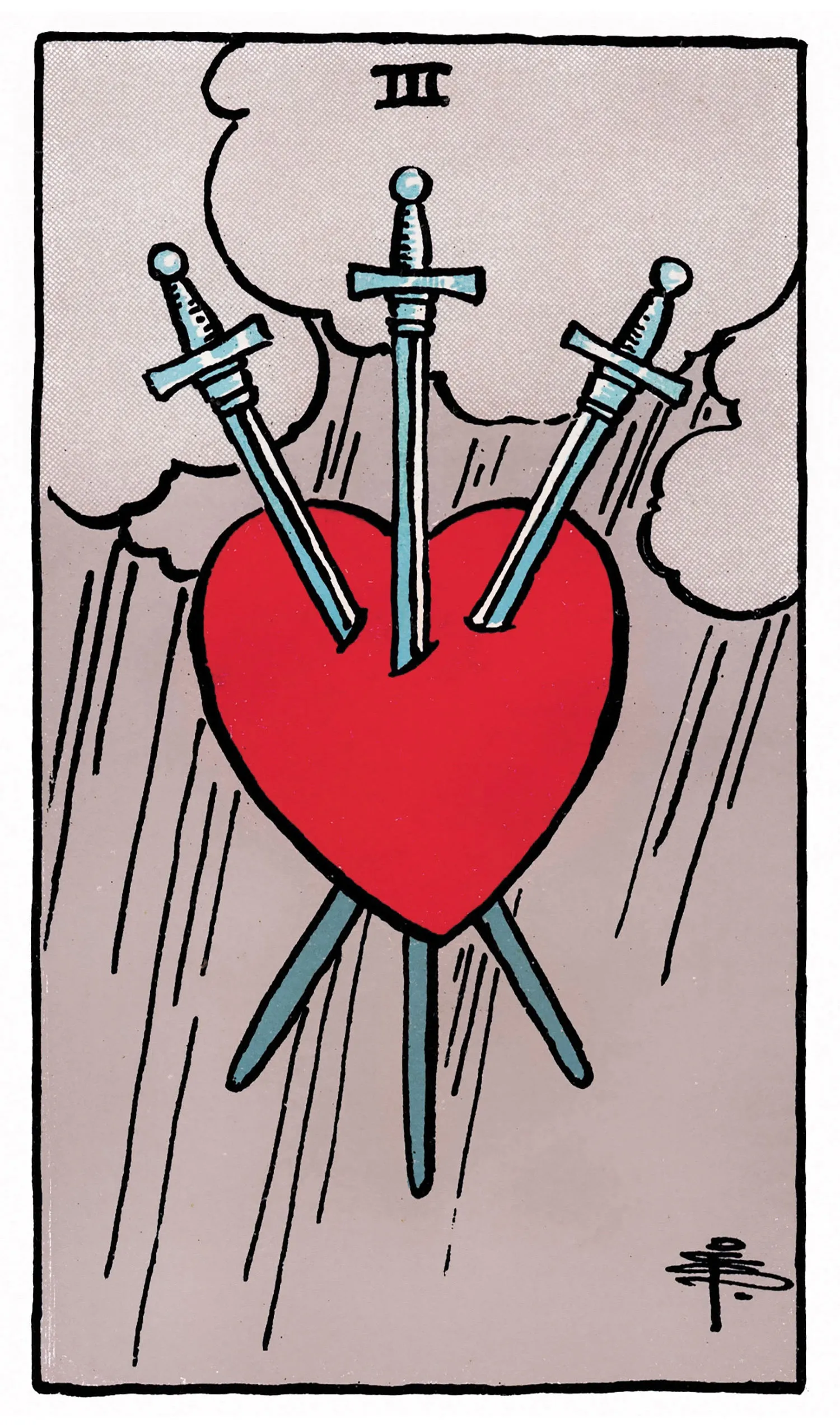
The Rider–Waite–Smith Three of Swords is visually unusual because almost everything unnecessary has been removed.
There is no human figure, no complex scene, and almost no narrative detail.
There is only a heart, three swords, rain, and dark clouds.
The simplicity makes the message brutally clear.
The Pierced Heart
The heart represents emotional vulnerability, attachment, love, expectations, and the part of the person capable of being wounded.
It is not merely sad.
It is penetrated.
The image suggests that the emotional pain has a specific cause rather than being vague or undefined.
The Three Swords
The heart is pierced by Swords rather than Cups.
This is essential.
The pain is connected with the mind: truth, knowledge, communication, words, decisions, conclusions, or information.
Something has been understood.
The three swords can also suggest several conflicting factors or positions creating one painful realization, but they should not automatically be interpreted as three people or a love triangle.
That interpretation requires confirmation from the question and surrounding cards.
The Crossing of Mind and Heart
The image visually expresses one of the card's deepest mechanics:
the mind knows something that the heart does not want to accept.
This can be the realization that plans have failed, that another person does not feel the same way, that two positions are incompatible, or that a painful decision has become necessary.
The Storm Clouds
The dark clouds represent psychological heaviness and the emotional atmosphere created by the realization.
The situation may now be clearer intellectually, but clarity has not yet produced relief.
Knowing the truth and feeling better are not the same thing.
The Rain
Rain reflects grief, sadness, emotional release, and the natural response to loss or disappointment.
It shows that the card is not purely intellectual.
The mind understands, and the emotional system reacts.
The Absence of People
There is no visible person in the card.
This makes the experience universal.
The Three of Swords is not limited to one specific relationship or circumstance.
It represents the general human experience of discovering something that changes how we feel because we can no longer pretend not to know it.
The Core Symbolism of The Three of Swords
The Three of Swords brings the suit of the mind directly into the heart.
Its image expresses the moment when truth becomes emotionally painful.
The card is therefore larger than the popular image of “a broken heart.”
It is the painful recognition of reality — often revealed through words, conflict, incompatible positions, failed expectations, or a decision that the mind knows is necessary even when the heart does not want to accept it.