Minor Arcana · Swords · Eight
The Eight of Swords Tarot Card Meaning
The Eight of Swords represents restriction, limited freedom, and a situation in which your hands are effectively tied. You may want to act, change something, or move forward, but the available room for action is extremely narrow or temporarily nonexistent. These limitations may come from fear or your own thinking, but they can just as easily be created by real circumstances, obligations, rules, dependence, or decisions that are outside your control.
This is not a card of strong development. In TAROVERA, the Eight of Swords belongs to the sequence of Swords that closes doors rather than opens them. When a developing situation begins with this card, it can indicate that the expected event will not develop at all rather than simply developing badly.
Card Meanings
General Meaning
The Eight of Swords describes a position in which freedom has become restricted. You may understand what you would like to do and may even have a clear preference, yet there is very little you can actually change at the present moment.
This card should not automatically be reduced to the idea that “the problem is only in your head.” Sometimes fear, assumptions, or excessive mental control contribute to the restriction, but the Eight of Swords can also describe genuinely limiting circumstances: financial dependence, legal or administrative barriers, commitments, another person's decision, lack of access, external rules, or simply a situation in which no workable move is currently available.
The essential experience of the card is having your hands tied.
The Eight also matters as a stage of development. This is not an Ace carrying fresh potential. By the Eight, the situation has already formed enough for its limitations to become established. The person is not standing in front of a wide field of possibilities. The field has narrowed.
For this reason, the Eight of Swords is especially important in predictive spreads. If a sequence describing how an event will develop begins with the Eight of Swords, TAROVERA does not normally read this as “the event will happen but go badly.” It can mean that the event simply does not get underway.
If you ask, for example, “How will the trip go?” and the development begins with the Eight of Swords, the primary interpretation may be that the trip does not happen at all.
The Shadow Side of The Eight of Swords
The difficult side of the Eight of Swords is prolonged powerlessness. The longer a person remains inside a highly restricted situation, the easier it becomes to spend energy fighting the same closed doors again and again.
Fear can make the limitation feel even narrower. A person may become afraid of making any move because each available option appears to carry consequences. At other times, the opposite happens: they repeatedly attempt to break through a situation that currently has no real potential for development, exhausting themselves without changing the result.
The danger is not simply “negative thinking.” It is the combination of low freedom, low leverage, and the inability to produce meaningful movement.
The Eight of Swords Reversed
Reversed, the Eight of Swords does not automatically represent liberation.
In TAROVERA, the reversed card is a deterioration of the upright principle. Restrictions become harder to overcome, the sense of helplessness increases, and attempts to change the situation may repeatedly fail.
A person may struggle desperately to escape the circumstances but discover that each attempt leads back to the same limitation. Fear can become stronger, dependence can deepen, or the available choices can narrow even further.
In some situations, the reversed Eight of Swords describes chaotic attempts to regain control when there is still no effective way forward.
Core Message
Your hands are tied for now. The situation has little room for movement and very little immediate potential for development. Recognize the limits that actually exist instead of assuming that every closed path can be opened through greater effort.
The Eight of Swords as a Person
Explore all 78 Tarot cards as personality →
As a person, the Eight of Swords can describe someone whose life or behavior is heavily shaped by restrictions. They may appear passive, cautious, hesitant, or dependent, but this does not necessarily mean they lack intelligence, desire, or willpower.
Often, they see the consequences of each possible move very clearly and therefore feel that they cannot act freely.
They may live under strong obligations, financial dependence, family pressure, institutional rules, fear of consequences, or another form of limitation that reduces their independence.
Psychologically, this person can become highly controlled and careful. They may think constantly about what cannot be done, what could go wrong, or what consequences a decision could create.
The Eight of Swords as Actions
As actions, the Eight of Swords usually shows very little effective action.
The person may:
- wait;
- remain where they are;
- avoid making a move;
- act only within very narrow limits;
- follow rules or restrictions;
- depend on someone else's decision;
- be unable to intervene;
- postpone action because no workable option exists.
The card does not necessarily mean that the person does not want to act. Quite often they would act if they could.
The problem is that they currently feel or genuinely are unable to change the situation.
The Eight of Swords in Love and Relationships
Explore all 78 Tarot cards in Love & Relationships →
In relationships, the Eight of Swords shows restricted movement.
A relationship may exist, but the people involved cannot develop it freely. There may be external obstacles, commitments, distance, family circumstances, another relationship, financial dependence, fear of consequences, or emotional conditions that prevent the connection from moving naturally.
The card can also describe a relationship in which one or both people feel trapped.
This does not automatically mean that there are no feelings. The problem is that whatever exists emotionally cannot be freely translated into action or development.
For a new relationship, the Eight of Swords is weak for development. If it appears at the beginning of a predictive sequence, it can show that the connection never properly begins.
The Eight of Swords as Thoughts
In thoughts, the Eight of Swords is:
“I cannot do anything about this.”
The person thinks in terms of limitations, consequences, obstacles, and what is currently impossible.
They may believe that every available choice creates another problem. Their thinking may be fearful or excessively restrictive, but it may also be a realistic assessment of circumstances that genuinely leave little room for action.
The Eight of Swords as Feelings
As feelings, the Eight of Swords does not mean an absence of emotion.
Instead, feelings are constrained.
A person may experience attraction, attachment, longing, fear, or emotional involvement while simultaneously feeling unable to express or act on those emotions.
The emotional experience can therefore be uncomfortable: “I feel something, but I cannot do anything with it.”
It may also describe feeling trapped, powerless, nervous, or emotionally restricted inside the relationship.
The Eight of Swords as Intentions
As intentions, the Eight of Swords shows very limited ability or willingness to move forward.
The person may want circumstances to change, but their actual intention is often to remain within the existing boundaries because they do not see a safe or realistic alternative.
They may intend to wait, avoid making matters worse, or simply do nothing until external circumstances change.
This is not a strong card of proactive intentions.
The Eight of Swords as an Outcome
Explore all 78 Tarot cards as Outcomes →
As an outcome, the Eight of Swords is a card of blocked development.
The situation does not reach free movement, expansion, or successful realization. Instead, it reaches a point where options are restricted and further progress becomes difficult or impossible under the current conditions.
In predictive work, this distinction is crucial.
The Eight of Swords does not necessarily say:
“The event happens, but badly.”
It may say:
“The event does not happen because the path to realization is closed.”
This is particularly important when the Eight of Swords appears at the beginning of a development sequence.
The card has very little independent potential to move a situation forward.
The Eight of Swords in Career and Work
Explore all 78 Tarot cards in Career & Work →
In career matters, the Eight of Swords indicates limited professional freedom.
You may be unable to change jobs, make an independent decision, advance a project, negotiate better conditions, or act without approval from someone else.
The card can describe:
- bureaucracy;
- contractual restrictions;
- lack of authority;
- blocked hiring;
- frozen projects;
- administrative barriers;
- dependence on management;
- lack of viable alternatives;
- a position that currently cannot develop.
Sometimes the employee is capable but simply has no room to use that capability.
For a new job, promotion, or project, the card is weak. If it opens the development line, it can mean the opportunity does not proceed.
The Eight of Swords in Money and Finances
Explore all 78 Tarot cards in Money & Finances →
Financially, the Eight of Swords describes money that cannot be used freely.
Resources may be limited, tied up, unavailable, committed elsewhere, frozen, or controlled by obligations.
Possible manifestations include:
- high fixed expenses;
- debt obligations;
- restricted access to funds;
- money tied up in a process;
- inability to make a desired purchase or investment;
- dependence on another person's financial decisions;
- lack of realistic financial alternatives.
This is not a card of growth or financial expansion. Its primary theme is reduced freedom.
The Eight of Swords in Health
Explore all 78 Tarot cards in Health →
In the TAROVERA health system, the Eight of Swords represents a condition that restricts a person's freedom and can create dependence on ongoing management, medication, or another health-related necessity.
The underlying system gives dependence on necessary medication — insulin is one example — as a model for the card's central health principle: the person cannot simply behave as though the restriction does not exist.
Diarrhea is an association for both upright and reversed orientations.
These are Tarot-system associations, not medical diagnoses.
Tarot should not be used as a substitute for medical diagnosis or treatment.
The Eight of Swords Timing — When Will It Happen?
Explore Timing for all 78 Tarot cards →
The Eight of Swords has two very different timing functions depending on whether the surrounding spread actually confirms realization.
If the overall spread is positive and clearly shows that the event will happen, the Eight of Swords indicates a long wait.
The expected period is generally more than six months, most often approximately eight months to one year.
However, if the surrounding cards do not confirm realization, the Eight of Swords should not automatically be converted into “eight months.”
In that context, the card means that the path itself is closed.
The event may simply not happen.
Key Timing Correspondence
If realization is confirmed: approximately 8 months to 1 year.
If realization is not confirmed: closed path; the event does not develop.
The Eight of Swords as an Event
Explore all 78 Tarot cards as Events →
As an event, the Eight of Swords often manifests through something not happening.
A plan may be cancelled, blocked, refused, restricted, or made impossible by circumstances.
Possible events include:
- cancellation of a trip;
- refusal of permission;
- a blocked application;
- inability to proceed with a plan;
- access being restricted;
- a project being frozen;
- someone becoming unavailable;
- circumstances preventing action;
- a decision being taken out of your hands.
The defining principle is not simply that the event is unpleasant.
The defining principle is that the path forward closes.
The Eight of Swords as Card of the Day
Explore all 78 Card of the Day meanings →
As Card of the Day, the Eight of Swords suggests that something may not move according to plan.
You may encounter a restriction, cancellation, refusal, rule, delay, or circumstance that leaves you with fewer options than expected.
The most useful response is not necessarily to force movement. First establish what can actually be changed and what cannot.
Some doors may simply remain closed today.
The Eight of Swords as Advice
Explore Advice from all 78 Tarot cards →
The Eight of Swords advises you to accept the situation as it currently is.
This is not a card that asks you to manufacture potential where almost none exists.
Your hands may genuinely be tied.
Recognize the limitations instead of fighting the same reality again and again. Stop trying to force immediate development from a situation that currently has no workable path forward.
Acceptance here does not mean that nothing can ever change.
It means understanding that right now, your ability to change this particular situation is extremely limited.
Save your energy rather than wasting it on a closed door.
The Eight of Swords Reversed as Advice
Acknowledge that the struggle itself may now be making the situation worse.
Repeated attempts to escape, force movement, or regain control are not producing the desired effect.
Do not assume that more effort automatically creates more possibility.
Accept how restricted the situation has become, contain further losses, and stop exhausting yourself against something that currently offers no effective route forward.
The Eight of Swords as a Warning
Explore Warnings from all 78 Tarot cards →
The Eight of Swords warns against wasting time, strength, money, or emotional energy trying to force development where the path is currently closed.
Not every restriction is imaginary.
Do not allow someone to convince you that a situation must have an immediate solution simply because you want one.
The card also warns against entering circumstances that would take away too much of your freedom or leave critical decisions outside your control.
The Eight of Swords — Yes or No
Explore Yes or No meanings for all 78 Tarot cards →
Upright: No
The Eight of Swords is a clear No.
The path is restricted, the necessary freedom to act is missing, and the situation has very little potential for development.
If the question is whether something will happen, the card often indicates that it will not reach realization.
Reversed: No
The reversed Eight of Swords is also a clear No.
The original restriction has not been resolved. It has become more difficult, more entrenched, or harder to overcome.
This is not a reversed card that turns the answer into Yes.
The Eight of Swords Symbolism
Explore Symbolism for all 78 Tarot cards →
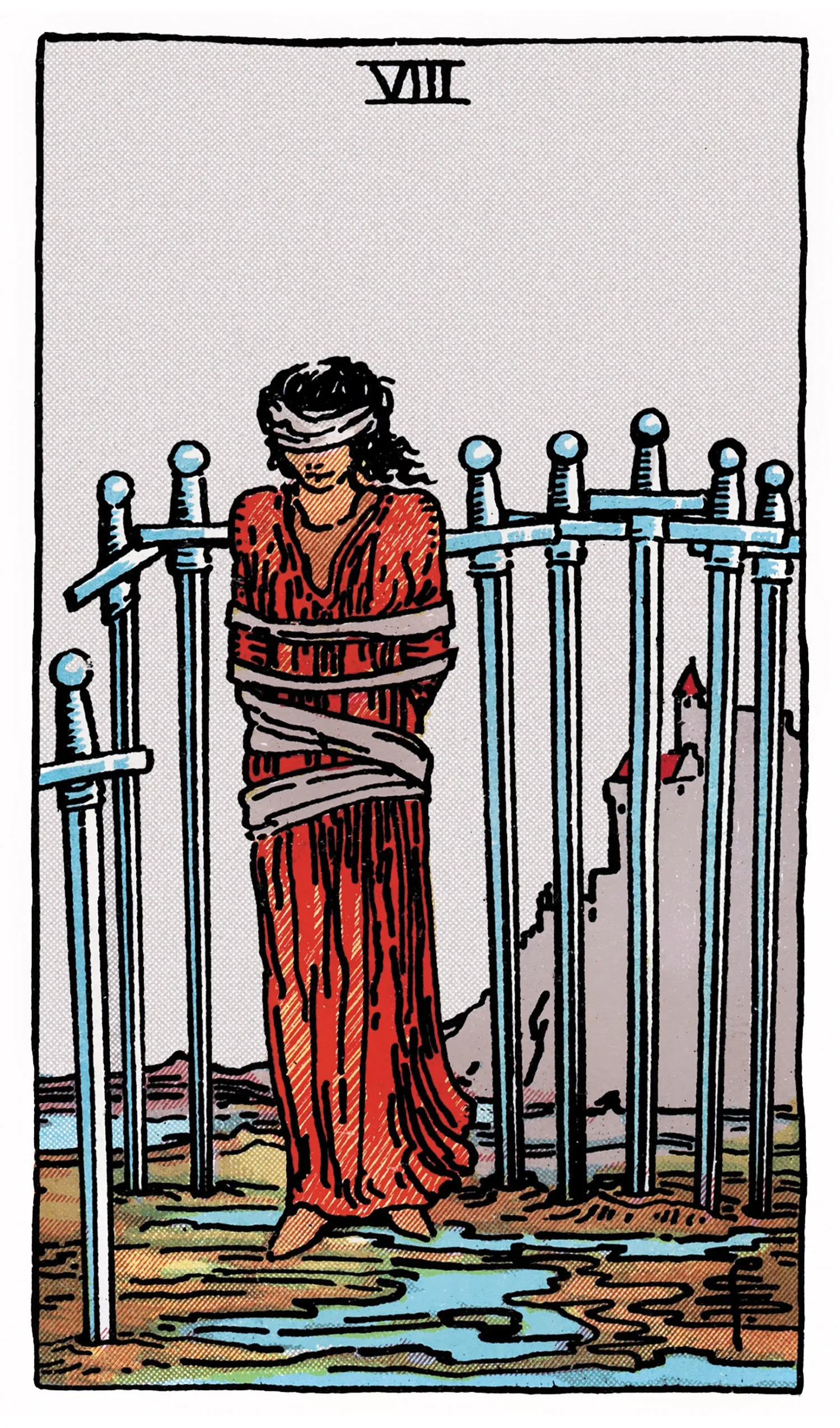
The traditional Rider–Waite–Smith image shows a blindfolded and bound woman surrounded by upright swords. The symbolism emphasizes restriction, limited perception, and the narrow field in which movement is possible.
In TAROVERA, the image should not be used to support the simplistic conclusion that “she can easily escape if she only realizes it.” The symbolism describes confinement. It does not guarantee that a workable escape currently exists.
The Bound Figure
The bindings are the clearest visual representation of the card's central principle: hands tied.
The figure cannot act freely. Desire and ability are separated. She may want to move, but her present circumstances restrict what she can actually do.
The Blindfold
The blindfold adds limited information and limited perspective.
The person may not see every aspect of the situation clearly, but lack of perspective is only one part of the card. It should not erase the reality of the restrictions represented by the rest of the image.
The Eight of Swords can therefore indicate both incomplete understanding and genuine external limitation.
The Eight Swords
The swords create a narrow and threatening environment around the figure.
They symbolize the established conditions, rules, consequences, fears, or circumstances that limit movement.
Unlike the open potential of an Ace, the Eight has already developed into a structured situation. The available space has become narrow.
The Distant Castle
The castle suggests another place, another condition, or another state of security that exists at a distance from the figure's present position.
Something else may exist beyond the current restriction, but there is no guarantee that the person can reach it now.
The Wet Ground
The wet, uneven ground contributes to the instability of the situation.
Even movement that appears technically possible may carry difficulty or risk. The figure is not standing in an open, secure environment from which action is easy.
The Core Symbolism of The Eight of Swords
The Eight of Swords is the image of restricted agency.
The bound body represents limited action. The blindfold represents limited perspective. The surrounding swords represent established barriers and consequences. Together they create a situation in which desire alone is not enough to produce movement.
The card's central question is therefore not simply:
“Why don't you leave?”
It is:
“How much freedom do you actually have to change this right now?”
And sometimes the answer is: very little.