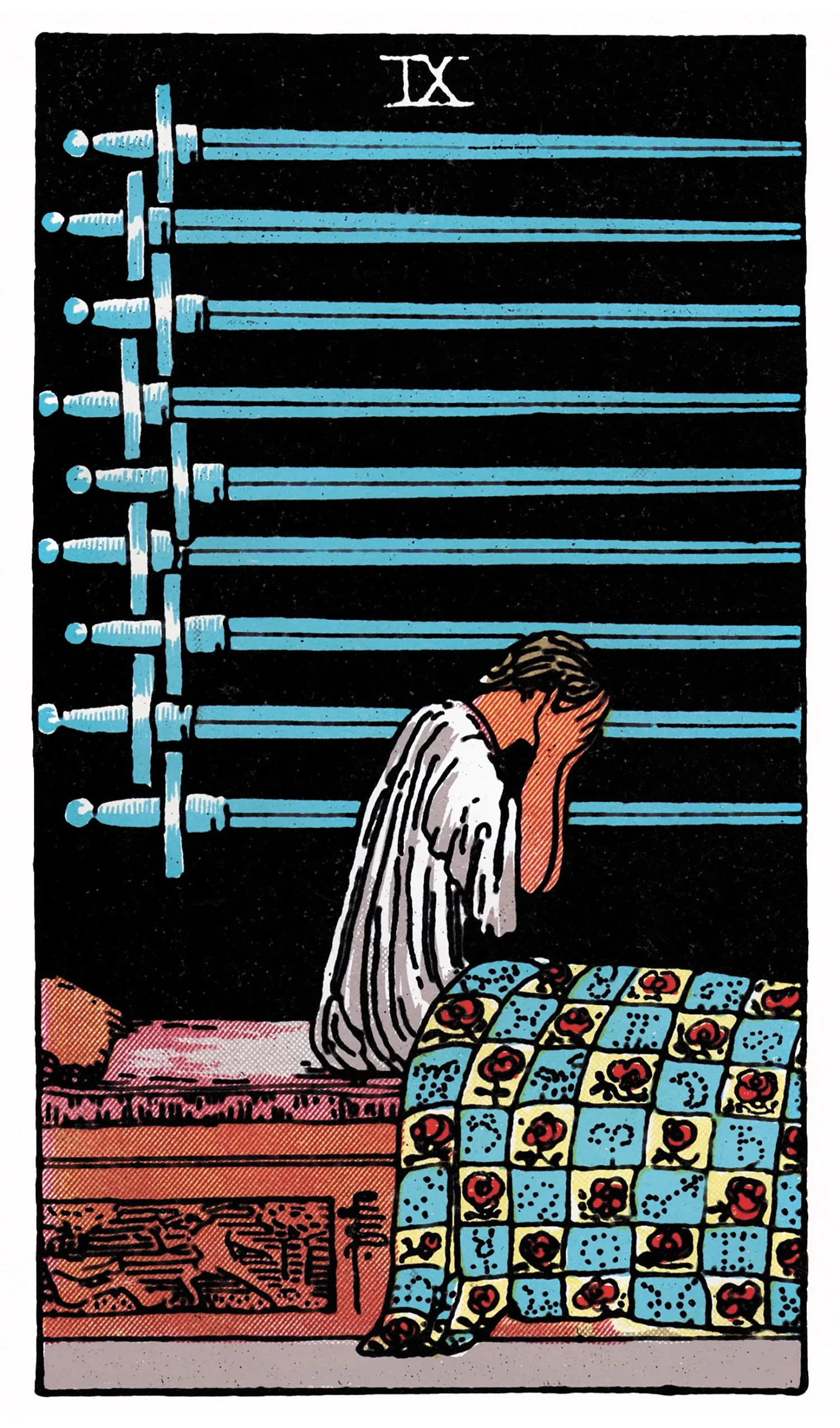
Minor Arcana · Swords · Nine
The Nine of Swords Tarot Card Meaning
The Nine of Swords represents severe mental pressure, fear, distress, and the painful experience of a situation that has already reached a difficult stage. It can describe anxiety, sleeplessness, guilt, shame, dread, obsessive thinking, or the expectation of a negative outcome.
However, this card should not automatically be reduced to “imaginary fears.” Sometimes the person is catastrophizing, but sometimes the circumstances are genuinely serious. The core of the Nine of Swords is not simply fear itself, but the mental and emotional suffering created by a situation that has become extremely difficult to carry.
In TAROVERA, the Nine of Swords belongs to the closing-door sequence of the suit. It carries very little potential for new development and is usually weak for successful realization.
Card Meanings
General Meaning
The Nine of Swords describes a situation that has become psychologically or emotionally difficult to bear.
Something weighs heavily on the mind. The person may repeatedly replay events, anticipate consequences, fear what will happen next, blame themselves for what has happened, or struggle to stop thinking about the problem.
This card often appears when an external situation has already created an internal crisis.
The fear may be exaggerated, but it does not have to be imaginary.
Sometimes the person is genuinely dealing with:
- bad news;
- loss;
- uncertainty;
- serious consequences;
- guilt or shame;
- conflict;
- fear of failure;
- fear of losing someone or something;
- a problem that has already progressed too far.
The essential question of the card is not:
“Is the fear rational?”
It is:
“How badly is this situation affecting the person now?”
The Nine of Swords can also describe the psychological aftermath of something that has already happened. The external event may be over, the immediate crisis may have passed, but the person's mind is still living inside it. They continue replaying, fearing, regretting, or emotionally processing what is technically already finished.
This is one of the reasons the card can sometimes appear close to the end of a difficult period: the external problem may be closing while its emotional consequences remain.
The Nine of Swords is a late-stage card.
It does not carry the open potential of an Ace or the developmental energy of an earlier number. The situation has already accumulated enough tension to become exhausting.
In predictive spreads, this matters.
If the development of a desired event begins with the Nine of Swords, TAROVERA normally reads this as a closed line of development, not as a promise that the event will happen but feel unpleasant.
The event may simply fail to develop.
The Shadow Side of The Nine of Swords
The shadow side appears when suffering becomes self-reinforcing.
The person may repeatedly return to the same thoughts, imagine increasingly severe outcomes, lose sleep, search constantly for reassurance, or mentally live through the feared event again and again.
Guilt may turn into self-punishment.
Shame may become more painful than the original mistake.
A person may keep asking:
“What did I do wrong?”
“What will people think?”
“How could I have allowed this to happen?”
At its worst, the card creates a closed mental circle in which fear produces more fear, guilt produces more guilt, and every thought seems to confirm the worst possible interpretation.
Fear may become stronger than the ability to think clearly.
At the same time, it would be incorrect to dismiss every Nine of Swords situation as unnecessary worrying. Sometimes the circumstances themselves are painful.
The shadow therefore lies both in the difficult reality and in the mind's ability to make that reality even harder to endure.
The Nine of Swords Reversed
Reversed, the Nine of Swords does not automatically mean relief, recovery, or the end of anxiety.
The upright principle becomes more distorted.
One manifestation is fear that has become increasingly disproportionate to reality. The person may worry intensely even when there is little objective evidence supporting the worst-case scenario.
This can manifest as:
- phobic thinking;
- severe catastrophizing;
- obsessive worry;
- suspicion;
- fear of humiliation;
- excessive guilt;
- repeated reassurance-seeking;
- inability to stop mentally returning to the same fear.
Another manifestation is denied suffering.
Instead of openly acknowledging fear, grief, guilt, or pain, the person pushes it inward and tries to behave as though nothing is wrong. The distress remains active underneath and continues affecting their thinking and behavior.
In both cases, the reversed card remains an impaired Nine of Swords. It does not become a simple card of liberation.
Core Message
The situation has reached a point where it is creating serious mental or emotional suffering. Do not underestimate the weight of what is happening, but do not allow fear, guilt, or shame to multiply the problem beyond what the circumstances actually support.
The Nine of Swords as a Person
Explore all 78 Tarot cards as personality →
As a person, the Nine of Swords can describe someone who carries a great deal of internal tension.
They may be:
- anxious;
- highly sensitive to consequences;
- prone to worry;
- guilt-ridden;
- ashamed of past actions;
- mentally exhausted;
- afraid of making mistakes;
- fearful of loss or failure.
This person can appear outwardly functional while privately struggling with intense thoughts.
They may replay conversations, anticipate problems, worry about how others judge them, or assume the worst before they have enough information.
At other times, their anxiety is connected to genuinely difficult circumstances rather than personality alone.
The Nine of Swords as Actions
As actions, the Nine of Swords is weak.
The person tends to worry more than act.
They may:
- hesitate;
- withdraw;
- avoid decisions;
- repeatedly check something;
- seek reassurance;
- lose sleep over the situation;
- cancel plans because of fear;
- react nervously;
- make decisions from panic rather than strategy.
Importantly, the person may already know what needs to be done.
The problem is that taking the necessary action feels too frightening, painful, humiliating, or emotionally difficult.
They may therefore avoid reality not because they genuinely have no idea what to do, but because they are afraid of what doing it will require.
The card does not show confident or productive forward movement.
Often, the person's energy is consumed internally.
The Nine of Swords in Love and Relationships
Explore all 78 Tarot cards in Love & Relationships →
In love, the Nine of Swords describes a relationship or emotional situation that is causing significant distress.
A person may fear:
- losing the relationship;
- rejection;
- betrayal;
- separation;
- abandonment;
- being replaced;
- the consequences of something that has already happened;
- the future of the connection.
The card can appear after arguments, breakups, betrayals, difficult discoveries, periods of uncertainty, or situations in which one person no longer feels emotionally safe.
It can also describe inability to forgive.
A painful event may technically be over, but one person continues replaying it and cannot emotionally move beyond what happened.
The Nine of Swords may show loneliness and the feeling of being abandoned or emotionally rejected even when the person desperately wants closeness.
It can also create suspicion and jealousy.
Fear of losing the partner may become so intense that love turns into constant checking, monitoring, reassurance-seeking, accusations, or attempts to control the other person's behavior.
The person suffers themselves and, through their fear, may begin making the relationship painful for the other person as well.
This does not automatically mean there are no feelings.
In fact, the person may be suffering precisely because the connection matters deeply to them.
However, the Nine of Swords is not a strong card for constructive relationship development.
If it opens a predictive sequence for a new connection or desired development, the relationship may fail to move forward.
The Nine of Swords as Thoughts
As thoughts, the Nine of Swords is one of the clearest cards of mental distress.
The person's mind keeps returning to the problem.
Typical thoughts include:
- “What if everything goes wrong?”
- “What if I lose this?”
- “What if I made a terrible mistake?”
- “What will they think of me?”
- “What happens now?”
- “I cannot stop thinking about this.”
The person may imagine worst-case scenarios, replay previous events, fear consequences, blame themselves, or mentally prepare for disaster.
Some of these fears may be exaggerated.
Others may be based on very real concerns.
The Nine of Swords as Feelings
As feelings, the Nine of Swords represents emotional pain.
It can indicate:
- fear;
- guilt;
- shame;
- anxiety;
- dread;
- regret;
- sadness;
- despair;
- loneliness;
- emotional pressure;
- fear of loss;
- feeling abandoned or rejected.
The person may feel deeply affected by the situation but unable to find emotional relief.
This is not a card of calm affection.
It is the experience of feelings becoming painful to carry.
The Nine of Swords as Intentions
As intentions, the Nine of Swords rarely shows confident forward movement.
The person may want to avoid pain, prevent a feared outcome, protect themselves, or reduce the immediate emotional pressure.
They may intend to:
- wait;
- avoid confrontation;
- withdraw;
- seek reassurance;
- postpone a decision;
- prevent something from getting worse.
The card can also show that fear is stronger than intention.
The person may know what should be done and even want to do it, but still be unable to bring themselves to act.
The Nine of Swords as an Outcome
Explore all 78 Tarot cards as Outcomes →
As an outcome, the Nine of Swords is usually poor for realization.
The desired situation may fail to develop, become psychologically unbearable, or reach a point where continuation no longer has meaningful potential.
For questions about:
- a new relationship;
- a project;
- a plan;
- a trip;
- an opportunity;
- a desired future event;
the Nine of Swords generally does not support successful realization.
However, TAROVERA uses an important contextual exception.
If the original situation itself is already negative, then the Nine of Swords as an outcome can indicate that the negative process is reaching its end.
For example, if the question concerns:
- an ongoing crisis;
- a difficult conflict;
- a painful period;
- a stressful problem;
- an unpleasant process already underway;
then the Nine of Swords can show that the situation reaches its final difficult stage and closes.
In other words:
The Nine of Swords closes the line.
If the line is something you wanted to develop, this is negative.
If the line itself is something painful that you want to end, closure can be favorable.
The card can also show residual distress after the practical problem has already ended. The situation may be finished externally while the person still needs time to emotionally process what happened.
The Nine of Swords in Career and Work
Explore all 78 Tarot cards in Career & Work →
In career matters, the Nine of Swords indicates serious professional stress.
It can describe:
- fear of losing a job;
- professional failure;
- disciplinary consequences;
- guilt over a mistake;
- pressure from management;
- fear of an evaluation;
- workplace conflict;
- a project that is going badly;
- sleeplessness caused by work;
- fear of financial or professional consequences.
It is especially characteristic of deadline pressure and severe time stress.
The person may feel that they cannot complete everything on time or that too much depends on one result.
The Nine of Swords can also describe fear of:
- audits;
- inspections;
- performance reviews;
- assessments;
- examinations;
- public presentations;
- being judged professionally.
In difficult workplace environments, it may show bullying, mobbing, unfair treatment, hostility, or a toxic atmosphere that makes the thought of returning to work emotionally exhausting.
For a new job, promotion, or project, the card is weak.
If it begins the development line, the opportunity may fail to proceed.
The Nine of Swords in Money and Finances
Explore all 78 Tarot cards in Money & Finances →
Financially, the Nine of Swords represents serious worry about money and can sometimes correspond with objectively difficult financial circumstances.
Possible manifestations include:
- debt;
- overdue or delayed payments;
- loss of money;
- loss of property;
- a failed business;
- a failed financial transaction;
- fear of bankruptcy;
- inability to meet obligations;
- financial pressure that causes sleeplessness;
- deception or manipulation involving money.
The card does not itself promise financial recovery.
It primarily describes a situation in which money has become a source of serious distress.
Sometimes the actual financial problem is severe.
Sometimes the fear is larger than the objective situation.
The surrounding cards determine the difference.
The Nine of Swords in Health
Explore all 78 Tarot cards in Health →
In the TAROVERA health system, the Nine of Swords is associated with serious health fears and severe medical situations.
Upright, it can correspond symbolically with receiving a very serious or potentially fatal diagnosis, the night before a major operation, or oncology-related themes.
This is a Tarot association and must not be treated as a medical diagnosis.
The TAROVERA source also gives a specific combination with The Moon for severe psychiatric states. This combination-specific association should not be generalized to the Nine of Swords alone.
Tarot should not be used as a substitute for medical diagnosis or treatment.
The Nine of Swords Timing — When Will It Happen?
Explore Timing for all 78 Tarot cards →
The Nine of Swords does not provide a specific timeframe.
It should not automatically be translated into:
- nine days;
- nine weeks;
- nine months;
- half a year;
- any other fixed period.
If the overall spread is positive and clearly confirms that the event will happen, the Nine of Swords simply does not answer the question of when.
The timing must be determined from other cards or other timing indicators in the spread.
If the surrounding cards do not confirm realization, the Nine of Swords reinforces the opposite conclusion:
the situation is unlikely to realize or develop as intended.
In that context, the card indicates a closed development line rather than a period of waiting.
Key Timing Correspondence
If realization is confirmed: no specific timing answer.
If realization is not confirmed: the event does not develop as intended.
The Nine of Swords as an Event
Explore all 78 Tarot cards as Events →
As an event, the Nine of Swords often represents a difficult development that creates significant mental or emotional distress.
Possible manifestations include:
- receiving upsetting news;
- a painful realization;
- consequences of an earlier mistake;
- a stressful conversation;
- a crisis reaching its most difficult stage;
- a plan collapsing before realization;
- the cancellation or failure of something important;
- a night of severe worry or sleeplessness;
- being forced to face a reality that has previously been avoided.
The card can also represent the end of an already negative process.
If something painful has been developing for some time, the Nine of Swords may show that the situation reaches its final difficult stage and closes.
If the question instead concerns a desired event, the card is weak for occurrence.
The Nine of Swords as Card of the Day
Explore all 78 Card of the Day meanings →
As Card of the Day, the Nine of Swords suggests a mentally difficult day.
You may worry more than usual, receive information that unsettles you, lose sleep over something, feel guilty about a decision, or become preoccupied with a problem.
Before assuming the worst, separate:
- what has actually happened;
- what may happen;
- what you are imagining.
At the same time, do not dismiss a real problem simply because fear is present.
If something genuinely requires action, avoiding it may only prolong the anxiety.
The Nine of Swords as Advice
Explore Advice from all 78 Tarot cards →
The Nine of Swords advises you to return to reality and separate facts from fear.
Do not pretend that everything is fine if it is not.
If a real problem exists, identify what can still be done and deal with that part directly.
You may already know what needs to happen but be avoiding it because the action feels unpleasant, frightening, or emotionally difficult.
Avoidance does not necessarily make the situation safer.
At the same time, do not spend all your energy mentally living through every possible negative outcome.
Ask:
- What has actually happened?
- What am I afraid might happen?
- What can I still influence?
- What is already outside my control?
If the situation is already reaching its end, allow it to close instead of trying to revive a line that has little remaining potential.
Recognize reality, act where action is still possible, and stop feeding a closed situation with endless mental energy.
The Nine of Swords Reversed as Advice
Do not let fear become your main source of information.
If your thinking has become obsessive, suspicious, catastrophic, or disproportionate, return to facts before making a decision.
If you are doing the opposite — denying pain and pretending nothing affects you — acknowledge what you are actually feeling.
Neither uncontrolled fear nor complete suppression gives you an accurate view of the situation.
The Nine of Swords as a Warning
Explore Warnings from all 78 Tarot cards →
The Nine of Swords warns that a difficult situation can become even more damaging when the mind repeatedly amplifies it.
Be careful of:
- assuming the worst before it happens;
- losing sleep over what you cannot control;
- guilt that becomes self-punishment;
- shame that prevents necessary action;
- repeatedly imagining disaster;
- allowing fear to replace facts;
- making major decisions while panicking.
The card also warns against entering questionable or risky situations whose consequences may later become a source of serious regret.
Do not ignore obvious warning signs simply because dealing with them now feels uncomfortable.
And do not waste energy trying to force continued development from a situation that is already reaching a closed stage.
The Nine of Swords — Yes or No
Explore Yes or No meanings for all 78 Tarot cards →
Upright: No
The Nine of Swords is a clear No.
The situation carries too much crisis, distress, and closed development potential to support the desired realization.
If the question is whether something will happen, the card generally does not support successful development.
Reversed: No
The reversed Nine of Swords is also a clear No.
Fear, distortion, suppression, or psychological pressure has intensified, while the underlying development remains weak or closed.
Reversal does not turn this card into a positive answer.
The Nine of Swords Symbolism
Explore Symbolism for all 78 Tarot cards →
The Rider–Waite–Smith Nine of Swords shows a figure sitting upright in bed with their face in their hands. Nine swords hang horizontally on the wall behind them.
The image emphasizes the experience of suffering that continues even when the external world appears still.
The Figure Sitting in Bed
The figure has awakened or cannot sleep.
This immediately connects the card with:
- anxiety;
- sleeplessness;
- intrusive thoughts;
- fear that follows a person into the night;
- inability to mentally disengage from a problem.
The body is physically still, but the inner experience is intense.
The Hands Covering the Face
The covered face suggests distress, grief, shame, guilt, fear, or the desire not to look directly at what is happening.
It can also reflect the feeling that the problem has become too painful to process calmly.
The Nine Swords
The swords dominate the background.
They represent thoughts, fears, conclusions, memories, consequences, and mental pressure that have accumulated over time.
There are already nine of them.
This is not the beginning of the process.
The situation is approaching the end of the suit's development.
The Bed
The bed should be a place of rest, but here rest is impossible.
This contrast is central to the card.
The problem has entered the person's private mental space so completely that even withdrawal from the external world does not create relief.
The Dark Background
The darkness strengthens the atmosphere of uncertainty and fear.
At night, problems often feel larger because there are fewer distractions and less external information.
The card therefore also illustrates how uncertainty can intensify anxiety.
The Core Symbolism of The Nine of Swords
The Nine of Swords shows the mind suffering under the weight of a situation that has reached a late and difficult stage.
The person is not actively moving forward.
The swords have already accumulated.
The crisis is being experienced internally.
In TAROVERA, this symbolism also supports the card's predictive role as a closing card: there is very little fresh developmental potential left.
The question is no longer:
“What new beginning is possible?”
It is:
“How does this difficult line finally reach its limit?”