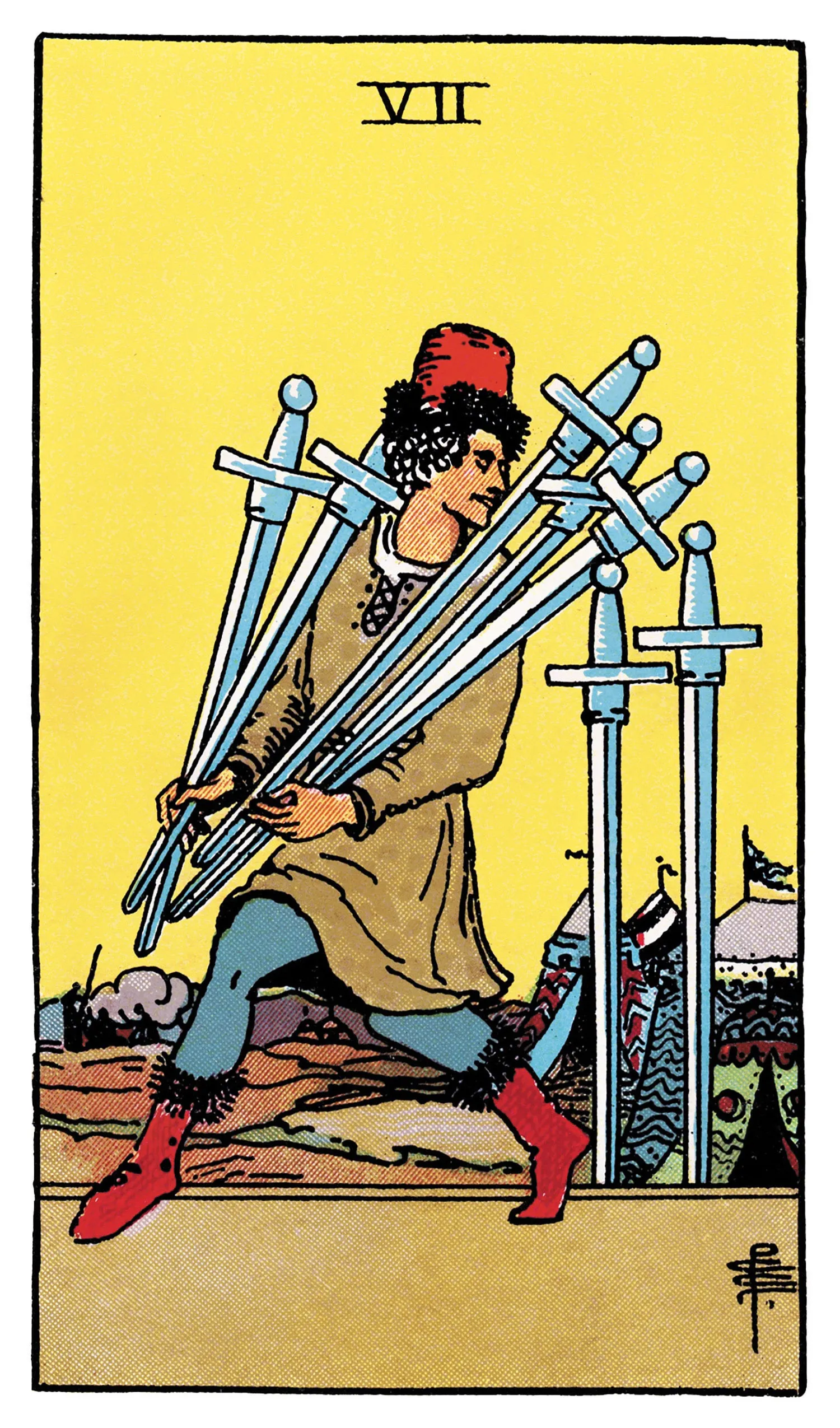
Minor Arcana · Swords · Seven
The Seven of Swords Tarot Card Meaning
The Seven of Swords is a card of quiet strategy, cautious movement, uncertainty, and acting without unnecessary exposure. It often describes a period in which nothing should be forced: events develop slowly, plans remain private, communication becomes careful, and a person prefers to observe, think, wait, or take an indirect route rather than confront the situation openly.
Although popular Tarot interpretations often reduce the Seven of Swords to deception, betrayal, or infidelity, TAROVERA reads this card more broadly. In repeated practical readings, one of its most important manifestations is simply a quiet and uncertain period — a pause in visible activity while strategy, possibilities, and the next move are still being formed.
Card Meanings
General Meaning
The Seven of Swords represents a situation that develops quietly rather than openly.
Visible activity may decrease.
People may communicate carefully.
Plans may still exist only in someone's mind.
Important decisions may not yet be announced.
Someone may be watching what happens before committing to the next step.
This is one of the central TAROVERA meanings of the card.
The Seven of Swords does not automatically mean betrayal, lying, cheating, theft, or manipulation.
Sometimes nothing negative is happening at all.
The card may simply describe:
a calm, cautious, unresolved period in which it is better not to force events.
The person may be uncertain about the final direction.
They may need time to observe the situation.
They may prefer to avoid unnecessary confrontation.
They may decide not to reveal everything they are planning until the plan becomes more developed.
This gives the Seven of Swords a strong strategic quality.
The central question becomes:
How can I move through this situation without creating unnecessary resistance?
Sometimes the answer is:
- wait;
- observe;
- say less;
- keep the plan private;
- choose an indirect route;
- do not provoke;
- allow the situation to settle;
- move when the opening becomes clearer.
This can be intelligent discretion rather than dishonesty.
Plans, Designs, and Strategic Thinking
The Seven of Swords is also a strong card of plans that are still being designed.
The person may be mentally constructing a strategy before acting.
They compare possibilities.
They test ideas.
They look for weak points, shortcuts, alternative routes, or solutions that other people have not considered.
The plan may exist more clearly in the mind than in external reality.
This is why the card is especially connected with:
- tactical thinking;
- research;
- planning;
- experimenting;
- problem-solving;
- developing a project privately;
- working out how to approach a difficult objective.
Another important manifestation is a new attempt after an earlier setback.
The person has learned something from previous experience.
They may have failed before, been blocked, lost an opportunity, or discovered that the direct route did not work.
Now they return with another strategy.
They are more cautious.
More experienced.
Less willing to act naively.
Instead of repeating the same method, they ask:
What can I do differently this time?
Partial Achievement
The Seven of Swords rarely feels completely finished.
Something may already have worked.
Part of the objective may be secured.
The person may obtain an advantage, gather information, complete part of the task, or successfully avoid a problem.
But another part remains unresolved.
This is an important Seven mechanism:
some progress has been made, but the whole situation has not been completed.
The result may therefore be partial, provisional, or dependent on what happens next.
The Shadow Side of The Seven of Swords
The shadow appears when discretion turns into deception.
A person may withhold information because they want to manipulate what other people know.
They may:
- lie;
- mislead;
- hide important facts;
- act behind someone's back;
- exploit trust;
- avoid accountability;
- manipulate circumstances;
- take something that does not belong to them;
- use a loophole unfairly.
This is where the familiar meanings of betrayal, theft, double dealing, and hidden agendas appear.
But TAROVERA does not treat them as automatic.
A serious interpretation such as infidelity, betrayal, or deliberate deception should be supported by the wider spread.
Another important shadow is self-deception.
The person may create such a complicated mental strategy that they begin believing their own construction instead of looking at reality.
They explain everything.
Justify everything.
Plan around every possibility.
And eventually become trapped inside a theory that may not correspond to what is actually happening.
The Seven of Swords can therefore warn:
clever thinking is useful until you become too clever for your own good.
Another shadow is excessive avoidance.
The person keeps trying not to create conflict, not to expose themselves, and not to make a clear decision.
Eventually the quiet strategy becomes indefinite delay.
Nothing gets resolved because the person is always preparing for the next move instead of making it.
The Seven of Swords Reversed
The reversed Seven of Swords shows a weakened, blocked, exaggerated, poorly executed, or self-defeating version of the same strategy.
The person may become too cautious.
They wait too long.
They hide for too long.
They keep changing the plan.
They overthink the situation until the opportunity passes.
The strategy stops being clever and becomes inefficient.
A plan can also be badly designed.
The person may miscalculate the situation, overlook something important, underestimate other people, or become trapped in their own tactics.
If deception is already confirmed by surrounding cards, the lie may become more difficult to maintain, the hidden strategy may become clumsy, or consequences may begin to appear.
However, reversed Seven of Swords does not automatically mean that the truth is revealed or that the person becomes honest.
The card remains the Seven of Swords.
Its strategy is simply functioning badly.
Another important reversed manifestation is unfinished execution.
The person can make considerable progress and then retreat.
They may reach very close to the objective but lose confidence at the final stage.
Fear, uncertainty, exhaustion, or lack of commitment becomes stronger than the original plan.
They abandon the strategy almost when it could have produced a result.
This creates the feeling:
“I came this far, but I could not finish it.”
Core Message
The Seven of Swords says:
move quietly, think strategically, and do not force what is still uncertain.
Not every private plan is deception.
Not every quiet period hides betrayal.
Sometimes caution is simply the intelligent response to a situation that is not ready for open action.
But strategy must eventually lead somewhere.
The Seven of Swords as a Person
Explore all 78 Tarot cards as personality →
The Seven of Swords can describe someone observant, strategic, private, independent, and careful about revealing their plans.
They may naturally think several steps ahead.
They notice details.
They look for alternatives.
They often prefer finding an intelligent workaround rather than confronting an obstacle directly.
This person may be good at:
- research;
- planning;
- independent work;
- problem-solving;
- noticing loopholes;
- protecting confidential information;
- developing unusual solutions.
They may also have learned from previous failures.
Instead of approaching the same challenge in the same way again, they modify the strategy.
At their best, this makes them adaptable and resourceful.
However, they may also be difficult to read.
They do not necessarily say everything they think.
They may prefer to decide privately before involving other people.
That does not automatically make them dishonest.
In a shadow expression, however, the same qualities can become manipulation, evasiveness, dishonesty, or an inability to be transparent.
The Seven of Swords as Actions
As Actions, the Seven of Swords describes quiet, cautious, or indirect movement.
The person may:
- observe;
- wait;
- keep a low profile;
- plan privately;
- collect information;
- research;
- avoid unnecessary confrontation;
- communicate carefully;
- reveal only what is necessary;
- use an indirect route;
- test an idea before announcing it;
- work independently;
- attempt something differently after a previous failure.
Sometimes the person deliberately does not want attention.
This can be entirely reasonable.
For example, they may quietly prepare a project before presenting it publicly.
They may wait until conflict has cooled.
They may avoid engaging with someone who is actively provoking them.
In a shadow context, the same behavior can become:
- lying;
- hiding;
- manipulating;
- stealing;
- misleading;
- acting behind someone's back;
- avoiding responsibility.
Context determines the difference.
The Seven of Swords in Love and Relationships
Explore all 78 Tarot cards in Love & Relationships →
In Love, the Seven of Swords is frequently interpreted too negatively.
TAROVERA does not treat this card as automatic evidence of infidelity, betrayal, a third party, or secret relationships.
One of its most common practical manifestations can simply be a quiet, uncertain period in the relationship.
The connection may become less active.
Communication may be cautious.
People may avoid forcing the issue.
One or both partners may need time to observe what is happening before making decisions.
The relationship can enter a phase in which:
- nobody wants another conflict;
- people choose their words carefully;
- contact becomes quieter;
- there is some distance;
- the future remains uncertain;
- the situation is allowed to settle.
This can happen after a difficult period.
It can also happen before the next stage becomes clear.
The Seven of Swords may therefore indicate:
calm without certainty.
Something is still happening underneath, but not necessarily something negative.
The card can also show one person keeping thoughts or plans private.
They may not yet be ready to talk openly.
They may be considering what they want.
They may want to continue the relationship but without pressure.
Only when surrounding cards independently support themes such as deception, hidden partners, triangles, manipulation, or betrayal should the Seven of Swords be intensified into those meanings.
A single Seven of Swords is not enough to conclude:
“This person is cheating.”
The Seven of Swords as Thoughts
As Thoughts, the Seven of Swords is one of the strongest cards of strategy.
The person may be thinking:
- What is the smartest way to handle this?
- Should I say anything yet?
- What should I keep private?
- What is the alternative route?
- What did I do wrong last time?
- What can I change in the next attempt?
- How can I avoid unnecessary conflict?
- What happens if I wait?
- How can I achieve part of the result without risking everything?
The card can show the development of a plan that is not yet ready for execution.
The person may mentally test several scenarios.
This is also a strong card of learning from failure.
They may think:
“The first approach did not work. I need another strategy.”
In a shadow manifestation, thinking becomes overly complicated.
The person can construct elaborate theories, assumptions, or explanations and become detached from what is actually happening.
The Seven of Swords as Feelings
The Seven of Swords is not a strong card of open emotional expression.
Feelings may exist, but the person approaches them carefully.
They may feel:
- uncertain;
- guarded;
- cautious;
- uncomfortable with vulnerability;
- safer keeping emotional distance;
- curious but unwilling to expose themselves yet.
This can be particularly common during a quiet relationship phase.
The lack of visible emotional expression does not automatically mean lack of feeling.
The person may simply not want to show everything they feel while the situation remains uncertain.
The Seven of Swords as Intentions
As Intentions, the Seven of Swords often shows a desire to proceed carefully and privately.
The person may intend to:
- wait;
- observe;
- avoid pressure;
- keep plans private;
- test the situation;
- communicate selectively;
- maintain room for maneuver;
- act when conditions become more favorable.
A very important neutral interpretation is:
“I want to see where this goes without forcing it.”
The person may genuinely want continuation while preferring a quiet and gradual process.
The card can also show a plan to try again using another method after a previous failure.
In negative contexts, intentions may involve deception, hiding, manipulation, or acting behind another person's back.
That interpretation requires supporting evidence from the spread.
The Seven of Swords as an Outcome
Explore all 78 Tarot cards as Outcomes →
As an Outcome, the Seven of Swords rarely gives a completely settled final result.
One common manifestation is a quiet period of uncertainty.
The situation does not collapse.
But it does not necessarily move into an obvious final stage either.
Activity becomes less visible.
People watch.
Plans remain private.
The process continues in the background.
If the question is:
“How will this situation develop?”
the Seven of Swords can mean:
quietly, cautiously, and without a definitive resolution yet.
Another major Outcome meaning is partial achievement.
Something can work.
The person may receive part of what they wanted.
A strategy may succeed in one respect.
They may avoid a problem, secure an advantage, obtain information, or complete one stage.
But something remains unresolved.
The entire objective is not yet finished.
This is especially important in practical readings.
Seven of Swords is not necessarily failure.
It may mean:
“Yes, something has been achieved — but not everything.”
Another possibility is success through an unconventional or indirect route.
The person may reach a result that would have been difficult through direct action.
In a negative spread, the result can be unstable because it depends on secrecy, manipulation, incomplete information, or avoidance.
The Seven of Swords in Career and Work
Explore all 78 Tarot cards in Career & Work →
In Career, the Seven of Swords can be highly constructive when its strategic qualities are used well.
It can indicate:
- research;
- development of a project;
- private preparation;
- strategic planning;
- independent work;
- learning new skills;
- testing methods;
- unconventional problem-solving;
- confidential projects;
- competitive research;
- finding alternative ways to complete a difficult task.
This is especially useful for work that requires thinking before visible execution.
A person may be quietly developing something before showing it to colleagues, management, clients, or the public.
The card can also represent learning from professional failure.
A previous attempt did not work.
Now the person analyzes why.
They improve the method.
They acquire new skills.
They try again with more intelligence and less unnecessary exposure.
This is the professional version of:
work smarter, not harder.
The Seven of Swords can also indicate office politics or strategic navigation through a complicated workplace.
Keeping certain plans private may be wise.
But the shadow side includes:
- hidden agreements;
- manipulation;
- taking credit for someone else's work;
- dishonest competition;
- bypassing rules unfairly;
- acting behind the team's back.
The Seven of Swords in Money and Finances
Explore all 78 Tarot cards in Money & Finances →
In Finances, the Seven of Swords is primarily about financial strategy, not the amount of money itself.
It can indicate:
- planning privately;
- researching better terms;
- negotiating discreetly;
- protecting financial information;
- finding an alternative solution;
- looking for a legal or practical workaround;
- testing a financial strategy before committing fully;
- securing part of a financial objective.
The card can also represent a partial financial result.
Part of the money may be received.
One part of the deal may work while another remains unresolved.
A financial plan may be useful but still incomplete.
In a shadow context, the Seven of Swords can indicate:
- hidden expenses;
- misleading information;
- concealed obligations;
- fraud;
- theft;
- attempts to avoid responsibility;
- dishonest conditions.
Again, these should not be assumed without supporting context.
The Seven of Swords in Health
Explore all 78 Tarot cards in Health →
Within the TAROVERA Tarot health system, the upright Seven of Swords is associated with a health condition that may be hidden, not yet identified, or difficult to diagnose.
An important conditional meaning must be preserved:
if the person is already known to be ill, the upright Seven of Swords can instead indicate recovery.
The Seven of Swords Timing — When Will It Happen?
Explore Timing for all 78 Tarot cards →
The Seven of Swords indicates a long, quiet, and gradually developing period.
Events are not rushed.
Visible progress may be limited.
Much of the process can happen privately or indirectly.
If the wider spread already clearly confirms realization and the Seven of Swords appears specifically as the answer to “When?”, the card can indicate approximately:
six months to two years.
The wide range reflects the nature of the card.
This is a slow process without aggressive acceleration.
If realization itself is not confirmed by the rest of the spread, the Seven of Swords should not be forced into a precise date.
In that case, its stronger message is:
the situation remains in a prolonged period of quiet uncertainty, and the final timing cannot yet be reliably determined.
Key Timing Correspondence
Approximately six months to two years — only when the wider spread already confirms realization. Otherwise, the card indicates a prolonged period of quiet uncertainty rather than a reliable fixed deadline.
The Seven of Swords as an Event
Explore all 78 Tarot cards as Events →
As an Event, the Seven of Swords often describes something subtle rather than dramatic.
Possible manifestations include:
- a quiet period;
- reduced activity;
- cautious communication;
- waiting;
- observing;
- private planning;
- development of a new strategy;
- researching alternatives;
- avoiding confrontation;
- acting discreetly;
- trying again through another route;
- partial achievement;
- finding a workaround.
Sometimes the event is simply:
the situation calms down because nobody is forcing it.
This can be especially important after escalation or conflict.
People stop provoking each other.
Activity becomes less visible.
The emotional or practical temperature falls.
The situation may then develop later under calmer conditions.
In negative contexts supported by other cards, the Event can instead involve secrecy, deception, theft, manipulation, or hidden agreements.
The Seven of Swords as Card of the Day
Explore all 78 Card of the Day meanings →
As Card of the Day, the Seven of Swords suggests a quieter and more cautious pace.
This may be a good day to:
- observe;
- work privately;
- think before speaking;
- research;
- refine a plan;
- avoid unnecessary conflict;
- protect information that is not ready to be shared;
- allow a tense situation to settle.
Not every uneventful day is wasted.
Some progress happens through preparation rather than visible action.
You may also discover that a previous plan needs a smarter second attempt.
The Seven of Swords as Advice
Explore Advice from all 78 Tarot cards →
The Seven of Swords advises:
keep a low profile.
Do not force the situation.
Do not create unnecessary confrontation.
Do not reveal every plan before it is ready.
Observe.
Think.
Wait for a useful opening.
If the environment is hostile or highly escalated, the advice can be very literal:
stay quiet, avoid attracting unnecessary attention, and let the situation calm down before acting visibly.
Sometimes the smartest move is not to participate in the escalation.
The card also advises strategic thinking.
If the direct route repeatedly fails, do not keep attacking the same obstacle.
Try another method.
Learn from the previous attempt.
Find the alternative route.
Develop the plan before exposing it.
Use intelligence rather than force.
The Seven of Swords Reversed as Advice
Do not let caution become paralysis.
If you have been thinking, waiting, hiding, revising, or avoiding for too long, the strategy may no longer be helping.
Simplify.
Identify what the actual objective is.
Do not abandon something simply because the last stage feels uncertain.
If you have already come close to the goal, make sure fear is not causing you to retreat unnecessarily.
At the same time, if the strategy itself is clearly failing, reconsider the route rather than repeating the same complicated plan.
The Seven of Swords as a Warning
Explore Warnings from all 78 Tarot cards →
The Seven of Swords warns that strategy can become self-deception.
You may believe that you have considered every possibility while actually avoiding the most obvious reality.
Do not become so attached to a clever explanation that you stop checking whether it is true.
The card also warns against confusing:
privacy with dishonesty
and
caution with endless avoidance.
Keeping a plan private can be wise.
Misleading another person whose decision depends on the truth is something else entirely.
Another risk is unfinished action.
Planning can feel productive.
Research can feel productive.
Thinking about the next move can feel productive.
But at some point the strategy needs execution.
The Seven of Swords — Yes or No
Explore Yes or No meanings for all 78 Tarot cards →
Upright: Yes
The upright Seven of Swords gives a Yes, but it is a quiet, careful, and non-forceful Yes.
There is an opening.
Progress is possible.
But the best route may be indirect, gradual, private, or strategic.
The card advises:
Yes — but move quietly, carefully, and without forcing the situation.
The result may also develop partially before it becomes complete.
Reversed: No
The reversed Seven of Swords gives a clear No.
The strategy is blocked, ineffective, excessively delayed, poorly executed, or abandoned before completion.
The current route does not reliably lead to realization.
The Seven of Swords Symbolism
Explore Symbolism for all 78 Tarot cards →
The Rider–Waite–Smith Seven of Swords shows a figure carrying five swords while two remain standing behind him.
The image is often reduced to theft or deception.
But the composition supports a broader interpretation:
indirect movement, tactical thinking, incomplete action, and progress that happens away from open confrontation.
The Central Figure
The central figure moves while looking back.
He is alert to his environment.
He is calculating his timing.
He does not enter an open battle.
This represents awareness, strategy, discretion, and careful movement.
The same behavior can become suspicious in a negative context, but the posture itself is fundamentally tactical.
The Five Swords Being Carried
The five swords show that something has already been gained.
The person is not merely thinking.
Part of the strategy is already in motion.
The swords can symbolize:
- information;
- experience;
- advantage;
- resources;
- partial achievement;
- lessons taken from the situation.
This supports an important meaning of the card:
something may already be working.
The Two Swords Left Behind
The two swords remaining behind are one of the most important symbols.
The objective is incomplete.
Not everything has been taken.
Not every part of the situation has been resolved.
The figure may have succeeded partially while leaving another problem for later.
This is the visual foundation of partial achievement.
The Camp in the Distance
The camp represents the larger environment, other people, group expectations, or the situation the figure chooses not to confront directly.
Instead of moving through the center, the person operates at the edge.
This reinforces:
- independence;
- alternative strategy;
- avoidance of direct resistance;
- acting without unnecessary exposure.
The Cautious Movement
The figure is neither fighting nor standing still.
He is moving quietly.
That is central to the TAROVERA interpretation.
Progress under the Seven of Swords may be real but subtle.
Other people may not notice it.
The situation can appear calm while planning and development continue underneath.
The Unfinished Action
The scene does not feel complete.
The figure still looks backward.
Two swords remain.
The destination is not shown.
This reinforces the nature of the Seven:
the strategy is still in process.
The person has achieved something, learned something, or moved part of the way — but another stage remains.
The Core Symbolism of The Seven of Swords
The Seven of Swords is not simply an image of betrayal.
It is an image of quiet, strategic, incomplete movement.
The figure avoids direct confrontation, takes part of what is available, leaves part behind, watches the environment, and proceeds carefully.
In its constructive expression, this is discretion, planning, intelligence, and learning how to approach a difficult situation differently.
In its shadow expression, the same qualities become deception, manipulation, avoidance, or self-deception.
The essential TAROVERA message is:
move quietly, think before acting, use strategy instead of force, and remember that partial progress is not the same as a finished result.