Minor Arcana · Swords · Five
The Five of Swords Tarot Card Meaning
The Five of Swords is a card of conflict, unfair struggle, revenge, humiliation, and victory achieved at another person's expense. It shows a situation in which normal cooperation has broken down and the people involved begin thinking in terms of winners and losers.
The card can describe either side of the conflict: the person trying to dominate, punish, or defeat someone else — or the person who has been betrayed, humiliated, outmaneuvered, or forced to retreat.
Its central question is not simply “Who wins?” but “What will this victory cost?”
Card Meanings
General Meaning
The Five of Swords represents a conflict in which cooperation has broken down and the struggle itself begins to matter more than mutual understanding.
Someone wants the advantage.
Someone wants the other side to lose.
This can involve pressure, manipulation, betrayal, humiliation, provocation, strategic cruelty, or deliberately exploiting weakness.
The conflict may be open or indirect, but the underlying structure is the same:
one side is trying to gain at the expense of another.
The Five of Swords can also represent revenge.
A person may not simply want to protect themselves or obtain a result.
They may want to settle the score.
They may want the other person to feel defeated, embarrassed, punished, or forced to acknowledge who has the upper hand.
This is why humiliation is an important part of the card.
Sometimes the objective is not merely:
“I want to win.”
It is:
“I want you to know that you lost.”
However, the card can describe either side of the situation.
It may represent the aggressor, manipulator, competitor, or person seeking revenge.
But it can just as easily represent the person who has been deceived, outplayed, betrayed, humiliated, or forced to retreat.
The position in the spread and surrounding cards determine which side of the conflict the card describes.
The Five of Swords is also more complex than simple defeat because it can show formal victory.
A person may win the argument.
They may get the decision they wanted.
They may force another person to retreat.
They may secure a position, advantage, contract, resource, or immediate goal.
But the victory may leave damage behind.
Trust may be destroyed.
Communication may collapse.
A relationship may become hostile.
An ally may walk away.
The winner may obtain the immediate objective while making the larger situation worse.
This is why the Five of Swords is one of the clearest cards of:
winning the battle while damaging the war.
It is also important to distinguish it from earlier Swords.
The Three of Swords is primarily about painful realization.
The Four of Swords withdraws from conflict and suspends activity.
The Five of Swords returns to active movement — but in a harsh, competitive, and often unfair form.
The struggle is no longer only about the issue itself.
It is about dominance.
The Shadow Side of The Five of Swords
The shadow appears when winning becomes more important than what is actually being won.
The person may continue fighting long after the original problem could have been resolved.
They may insult, expose private information, exploit weaknesses, provoke, manipulate, or humiliate simply because they do not want the other side to leave with dignity.
Conflict becomes personal.
Another shadow expression is revenge.
The person stops asking how to protect themselves and begins asking how to make the other person suffer for what happened.
The card can also show a deeply adversarial worldview.
Every disagreement becomes a contest.
Every compromise feels like defeat.
Every apology feels like surrender.
The more aggressively the person protects their position, the more enemies they create.
Eventually, even a real victory can leave them isolated.
The Five of Swords Reversed
The reversed Five of Swords does not automatically mean reconciliation, forgiveness, or peaceful resolution.
It is a more destructive, unstable, humiliating, prolonged, or corrupted version of the same conflict.
The fight may become dirtier.
Resentment may deepen.
Revenge may replace direct confrontation.
Someone may continue the struggle through gossip, sabotage, hidden hostility, passive aggression, or attempts to regain control from the shadows.
Another important reversed manifestation is more definite defeat.
In the upright card, a person may still technically win while paying a high price.
In the reversed card, the struggle can lead to clearer loss, humiliation, damage, or collapse of the person's position.
Someone may realize that the conflict they entered cannot actually be won on acceptable terms.
The reversed Five of Swords can also show an inability to accept defeat.
A person has already lost but continues fighting because wounded pride is more powerful than reason.
They may keep provoking, attacking, or trying to prove that the outcome was unfair.
Another possible manifestation is remorse after damage has already been done.
The person may understand that they went too far.
They may regret what they said, how they acted, or what they destroyed.
They may even want to repair something.
But remorse does not automatically mean that the consequences can be reversed.
The relationship may already be damaged.
Trust may already be gone.
The opportunity may already have been lost.
In that sense:
the person may realize too late that winning the conflict cost them more than losing would have.
Core Message
The Five of Swords is a battle in which normal rules of cooperation have broken down.
Someone may win.
Someone may lose.
Someone may take revenge.
Someone may walk away humiliated.
But the deeper question is whether the victory, revenge, or need to dominate is worth what will remain after the conflict is over.
The Five of Swords as a Person
Explore all 78 Tarot cards as personality →
The Five of Swords can describe someone competitive, defensive, confrontational, strategic, or highly sensitive to losing.
They may naturally notice power differences, vulnerabilities, and opportunities to gain the upper hand.
At their best, they can be difficult to manipulate.
They recognize hostile environments quickly and know how to protect themselves when fair cooperation is no longer possible.
At their worst, they can become provocative, vindictive, cruel, manipulative, or obsessed with superiority.
They may enjoy making others back down.
They may need not only to win but to make the other person feel defeated.
However, the Five of Swords as a Person does not always describe the aggressor.
It can also describe someone who has recently lost a conflict, been humiliated, betrayed, defeated, or forced into retreat.
In that case, the card reflects the psychological condition created by the battle rather than an inherently aggressive personality.
This distinction matters.
The same card can describe the person holding the swords or the person walking away from them.
The Five of Swords as Actions
As Actions, the Five of Swords is highly confrontational.
The person may:
- argue;
- provoke;
- pressure;
- compete;
- manipulate;
- challenge someone's position;
- expose weakness;
- retaliate;
- seek revenge;
- use sharp words;
- force someone to retreat;
- exploit an advantage;
- humiliate;
- prioritize victory over goodwill.
They may use methods they would normally avoid because they believe the situation itself is already unfair.
The action can be defensive or offensive.
A person may genuinely believe:
“If I do not fight hard, they will take advantage of me.”
But the method can still become ruthless.
Another possible action is deliberately breaking communication.
A person may stop negotiating because they no longer see the other side as a partner.
The relationship becomes adversarial.
The Five of Swords in Love and Relationships
Explore all 78 Tarot cards in Love & Relationships →
In love, the Five of Swords describes a relationship dynamic in which the partners stop behaving like allies and begin behaving like opponents.
Arguments become power struggles.
The issue is no longer simply what happened.
The issue becomes:
Who is right? Who wins? Who gives in first?
This can include:
- harsh words;
- provocation;
- humiliation;
- retaliation;
- manipulation;
- emotional punishment;
- deliberately using vulnerabilities;
- silent hostility;
- revenge;
- forcing the other person to retreat.
One partner may want not merely to resolve the disagreement but to make the other feel defeated.
The card can also represent betrayal.
Someone may feel that normal trust has been violated and respond by entering a hostile, defensive, or retaliatory position.
A particularly important mechanism is hurt pride.
Many Five of Swords conflicts continue not because the original problem is impossible to solve but because neither side wants to be the one who “lost.”
The card does not automatically mean breakup.
A relationship can continue while becoming increasingly adversarial.
However, communication can also break down completely after a sufficiently destructive conflict.
People may remain emotionally involved while no longer communicating as partners.
The Five of Swords as Thoughts
As Thoughts, the Five of Swords shows an adversarial mindset.
The person may be thinking:
- How do I win?
- How do I protect myself?
- How do I get even?
- What is the other person's weak point?
- Who currently has the advantage?
- How do I make sure I am not the one who loses?
- How do I regain control?
- How do I make them regret what they did?
The thinking is tactical.
The person is focused less on understanding the other side and more on positioning.
A typical thought is:
“I am not going to let them win.”
Another is:
“They need to pay for what they did.”
The Five of Swords as Feelings
As Feelings, the Five of Swords often represents anger, bitterness, resentment, humiliation, wounded pride, hostility, or the emotional aftermath of conflict.
The person may feel attacked.
They may feel disrespected.
They may feel that they have been betrayed or unfairly defeated.
They may also feel the emotional emptiness of a hollow victory.
Someone can get exactly what they wanted and discover that the result does not feel satisfying because too much was damaged along the way.
The card can also represent the emotional desire for revenge.
The person may want the other side to experience the same hurt, embarrassment, or defeat that they themselves experienced.
The Five of Swords as Intentions
As Intentions, the Five of Swords usually shows a desire to win, dominate, protect one's position, or make the other side retreat.
The person may intend to:
- fight;
- prove themselves right;
- expose weakness;
- regain control;
- punish;
- retaliate;
- seek revenge;
- force acknowledgment of defeat;
- protect themselves by any means available.
This is not a strong card for compromise.
The person's objective may be more important to them than preserving harmony.
In some cases, the intention is defensive:
“I will not allow them to defeat or exploit me.”
But even defensive intentions can become aggressive once the interaction is framed entirely as a battle.
The Five of Swords as an Outcome
Explore all 78 Tarot cards as Outcomes →
As an Outcome, the Five of Swords can produce several difficult forms of result.
One possibility is defeat.
The person loses the conflict, is forced to retreat, or does not receive the desired result.
Another possibility is victory with losses.
The person technically gets what they wanted but pays too much for it.
They may lose:
- trust;
- reputation;
- cooperation;
- an ally;
- a relationship;
- future opportunities;
- peace.
A third possibility is unresolved hostility.
One side appears to win, but the conflict continues psychologically or strategically.
The formal result does not bring genuine resolution.
Another important outcome is withdrawal from the objective itself.
The person may decide that continuing the fight is no longer worth the cost.
They may abandon the goal voluntarily or be forced to walk away because winning would require sacrificing too much.
In that sense, the Five of Swords can show:
“I could continue fighting, but this is no longer worth what it is costing me.”
This should not automatically be interpreted as weakness.
Sometimes refusing to continue a destructive battle is the only way to stop losing more.
The Five of Swords in Career and Work
Explore all 78 Tarot cards in Career & Work →
In Career, the Five of Swords can indicate a competitive, hostile, politically difficult, or unfair professional environment.
Possible manifestations include:
- workplace conflict;
- rivalry;
- competition for status or position;
- conflict with management;
- team hostility;
- office politics;
- betrayal by a colleague;
- sabotage;
- manipulation;
- someone taking credit for another person's work;
- aggressive negotiations;
- deliberate humiliation;
- revenge;
- people prioritizing personal advantage over team success.
The card can also represent a breakdown of professional communication.
Negotiations may collapse.
Two sides may stop cooperating.
A business relationship can become openly adversarial.
Someone may decide that further diplomacy is pointless.
The Five of Swords can show a person winning a professional battle while damaging their long-term position.
They may obtain the promotion, contract, decision, or advantage they wanted but create strong hostility in the process.
The question then becomes whether that victory actually improves their career.
The Five of Swords in Money and Finances
Explore all 78 Tarot cards in Money & Finances →
In Finances, the Five of Swords can indicate disputes, unfair conditions, pressure, hostile negotiation, or situations in which one party benefits at another's expense.
This may involve:
- payment disputes;
- conflict over money;
- division of funds;
- financial pressure;
- aggressive bargaining;
- hidden disadvantages in an agreement;
- unfair allocation;
- conflict over compensation;
- conflict over obligations;
- attempts to secure a better position by exploiting the other party.
Because this is a Swords card, it does not automatically determine the size of the financial loss.
The strongest emphasis is on:
conflict, strategy, unfairness, betrayal, pressure, and power imbalance around money.
The card can also warn against a financial “victory” that looks attractive on paper but creates greater practical, legal, relational, or reputational damage afterward.
The Five of Swords in Health
Explore all 78 Tarot cards in Health →
Within the TAROVERA Tarot health system, the Five of Swords is associated with the uterine tubes, adhesions, inflammatory processes, and conditions involving obstruction or impaired passage through the uterine tube.
It is also associated with acute respiratory viral infections within this Tarot system.
The Five of Swords Timing — When Will It Happen?
Explore Timing for all 78 Tarot cards →
The Five of Swords is not a reliable card of guaranteed realization.
Its central themes — betrayal, unfair struggle, damaged cooperation, conflict, and victory at another person's expense — can directly undermine the expected outcome.
For this reason, timing should only be taken literally when the wider spread is positive and already clearly confirms realization.
If the surrounding cards show that the desired event will happen, and the Five of Swords appears specifically as the answer to “When?”, it can indicate a period of approximately six months.
If realization has not already been confirmed, the Five of Swords should not be forced into a precise timeline.
In that case, the stronger message is that the realization itself remains doubtful.
Conflict, betrayal, competing interests, dishonesty, revenge, or unfair behavior may prevent the expected result entirely.
Key Timing Correspondence
Approximately six months — only when the wider spread already clearly confirms realization. Otherwise, the card does not provide a reliable timing indication and the realization itself remains doubtful.
The Five of Swords as an Event
Explore all 78 Tarot cards as Events →
As an Event, the Five of Swords often describes a concrete conflict.
This may be:
- an argument;
- confrontation;
- betrayal;
- revenge;
- hostile competition;
- provocation;
- aggressive negotiation;
- public humiliation;
- someone being forced to retreat;
- someone deliberately gaining the upper hand;
- breakdown of communication.
The event may also be the aftermath of the conflict.
One person walks away.
Someone feels humiliated.
Someone technically wins.
Contact stops.
The winner discovers that the result has damaged more than expected.
The defining feature is the creation of a winner and a loser — or at least the attempt to create that dynamic.
The Five of Swords as Card of the Day
Explore all 78 Card of the Day meanings →
As Card of the Day, the Five of Swords suggests a day in which competition, disagreement, hostility, or ego conflict may become important.
Someone may provoke you.
You may have to defend your interests.
A conversation may turn into a contest over who has the stronger position.
The day can also bring revenge, resentment, or an attempt by someone to gain advantage through unfair methods.
Pay attention to whether the situation still allows fair cooperation.
If it does not, do not assume that the other side will suddenly begin playing by rules they have already ignored.
The Five of Swords as Advice
Explore Advice from all 78 Tarot cards →
The Five of Swords as Advice is not a card of softness.
If the situation is already a real battle, fight for your position.
Do not expect fairness from people who have already shown that they are willing to act unfairly.
Use the advantages available to you.
Protect your interests.
Do not allow another person to defeat you simply because you are trying to preserve harmony that no longer exists.
If necessary:
- compete;
- confront;
- expose weakness;
- outmaneuver;
- refuse compromise;
- defend your position aggressively;
- use every legitimate advantage available;
- be prepared to sacrifice approval or harmony in order to win.
The card can advise:
Fight until you secure your position.
In some situations, maintaining peace is no longer the priority.
The priority is not allowing yourself to become the defeated side.
The Five of Swords Reversed as Advice
Do not enter the fight carelessly.
The reversed card warns that the conflict can become dirtier, more humiliating, more destructive, or harder to control than expected.
If you are already fighting, understand exactly what you are risking.
Do not let wounded pride replace strategy.
Do not continue blindly simply because you cannot tolerate the idea of losing.
And if you have already crossed a line, recognize that regret afterward may not restore what was destroyed.
The Five of Swords as a Warning
Explore Warnings from all 78 Tarot cards →
The Five of Swords warns that winning can have consequences.
A strategy may be effective and still be costly.
Humiliation, betrayal, manipulation, revenge, provocation, and deliberately exploiting another person's weakness can create damage far larger than the immediate gain.
The card warns especially against confusing:
victory in the conflict
with
improvement of the overall situation.
Those are not the same thing.
You may win the argument and lose the relationship.
Win the position and lose the team.
Win the money and create a larger dispute.
Win revenge and remain tied to the conflict.
The card also warns that once interaction becomes openly hostile, the other side may use the same rules against you.
The Five of Swords — Yes or No
Explore Yes or No meanings for all 78 Tarot cards →
Upright: No
The Five of Swords gives a clear No.
The card points toward betrayal, conflict, unfair competition, defeat, damaged cooperation, revenge, or a result obtained at too high a cost.
Even when part of the objective can technically be achieved, the overall result is too compromised to give a positive answer.
Reversed: No
The reversed Five of Swords is also a clear No.
The conflict becomes more destructive, humiliating, prolonged, vindictive, or unstable.
A clearer defeat is possible, and even remorse after the conflict does not automatically restore the desired outcome.
The Five of Swords Symbolism
Explore Symbolism for all 78 Tarot cards →
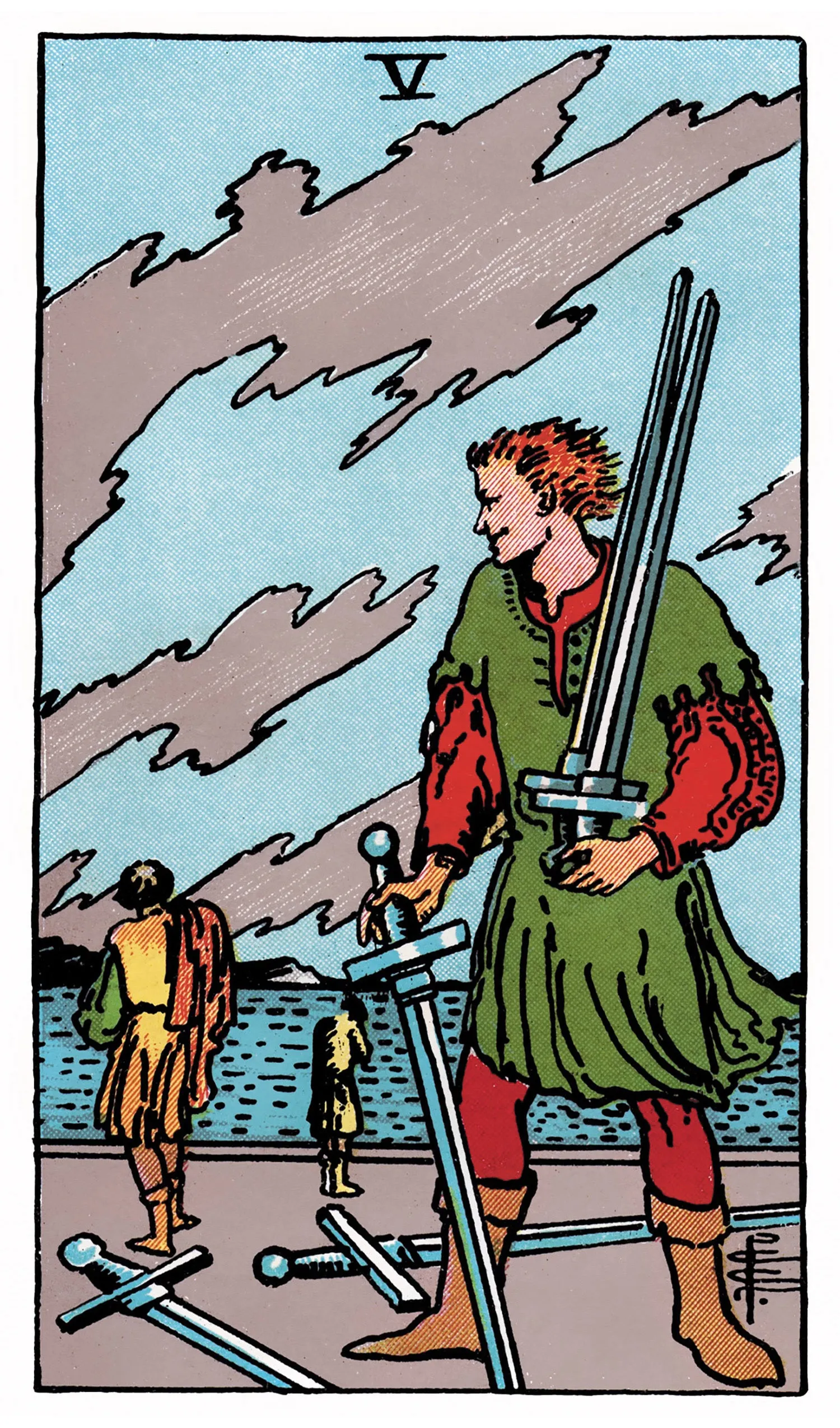
The Rider–Waite–Smith Five of Swords shows one figure holding several swords while two other people walk away in the distance.
The central figure appears to have won.
But the atmosphere does not feel victorious.
That contradiction is the essence of the card.
The Central Figure
The central figure stands holding the swords and watching the others leave.
He appears to have gained the advantage.
However, his expression gives the victory an uncomfortable quality.
This is not shared success.
It is triumph over other people.
The figure can symbolize competition, superiority, humiliation, strategic advantage, or the desire to ensure that the other side understands who won.
The Collected Swords
The central figure possesses more swords than the others.
This symbolizes advantage, control, and possession of what was gained through conflict.
But the image immediately raises the central question:
What was gained — and what had to be destroyed to gain it?
Possession of the swords does not automatically mean that the final outcome is good.
The Two Figures Walking Away
The distant figures represent defeat, withdrawal, humiliation, or refusal to continue the conflict.
They may have lost the immediate battle.
But their departure also means that the winner is increasingly alone.
This is one of the strongest visual expressions of the card's central theme:
victory can destroy the relationship, alliance, or cooperation that once connected the people involved.
The two figures also remind us that the Five of Swords can describe either side of the scene.
A reading may place the querent with the victor — or with those walking away.
The Uneasy Sky
The turbulent sky reflects tension that remains after the confrontation.
The battle may technically be over, but the atmosphere is not peaceful.
The psychological conflict continues.
This is not resolution.
It is the aftermath of struggle.
The Water
Water introduces an emotional layer beneath the intellectual and strategic nature of Swords.
Even when the conflict is approached tactically, people still feel the consequences.
Pride is wounded.
Humiliation hurts.
Revenge has emotional roots.
Strategic victory does not erase emotional damage.
The Uneven Ground
The unstable landscape reinforces the idea that the winner's position is not as secure as it first appears.
The immediate advantage may be real.
But the larger situation remains unsettled.
A person can stand with more swords and still be standing on unstable ground.
The Core Symbolism of The Five of Swords
The Five of Swords shows a winner holding the spoils while defeated figures walk away.
But the image refuses to celebrate the victory.
Instead, it asks what remains after the fight.
The card therefore captures one of the most uncomfortable truths of conflict:
you can win, humiliate the opponent, get revenge, and still discover that the victory cost more than it was worth.