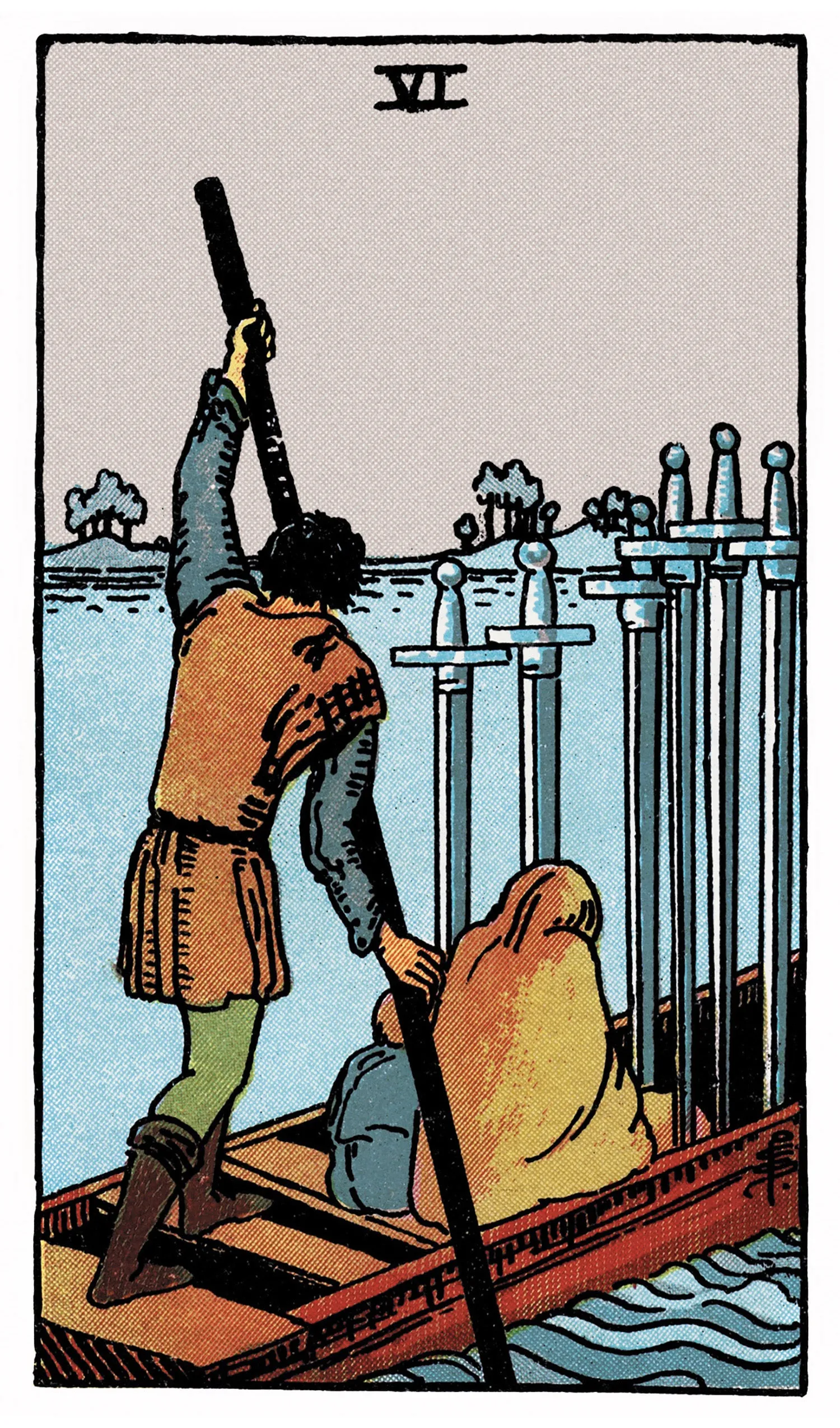
Minor Arcana · Swords · Six
The Six of Swords Tarot Card Meaning
The Six of Swords is a card of transition, movement, and changing direction after a difficult or tense period. The conflict begins to lose its intensity, the old position is being left behind, and something new starts to form.
However, the destination is not yet fully defined. The Six of Swords shows movement into the unknown: the person is no longer where they were, but the new shore has not yet taken a clear shape.
This is a calmer stage than the Five of Swords, but it is not stagnation. Change is already happening.
Card Meanings
General Meaning
The Six of Swords represents movement away from a difficult, tense, or conflict-heavy position.
The intensity of the Five of Swords begins to weaken.
The person is no longer primarily fighting.
They begin to move.
But this movement does not mean that the final result has already been determined.
One of the most important mechanics of the Six of Swords is:
the old shore is being left, while the new shore is still unknown.
The person understands that they cannot remain exactly where they were.
Something needs to change.
But they may not yet know precisely what the new life, relationship, profession, environment, or situation will eventually become.
In this sense, the Six of Swords can be understood as a moving Four of Swords.
The Four of Swords suspends activity because the situation is not ready to develop.
The Six of Swords begins moving again — but the final direction is still forming.
There is no longer complete stillness.
There is movement, choice, exploration, and transition.
The card therefore often describes a period when the person is entering unknown territory.
They may feel some relief because the old tension is decreasing, but also discomfort because the future is not yet clearly mapped.
This is not necessarily a negative uncertainty.
It is simply unfinished.
The situation is still becoming something.
Another central meaning of the Six of Swords is reconsideration of previous experience.
The person begins to look back at what happened and understand it differently.
They may:
- reconsider previous decisions;
- change their worldview;
- abandon old beliefs;
- recognize what no longer suits them;
- develop new plans;
- discover new ideas;
- choose a path that feels more personally appropriate.
This is especially important because the card belongs to the Suit of Swords.
The movement is not only geographical.
It can also be intellectual.
A person moves from one way of thinking to another.
They gain perspective.
They exchange ideas.
They learn.
They begin planning differently.
They may discover that after the conflict of the Five, they no longer want to live according to the same rules.
The Six of Swords can therefore represent the beginning of a more independent path:
What do I want now? Where do I want to go? What way of living actually suits me?
The answers may not be complete yet.
But the questions have changed.
The Shadow Side of The Six of Swords
The shadow appears when the person changes the external situation without changing anything internally.
They leave one job and reproduce the same conflict in another.
They move to another city but continue living through the same patterns.
They end one relationship and carry the same unresolved beliefs into the next.
The person may also become obsessed with reaching “somewhere else” simply because the current position is uncomfortable.
Movement then becomes escape rather than development.
Another shadow expression is remaining permanently between two shores.
The person has already left the old life but does not commit to the new one.
Uncertainty becomes a lifestyle.
They continue moving without forming a direction.
The Six of Swords Reversed
The reversed Six of Swords shows a disrupted, blocked, delayed, or resisted transition.
The person cannot properly leave the difficult position.
They may know that something must change but refuse to move away from familiar conditions.
This can mean resistance to:
- travel;
- relocation;
- changing profession;
- leaving a relationship;
- changing environment;
- changing habitual thinking;
- accepting new information;
- abandoning an old worldview.
The problem is not always that movement is objectively impossible.
Sometimes the person simply does not want to leave what is familiar, even when the familiar situation is uncomfortable.
Another manifestation is being trapped in negative thoughts.
The person keeps returning mentally to the same conflict, disappointment, fear, or previous experience.
They cannot create enough mental distance to move into something new.
Travel or practical movement can also be delayed, cancelled, interrupted, or complicated.
The person may choose the wrong direction and later discover that the route itself needs to be reconsidered.
The reversed card can therefore mean:
movement is needed, but the person cannot yet complete the transition successfully.
Core Message
The Six of Swords says that the old position is already changing.
The tension is decreasing.
Movement has begun.
But the future is not yet fully defined.
This is the stage of leaving, reconsidering, learning, and choosing a new path before the final destination becomes clear.
The Six of Swords as a Person
Explore all 78 Tarot cards as personality →
The Six of Swords can describe someone who is intellectually mobile, adaptable, thoughtful, and capable of changing direction after difficult experience.
They are often able to learn from what happened rather than remain permanently trapped in the conflict itself.
This person may be going through a period of major internal change.
Their worldview can be shifting.
Old assumptions may no longer make sense.
They may begin looking for a new social environment, profession, lifestyle, place to live, or group of people that feels more compatible with who they are becoming.
When the card strongly describes the mental sphere, the person can be strategic and reflective.
They rethink experience, plan their actions, exchange ideas, learn, and gradually develop a new perspective.
They can also use knowledge and mental ability to improve their social or professional position.
In a less consciously intellectual expression, the person may simply feel that they are in free movement.
They know they need change but have not yet decided exactly where they are going.
That uncertainty can feel uncomfortable.
The Six of Swords as Actions
As Actions, the Six of Swords shows movement and change.
The person may:
- leave;
- travel;
- relocate;
- change environment;
- move house;
- change profession;
- change workplace;
- begin working elsewhere or abroad;
- move toward new social circles;
- step away from conflict;
- exchange information;
- study;
- investigate new possibilities;
- make new plans;
- choose a different route.
The action does not always have a clearly defined endpoint.
The person may begin moving simply because remaining where they are is no longer acceptable.
This is a major distinction:
they know what they are leaving before they fully know where they are going.
The Six of Swords in Love and Relationships
Explore all 78 Tarot cards in Love & Relationships →
In love, the Six of Swords represents movement out of a difficult relational phase.
Tension may begin to decrease.
The couple may stop fighting at the intensity shown by the Five of Swords and begin trying to understand what should happen next.
This can happen through:
- calmer conversation;
- exchange of perspectives;
- honest discussion;
- temporary distance;
- a change in the relationship structure;
- physical relocation;
- leaving old conflicts behind.
Two people can remain together and move through the transition jointly.
They may be trying to establish a new way of relating after a difficult period.
But the final state of the relationship may still be unclear.
The Six of Swords does not necessarily tell us exactly what the relationship will eventually become.
It shows that the old form is changing.
In other readings, one person may be leaving the relationship or creating significant distance.
Again, the key is not necessarily breakup.
The key is:
the current relational position is being left behind.
The Six of Swords as Thoughts
As Thoughts, the Six of Swords is an important card of intellectual transition.
The person is reconsidering what happened.
They may be asking:
- What did I learn from this?
- What do I want now?
- What direction actually suits me?
- What needs to change?
- What new possibilities exist?
- How should I plan the next step?
They may be changing their worldview.
Information that once seemed irrelevant can suddenly become important.
New ideas appear.
The person begins forming new plans.
This can also show learning, exchanging thoughts, talking with knowledgeable people, researching alternatives, or expanding one's perspective through travel and new experience.
A central thought is:
“I do not know exactly where I will end up, but I know I cannot remain where I was.”
The Six of Swords as Feelings
As Feelings, the Six of Swords is quieter than emotionally intense cards.
The person may feel relief because the tension is decreasing.
They may also feel uncertainty.
Leaving familiar circumstances can create sadness, anxiety, or emotional discomfort even when the change is necessary.
The emotional state may contain both:
relief about leaving
and
uncertainty about where they are going.
The person may also feel curious about new possibilities.
They are not necessarily emotionally settled yet.
The Six of Swords as Intentions
As Intentions, the Six of Swords shows a desire to change direction.
The person may want to:
- leave the conflict;
- create distance;
- travel;
- relocate;
- change the relationship dynamic;
- choose another path;
- enter a new environment;
- explore new possibilities;
- stop living according to old assumptions.
They may not yet have a fully formed plan.
The intention can simply be:
“I need something different.”
This is also a card of choosing one's own path.
The person may begin prioritizing what is comfortable, meaningful, or appropriate for them rather than continuing according to other people's expectations.
The Six of Swords as an Outcome
Explore all 78 Tarot cards as Outcomes →
As an Outcome, the Six of Swords is fundamentally a card of movement without a fully defined destination.
The situation will not remain exactly as it is.
Something begins changing.
The old position is being left.
Tension can decrease.
New possibilities may appear.
But the card does not necessarily reveal what the final result will be.
This is one of its most important TAROVERA meanings.
If the question is:
“How will this situation eventually develop?”
the Six of Swords can indicate that the final form of the situation has not yet been established.
There are still factors, decisions, movements, and circumstances that will determine where the process eventually leads.
The new shore is not yet clearly visible.
For this reason, the Six of Swords should not automatically be read as:
“Everything will work out well.”
A more accurate interpretation is:
the current situation will change, but the final destination remains unknown.
The person may enter a new environment, change direction, develop new ideas, or gradually choose a path that feels more suitable.
But the result is still forming.
The Six of Swords in Career and Work
Explore all 78 Tarot cards in Career & Work →
In Career, the Six of Swords can indicate substantial professional change.
Possible manifestations include:
- changing job;
- changing profession;
- transferring to another department;
- leaving a toxic workplace;
- working away from home;
- earning money in another country;
- professional relocation;
- business travel;
- retraining;
- studying;
- learning a new specialization;
- entering a new professional environment.
The card is especially important for intellectual and information-based work.
It can represent:
- analysis;
- research;
- exchanging information;
- negotiations;
- planning;
- learning;
- acquiring expertise;
- developing new professional ideas.
The person may improve their social or professional position through knowledge, strategic thinking, and the ability to change direction.
This is not necessarily immediate success.
It is often the beginning of a new professional course.
A person may realize that the old career no longer suits them and begin searching for a path that feels more personally appropriate.
The Six of Swords in Money and Finances
Explore all 78 Tarot cards in Money & Finances →
In Finances, the Six of Swords indicates changing financial direction.
Improvement can become possible, but usually through changing the current model rather than simply waiting for more money to appear.
This may involve:
- changing source of income;
- changing job or profession;
- earning abroad;
- restructuring obligations;
- postponing or reorganizing payments;
- moving money;
- leaving an unsustainable financial arrangement;
- choosing a different strategy.
The card does not guarantee wealth.
It shows that the current financial pattern is being left and another one is beginning to form.
The person may still be uncertain about the final level of stability.
The important principle is:
financial improvement requires a change of course.
The Six of Swords in Health
Explore all 78 Tarot cards in Health →
Within the TAROVERA Tarot health system, the Six of Swords is associated with recovery and movement toward improvement.
It is also associated with conditions of the large intestine within this Tarot system.
The general Tarot-health principle of the card is transition away from a more difficult state.
The Six of Swords Timing — When Will It Happen?
Explore Timing for all 78 Tarot cards →
The Six of Swords does not provide reliable timing unless the wider spread already confirms realization.
The card itself represents transition and an unknown destination.
Movement has begun, but the final point has not yet been clearly established.
If the surrounding cards already show that the desired event will happen, and the Six of Swords appears specifically as the answer to the question “When?”, it can indicate approximately six months.
If realization is not already confirmed, the card should not be forced into a precise deadline.
In that case, its message is:
the timing remains unknown because the situation itself is still forming.
The process is moving, but the final result and therefore the moment of arrival cannot yet be determined reliably.
Key Timing Correspondence
Approximately six months — only when the wider spread already confirms realization. Otherwise, the timing and final realization remain uncertain because the situation is still in transition.
The Six of Swords as an Event
Explore all 78 Tarot cards as Events →
As an Event, the Six of Swords strongly represents movement, change, and entering something new.
Possible events include:
- travel;
- departure;
- relocation;
- moving house;
- changing workplace;
- changing profession;
- working in another country;
- a short flight;
- business travel;
- visitors arriving from far away;
- receiving news;
- entering a new social environment;
- new plans;
- new opportunities;
- exchange of ideas;
- learning something new.
The event can also be less literal.
A person's outlook may change.
They may suddenly recognize that they want a different life.
They may begin planning a direction that did not previously exist.
The defining feature is:
the old position begins giving way to something new, but the new direction may still be unclear.
The Six of Swords as Card of the Day
Explore all 78 Card of the Day meanings →
As Card of the Day, the Six of Swords suggests movement, new impressions, and a gradual shift away from recent tension.
You may travel, change plans, receive news, meet someone from elsewhere, discover new information, or begin thinking about your future differently.
The day may bring a sense that something is changing even if the destination is not yet clear.
New ideas can appear.
A previous problem may begin losing its emotional intensity.
Do not demand a final answer too early.
Today may be about discovering the direction rather than reaching the destination.
The Six of Swords as Advice
Explore Advice from all 78 Tarot cards →
The Six of Swords advises you to move.
Do not remain in a position simply because it is familiar.
If the old environment, strategy, profession, relationship pattern, or way of thinking no longer works, begin leaving it.
You do not need to know the entire route before taking the first step.
Allow yourself to explore.
Travel if necessary.
Learn.
Exchange ideas.
Speak to people who know more than you do.
Look at your situation from another perspective.
Consider another profession, another environment, another social circle, or another way of living if the current one no longer fits.
Most importantly:
choose your own path.
The next stage should be based increasingly on what is right and workable for you rather than on the conflict or expectations you are leaving behind.
The Six of Swords Reversed as Advice
Do not remain where you are simply because change feels uncertain.
Examine whether habit, fear, negative thinking, or attachment to the familiar is keeping you trapped.
At the same time, do not move blindly.
If the route repeatedly fails or leads back to the same problem, reconsider the direction itself.
The goal is not movement for its own sake.
The goal is a transition that actually changes your position.
The Six of Swords as a Warning
Explore Warnings from all 78 Tarot cards →
The Six of Swords warns that movement does not guarantee destination.
The new shore is still unknown.
Do not assume that every change will automatically be better simply because it is different.
The card also warns against carrying the old problem into the new environment.
Changing countries, jobs, partners, or circumstances does not help if the same mental pattern travels with you.
Another risk is expecting certainty before movement.
Sometimes the future cannot become clear until the transition has already begun.
The Six of Swords — Yes or No
Explore Yes or No meanings for all 78 Tarot cards →
Upright: Yes
The Six of Swords gives a Yes.
The situation can move forward, but the path may involve change, transition, travel, relocation, or leaving the current conditions behind.
This is not a Yes that guarantees the exact final form of the result.
It is:
Yes — movement is possible, but the destination may still be unknown.
Reversed: No
The reversed Six of Swords gives a clear No.
The transition is blocked, delayed, resisted, or directed poorly.
The card can also carry the practical message:
do not go there / do not proceed in this direction.
The current route does not support constructive movement.
The Six of Swords Symbolism
Explore Symbolism for all 78 Tarot cards →
The Rider–Waite–Smith Six of Swords shows a small boat crossing water with passengers while six swords stand upright inside the vessel.
The image is one of passage.
The old place has been left.
The new place has not yet been reached.
The Boat
The boat represents transition.
It is not the destination.
It is the temporary space between one shore and another.
This is the essence of the Six of Swords:
the person is no longer where they were, but they are not yet where they will eventually be.
The Ferryman
The figure guiding the boat represents direction, navigation, knowledge, and practical assistance.
The person undergoing transition may benefit from guidance, information, expertise, or someone who knows how to navigate unfamiliar territory.
This also supports the intellectual nature of the card.
New knowledge can help determine the route.
The Seated Figures
The passengers appear quiet and subdued.
They are not celebrating.
Leaving the old situation can still involve sadness, uncertainty, or discomfort.
The movement may be necessary without being emotionally easy.
The Six Swords in the Boat
The swords travel with the passengers.
This is one of the most important symbols in the card.
The people have changed location, but their thoughts, experience, memories, beliefs, and previous conflicts remain with them.
The swords can represent both:
what has been learned
and
what still needs to be reconsidered.
The person carries their past into the transition, but they now have the opportunity to understand it differently.
The Rough and Calm Water
The contrast in the water shows movement away from greater disturbance toward relative calm.
The pressure of the Five of Swords begins to weaken.
However, calm does not necessarily mean the final destination is known.
It simply means that the immediate tension is becoming less severe.
The Distant Shore
The distant land symbolizes the future.
It exists.
But it is not yet fully reached or understood.
This is the visual foundation of one of the card's deepest meanings:
the new shore is still undefined.
The person has chosen movement before receiving complete certainty about the destination.
The Core Symbolism of The Six of Swords
The boat has left one shore and moves toward another.
The passengers carry their swords — their thoughts, experience, memories, and lessons — with them.
The water becomes calmer, but the destination remains ahead.
The Six of Swords therefore symbolizes:
movement after conflict, intellectual and practical transition, reconsideration of experience, and the search for a new path whose final form has not yet been determined.