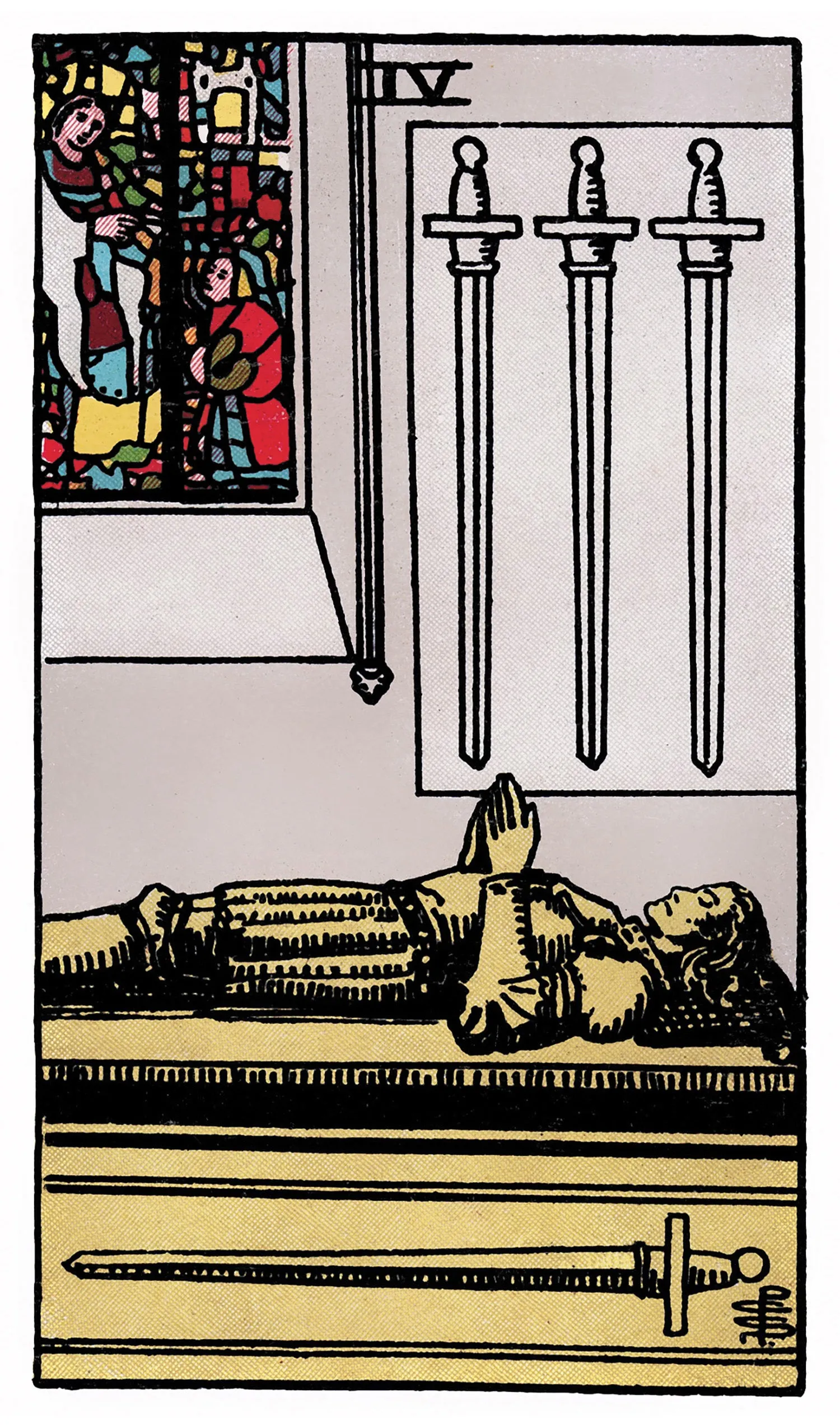
Minor Arcana · Swords · Four
The Four of Swords Tarot Card Meaning
The Four of Swords is a card of pause, withdrawal, recovery, and suspended external activity. Something stops because continuing at the same pace is temporarily impossible, unproductive, or simply not the right course.
However, external stillness does not necessarily mean that nothing is happening. One of the deeper meanings of the Four of Swords is inner work during outer inactivity: while the situation appears frozen, the person may be recovering, processing what has happened, reviewing previous experience, reconsidering their strategy, and preparing for the next stage.
Card Meanings
General Meaning
The Four of Swords represents a temporary withdrawal from active movement.
The person, relationship, project, conflict, or process reaches a point where further pressure is unlikely to help.
Sometimes the pause is chosen consciously.
At other times, it is imposed by circumstances.
A person may want to act but simply cannot move the situation forward right now.
A decision may be delayed.
A project may be suspended.
A conflict may temporarily quiet down.
Communication may stop.
The person may physically or psychologically lack the resources to continue.
The important point is that the Four of Swords does not usually represent final resolution.
The problem may remain unresolved.
The relationship may still exist.
The project may still be possible.
The decision may still need to be made later.
What changes is the level of activity.
The situation is taken temporarily out of active movement.
This is how the stabilizing principle of the Four operates within the Suit of Swords.
Stability is created through reduction of stimulation, conflict, mental pressure, and external action.
There is also a clear progression from the Three of Swords.
The Three of Swords brings painful realization, disappointment, confrontation, or emotional injury.
The Four of Swords comes afterward and says:
Stop. Step back. Do not keep fighting at the same intensity.
The mind needs space after strain.
However, this pause should not be confused with emptiness.
One of the most important mechanisms of the Four of Swords is internal activity during external stillness.
The person may appear inactive while doing significant inner work:
- analyzing what happened;
- reconsidering previous decisions;
- processing disappointment;
- reviewing mistakes;
- restoring mental clarity;
- rebuilding strength;
- developing a new strategy;
- deciding what should happen when movement resumes.
The card can therefore represent strategic retreat rather than simple passivity.
Sometimes nothing can be changed externally yet, but a great deal can still be prepared internally.
The Four of Swords can also indicate that forcing the situation now is largely pointless.
More pressure does not necessarily create faster progress.
Sometimes progress depends on allowing the pause to complete its function.
The Shadow Side of The Four of Swords
The shadow appears when a necessary pause stops restoring the person and begins protecting them from life itself.
Rest can become avoidance.
A person may continue postponing action long after the original need for withdrawal has passed.
They may isolate themselves, avoid difficult conversations, refuse to make decisions, or wait indefinitely for the situation to change without their participation.
Internal reflection can also become over-analysis.
Instead of preparing for the next stage, the person may endlessly reconsider the same facts without ever returning to action.
Another shadow expression is excessive passivity.
The person may have enough strength to move forward but remain withdrawn because inactivity feels safer than uncertainty.
The same stillness that initially protected resources can eventually begin to weaken momentum.
The Four of Swords Reversed
The reversed Four of Swords shows a damaged, interrupted, excessive, or ineffective pause.
One of its most common manifestations is premature return to activity.
Movement may begin again, but this does not mean the person has actually recovered.
They may return to work too soon, restart communication before emotional tension has settled, re-enter a conflict without having processed it, or make decisions while still mentally exhausted.
In this sense, the reversed Four of Swords can indeed show the end of inactivity — but not necessarily in a healthy or productive way.
Movement returning is not the same as recovery being complete.
Another manifestation is the inability to rest at all.
The body may stop while the mind remains active.
The person lies down but continues thinking, worrying, analyzing, planning, or replaying the problem.
They cannot obtain the mental quiet that the upright card requires.
The opposite excess is also possible.
The pause has lasted so long that it has become stagnation.
The person is no longer restoring energy or preparing a new strategy.
They are simply disconnected from movement.
Core Message
The Four of Swords says that not every stage of progress is visible from the outside.
Sometimes the situation must stop so that the person can recover, analyze, conserve resources, and prepare for what comes next.
The pause is useful while it restores capacity.
It becomes a problem when it is interrupted too early or allowed to replace action indefinitely.
The Four of Swords as a Person
Explore all 78 Tarot cards as personality →
The Four of Swords can describe someone quiet, reserved, private, or temporarily withdrawn from active involvement.
They may value peace, solitude, personal space, and time to think.
This person often prefers stepping away from unnecessary conflict rather than continuing to argue simply for the sake of winning.
They may also be highly reflective.
Even when they appear inactive, they can be processing a great deal internally.
They observe, analyze, reconsider previous experience, and may prefer to form a strategy privately before revealing what they intend to do.
Very often, however, the card describes a current condition rather than a permanent personality.
The person may simply be exhausted.
They may have gone through a stressful period and currently have very little energy for social interaction, explanation, confrontation, or decision-making.
At their best, they understand when retreat is intelligent.
At their worst, they can become passive, unavailable, or excessively isolated.
The Four of Swords as Actions
As Actions, the Four of Swords is one of the clearest cards of suspended external activity.
The person may:
- stop contacting someone;
- take a break;
- postpone a decision;
- withdraw from conflict;
- go silent;
- wait;
- take time off;
- step away from a project;
- stop pushing for a result;
- deliberately do nothing externally for the moment.
Sometimes this inactivity is voluntary.
Sometimes circumstances leave very little choice.
The person may simply have no effective move available right now.
However, external inaction does not necessarily mean total passivity.
They may be researching, thinking, recovering, reviewing options, or quietly preparing what they will do when the situation becomes active again.
Their current action may therefore be:
do not move yet — prepare first.
The Four of Swords in Love and Relationships
Explore all 78 Tarot cards in Love & Relationships →
In love, the Four of Swords represents distance, silence, reduced interaction, or a pause in the development of the relationship.
Partners may temporarily reduce contact.
A difficult subject may be left alone.
Someone may take emotional space after an argument.
The relationship may still exist while very little happens externally.
This pause can be quite prolonged.
The Four of Swords does not necessarily describe a brief period of silence.
Sometimes the relationship remains suspended for weeks or months while one or both people process what happened, regain emotional stability, or reconsider what they want.
The card does not automatically mean that feelings are gone.
A lack of communication or visible development is not the same thing as emotional emptiness.
Someone may still care deeply while choosing not to engage.
The card can also describe a relationship that has reached a point where further discussion would currently produce more conflict than clarity.
In that case, distance serves a stabilizing function.
This differs from the Two of Swords.
The Two of Swords often preserves a fragile peace because a difficult decision or truth is being avoided.
The Four of Swords more often appears after strain, when the need for disengagement has already become obvious.
The Four of Swords as Thoughts
As Thoughts, the Four of Swords is much more active internally than it appears externally.
The person may be thinking:
“I need time before I do anything.”
They may be reviewing what happened, reconsidering their previous strategy, analyzing mistakes, comparing options, and trying to understand what the next move should be.
This can be a period of serious mental restructuring.
The person is not necessarily avoiding thought.
Sometimes the card shows the opposite: they are deliberately reducing external activity precisely so they can think more clearly.
They may be asking themselves:
- What actually happened?
- What did I miss?
- What should I change?
- What is worth continuing?
- What is the smartest next move?
- What resources do I need before acting again?
In other cases, the mind is simply exhausted and needs a break from the subject altogether.
The Four of Swords as Feelings
As Feelings, the Four of Swords is emotionally quiet and withdrawn.
It does not automatically mean that feelings are absent.
Instead, they may be muted, temporarily set aside, difficult to access, or simply not being expressed.
The person may be emotionally tired.
They may want peace more than intensity.
They may still care but have no desire to engage with the emotional complexity of the situation right now.
In some cases, the person is deliberately creating emotional distance so they can understand what they feel without being overwhelmed by immediate interaction.
The Four of Swords as Intentions
As Intentions, the Four of Swords shows the intention to pause, step back, and avoid forcing development.
The person may intend to remain quiet, postpone a conversation, keep their distance, stop escalating a conflict, or leave the situation unchanged for a period of time.
However, this does not necessarily mean they have abandoned the situation.
They may use the pause to reconsider their position, gather strength, or prepare a later decision.
Their intention may be:
“I am not acting now because I need to understand what to do next.”
The Four of Swords as an Outcome
Explore all 78 Tarot cards as Outcomes →
As an Outcome, the Four of Swords indicates pause, delay, temporary suspension, or reduced movement.
The situation does not necessarily fail.
But it does not reach active realization yet either.
This makes the card highly dependent on the question.
If the desired outcome is peace after conflict, stabilization, rest, or reduction of pressure, the Four of Swords can be favorable.
If the question asks for rapid development, active reconciliation, immediate communication, expansion, or concrete realization, the card is much weaker.
The result is often:
nothing further happens for now.
And importantly, attempts to force the outcome during this stage are unlikely to change it much.
The situation may currently be resistant to acceleration.
What can develop instead is preparation.
The person may emerge from the pause with clearer thinking, a new strategy, restored strength, or a better understanding of what should happen next.
The Four of Swords in Career and Work
Explore all 78 Tarot cards in Career & Work →
In Career, the Four of Swords can indicate vacation, sick leave, reduced workload, burnout recovery, temporary suspension of a project, or a period between more active professional phases.
A project may be frozen because further progress is currently impossible.
Management may be waiting.
A decision may be delayed.
Resources may need to be rebuilt before work continues.
This can be a strategic pause rather than a failure.
A team or individual may temporarily stop active implementation in order to:
- review what has already been done;
- correct previous mistakes;
- redesign the strategy;
- gather information;
- rebuild financial or human resources;
- prepare for the next stage.
The Four of Swords can therefore show important internal professional work while visible activity is minimal.
It is also a weak card for launching something aggressively.
If the question concerns immediate expansion, a new project, or rapid career progress, the card usually suggests that conditions are not ready yet.
This does not automatically mean dismissal or career collapse.
The stronger message is:
active professional movement is temporarily reduced or suspended.
The Four of Swords in Money and Finances
Explore all 78 Tarot cards in Money & Finances →
In Finances, the Four of Swords represents low activity, caution, and conservation of resources.
This is not primarily a card of financial growth.
It is more often a card of preserving what already exists.
A person may postpone purchases, delay investments, reduce unnecessary spending, maintain reserves, or avoid financial risks until the situation becomes clearer.
Money may simply remain where it is.
A payment, approval, transaction, or financial process may also be temporarily delayed.
The card can be especially constructive when it encourages a period of financial analysis.
Rather than acting impulsively, the person may review expenses, calculate risks, reconsider previous decisions, or wait until they have better information.
The Four of Swords therefore favors:
save first, analyze first, act later.
The Four of Swords in Health
Explore all 78 Tarot cards in Health →
Within the TAROVERA Tarot health system, the Four of Swords is strongly associated with recovery and enforced rest.
It can indicate postoperative rehabilitation, sanatorium or restorative treatment, hospitalization during acute conditions, and periods when the body requires reduced activity.
The card is also associated with nervous breakdowns and states in which rest becomes necessary because the system has been pushed too far.
The Four of Swords Timing — When Will It Happen?
Explore Timing for all 78 Tarot cards →
The Four of Swords is not a strong card of immediate realization.
Its primary timing message is pause, delay, suspension, waiting, and lack of active movement.
For this reason, timing should only be taken literally when the wider spread already confirms that the desired event will eventually happen.
If the surrounding cards are positive, realization is clearly supported, and the Four of Swords appears specifically as the answer to “When?”, it can indicate approximately four to five months.
If the wider spread does not confirm realization, the card should not be forced into a precise deadline.
In that case, the stronger interpretation is:
not now, not soon, and it is currently unclear when movement will resume.
The situation may remain suspended until recovery, preparation, or external circumstances make further action possible.
Key Timing Correspondence
Approximately four to five months — only when the wider spread already confirms realization. Otherwise, the card indicates delay, pause, and uncertain timing.
The Four of Swords as an Event
Explore all 78 Tarot cards as Events →
As an Event, the Four of Swords can indicate a period of rest, withdrawal, silence, waiting, or temporary suspension.
Someone may take time off.
A project may be paused.
A conversation may stop.
A conflict may quiet down.
A person may temporarily withdraw from communication or active involvement.
The event may also be externally uneventful while something important happens internally.
A person may spend this period recovering, reconsidering their position, developing a strategy, or deciding how they will act once movement becomes possible again.
The external event is therefore often the interruption of activity itself.
The Four of Swords as Card of the Day
Explore all 78 Card of the Day meanings →
As Card of the Day, the Four of Swords suggests reducing unnecessary activity.
You may need more rest than usual, have less desire to socialize, postpone a decision, or deliberately step away from pressure.
A situation may temporarily stop moving.
Do not assume that lack of visible movement means nothing useful is happening.
This may be a good day to think, review, analyze, recover, and prepare instead of pushing for immediate results.
Protect your resources.
Not every task needs to be completed today.
The Four of Swords as Advice
Explore Advice from all 78 Tarot cards →
The Four of Swords advises you to stop forcing progress.
Take a break from the situation before making the next move.
Reduce unnecessary pressure.
Step away from conflict if continuing it produces nothing useful.
Preserve your energy, money, time, and nervous system.
Do not spend resources simply because you feel uncomfortable with waiting.
At the same time, use the pause intelligently.
Reflect.
Review what happened.
Reconsider your previous strategy.
Identify what needs to change.
Prepare for the next stage.
The card does not advise empty passivity.
It advises constructive withdrawal.
Sometimes the smartest action is to stop external movement long enough to make the next action better.
The Four of Swords Reversed as Advice
Do not confuse movement with readiness.
If you are exhausted, returning to full activity too soon may create further problems.
If you cannot mentally switch off, simply being physically inactive may not be giving you real recovery.
At the same time, examine whether your pause has already become avoidance.
Rest should eventually restore your ability to act.
If withdrawal no longer gives you clarity, strength, or a better strategy, begin returning to movement gradually rather than remaining suspended indefinitely.
The Four of Swords as a Warning
Explore Warnings from all 78 Tarot cards →
The Four of Swords warns against continuing at full speed when the situation clearly requires a pause.
Mental exhaustion, accumulated stress, lack of resources, and repeated conflict can reduce judgment and make future actions less effective.
It also warns against trying to force movement during a period when the situation is temporarily resistant to change.
More effort does not always produce faster results.
The card also warns that silence does not automatically resolve the underlying problem.
A pause can stabilize the situation, but unresolved issues may still be waiting when activity resumes.
Finally, the Four of Swords warns against allowing recovery to turn into permanent withdrawal.
A useful pause should eventually make further action possible.
The Four of Swords — Yes or No
Explore Yes or No meanings for all 78 Tarot cards →
Upright: Yes, but not now
The Four of Swords can give a Yes, but only with an important condition.
The desired result is not immediate.
There is a pause, delay, temporary withdrawal, or period of inactivity that must occur first.
The card supports possibility more than immediate realization.
The situation may need recovery, preparation, or simply time before it can move again.
A better formulation is:
Yes, but after a pause.
Reversed: No
The reversed Four of Swords gives a No.
Movement may begin to return, but the underlying conditions are not healthy or stable enough to support reliable progress.
The person or situation may still be exhausted, insufficiently prepared, unable to recover properly, or stuck in a dysfunctional pause.
The card does not show a strong constructive realization.
The Four of Swords Symbolism
Explore Symbolism for all 78 Tarot cards →
The Rider–Waite–Smith Four of Swords shows a figure lying on a tomb-like structure inside what resembles a church or chapel.
The image is still, quiet, and almost entirely removed from ordinary activity.
This visual stillness is the essence of the card.
The Resting Figure
The figure lies motionless with hands together.
They are not fighting, arguing, working, or actively solving anything.
They have stepped outside the normal flow of events.
However, stillness should not automatically be read as emptiness.
The figure can symbolize withdrawal that creates space for reflection, recovery, and mental preparation.
The Three Swords Above
Three swords hang on the wall above the resting figure.
They visually connect the card with the strain and pain of the Three of Swords.
The previous conflict has not disappeared.
It has simply been removed from immediate action.
The problem remains in awareness while the person temporarily stops engaging with it.
The Fourth Sword Below
The fourth sword lies horizontally beneath the figure.
It is present but not being used.
The capacity for action still exists, but it is suspended.
The sword may be used later.
For now, restraint is more useful than action.
The Tomb or Stone Bed
The structure resembles a tomb, yet the card does not generally indicate literal death.
Symbolically, it emphasizes complete stillness and temporary removal from ordinary life.
The person is unavailable to the external world for a period of time.
This creates a protected interval between what has already happened and what will happen next.
The Church Interior
The sacred interior creates a protected, enclosed environment.
External stimulation is reduced.
The figure has temporarily moved away from noise, pressure, and conflict.
This setting supports restoration, contemplation, and internal reorganization.
The Stained-Glass Window
The stained-glass window introduces life and meaning beyond the immediate stillness.
The outside world has not disappeared.
The pause exists within a larger continuing reality.
This reinforces the temporary nature of the card.
Life continues, even when the person is not actively participating in it for a while.
The Core Symbolism of The Four of Swords
The resting figure, unused swords, protected interior, and visual stillness all communicate one principle:
external action has stopped so that recovery and internal preparation can take place.
The Four of Swords is not the final solution.
It is the protected space between strain and the next stage of movement.
Sometimes nothing visible happens because the most important work is happening inside.